


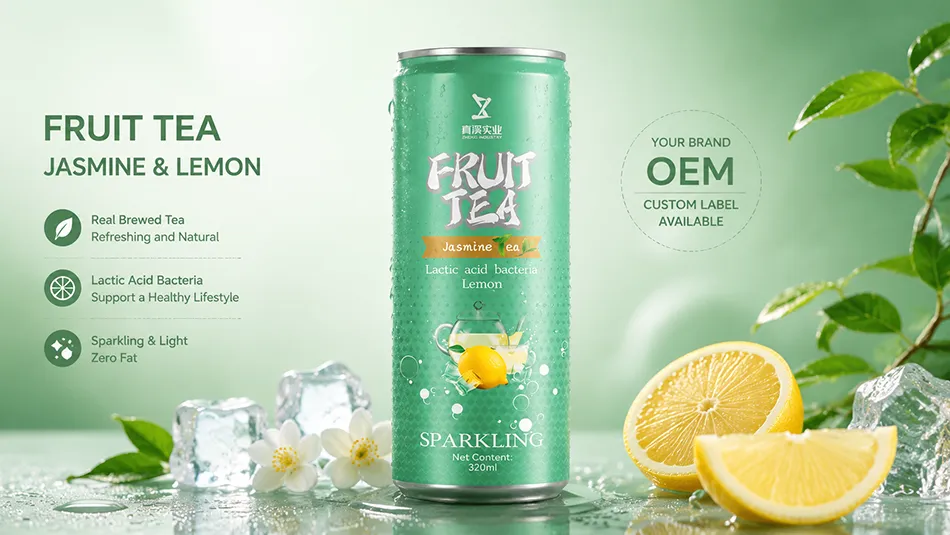

Key specifications
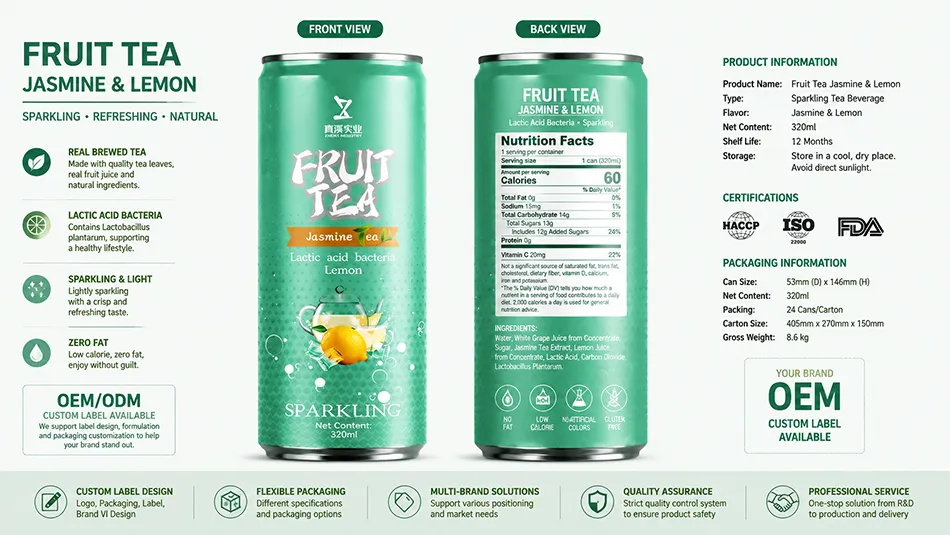
Standard format specs. Flavor, formula, finish and label are all customizable.
320ml canned fruit tea: the format, explained
Overview for distributors, importers, and private-label brand owners
This is a ready-to-drink (RTD) fruit tea filled into a 320ml aluminum beverage can with an easy-open end. As an OEM / private-label format, it lets a brand pair a chosen fruit-tea recipe with a durable, fully printable can rather than commit to a fixed product. The page covers the format itself — the can, the flavors, the customization, and how to order — so you can specify a private-label run with confidence.
The 320ml size is a deliberate middle ground. A 250ml slim can reads as a small, premium single serve; a 330ml standard can is the mainstream soft-drink size. At 320ml the can gives a fuller serve than a slim format while staying lighter and more refined than a 330ml — a combination that suits premium RTD tea aimed at younger, urban shoppers, which is exactly where fruit tea sells best.
Sourcing, recipe development, can printing, filling and export are handled within one facility, so the specification stays consistent from approved sample through to the shipped container, and the supply chain stays short.
Sales channels
Flavor & formula options
Standard profiles plus full custom development — sugar, tea strength and fruit intensity are all adjustable
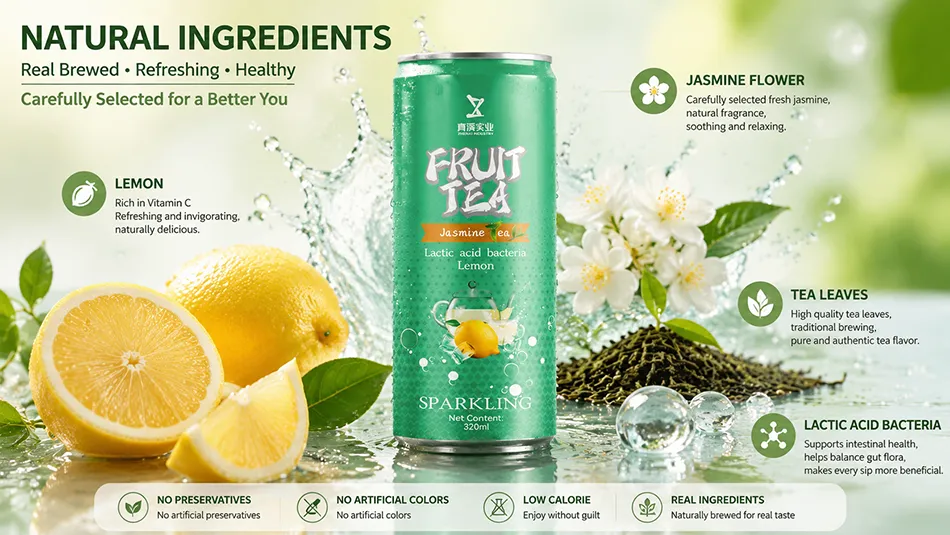
Lemon fruit tea
Refreshing and lightly sweet with a clean citrus lift — a broad, mass-market profile that performs across most regions.
Jasmine tea
A floral aroma over a smooth green tea base — a familiar, premium-leaning profile for shoppers who know scented tea.
Fermented-style (yogurt-inspired)
A tangy, yogurt-inspired profile developed through custom formulation. Available as a dairy-containing fermented recipe or a dairy-free flavor-matched version.
Custom formulas
Other fruit and tea blends — for example our grape oolong — developed to your target market.
How the aluminum can protects and presents the tea
The packaging detail buyers can use in listings and brand stories
Why aluminum suits fruit tea
A sealed aluminum can is a near-total barrier to light, oxygen and moisture — the three things that fade tea color and flatten fruit aroma over time. Light degrades the delicate compounds that give tea its clarity and freshness; oxygen oxidizes both the tea and the fruit notes. Because the can blocks all three, the flavor a customer tastes months later is much closer to the day it was filled than it would be in a clear bottle. That barrier is the single biggest technical reason premium RTD teas move to cans.
The can and the easy-open end
The body is drawn from food-grade aluminum with a food-safe internal lining that keeps the beverage from contacting bare metal. The top is closed with an easy-open end (the stay-on-tab lid familiar from soft drinks) and joined to the body with a double seam — two interlocked folds of metal that form a hermetic, pressure-stable seal. This construction is what allows the can to run on high-speed automated filling and seaming lines and to survive stacking, transport and chilling without leaking. For buyers who also need the components, ZhenXi produces the cans and the 202 SOT can ends in-house.
Full-wrap CMYK printing
The smooth cylindrical surface is printed full-wrap in CMYK, with a glossy or matte finish. Because the artwork is printed directly onto the can rather than applied as a label, there is no edge to peel or scuff, and the color stays consistent through transport and cold storage. The practical implication for a brand is a clean, high-impact shelf face with no wrinkling — which is why the format is favored for premium, design-led RTD lines.
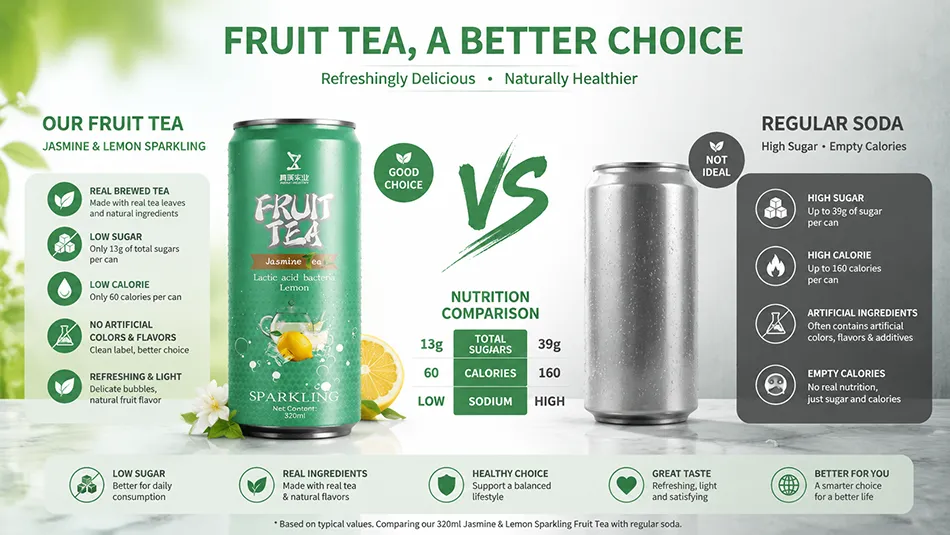
Buyer's guide: sourcing 320ml canned fruit tea
How to specify the format well, and the mistakes that cost importers money
Choosing the size and serve
Pick the can size against your shelf price and market norm, not by instinct. 250ml slim suits a higher per-ml price and a "premium small" feel; 330ml is the mainstream value size; 320ml is the premium middle that gives a satisfying serve while keeping a refined look. If you are entering a market that already drinks a particular size, match it first and differentiate on flavor and design rather than fighting an unfamiliar format.
Set sugar and claims by destination
Sugar is the biggest formulation lever and is increasingly regulated. Several markets apply sugar taxes or front-of-pack warnings above a threshold, so a recipe that sells well in one region can be penalized in another. Decide sweetness per destination, and confirm that any on-pack claim — including the dairy or allergen status of the fermented-style profile — matches what the recipe and documentation can support before artwork is approved.
Mistake: vague specs at quote stage
- Leaving shelf life or MOQ as "upon request" into negotiation
- Slows quoting and weakens trust
- Fix: agree target shelf life, volume and Incoterms up front
Mistake: artwork before proof
- Approving print without a physical or digital can proof
- Color shifts on metal vs screen
- Fix: sign off a CMYK can proof, not just a flat file
Mistake: ignoring allergen rules
- Selling a dairy fermented recipe without milk allergen declaration
- Customs and compliance risk
- Fix: lock dairy / dairy-free version early
Mistake: one recipe for all markets
- Shipping one sweetness level worldwide
- Sugar-tax exposure, taste mismatch
- Fix: tune sugar and flavor per destination
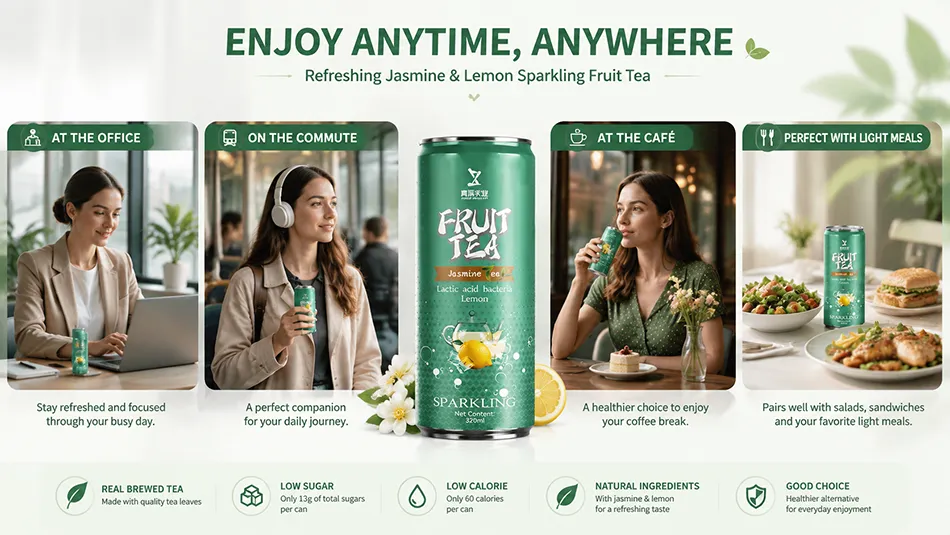
320ml in context: sizes and packaging
Quick reference for buyers choosing a format
| Size | 320ml (this format) | 250ml / 330ml |
|---|---|---|
| Serve | Fuller than slim, refined | 250ml small / 330ml standard |
| Positioning | Premium middle | Premium small / mainstream |
| Best for | Design-led premium RTD tea | Single-sip / value soft-drink size |
| Packaging | Aluminum can (this format) | PET bottle |
|---|---|---|
| Light/oxygen barrier | Excellent — protects flavor | Lower |
| Recyclability | Infinitely recyclable | Recyclable, lower yield |
| Chilling speed | Fast | Slower |
| Shelf impact | Full-wrap print, premium | Label, standard |
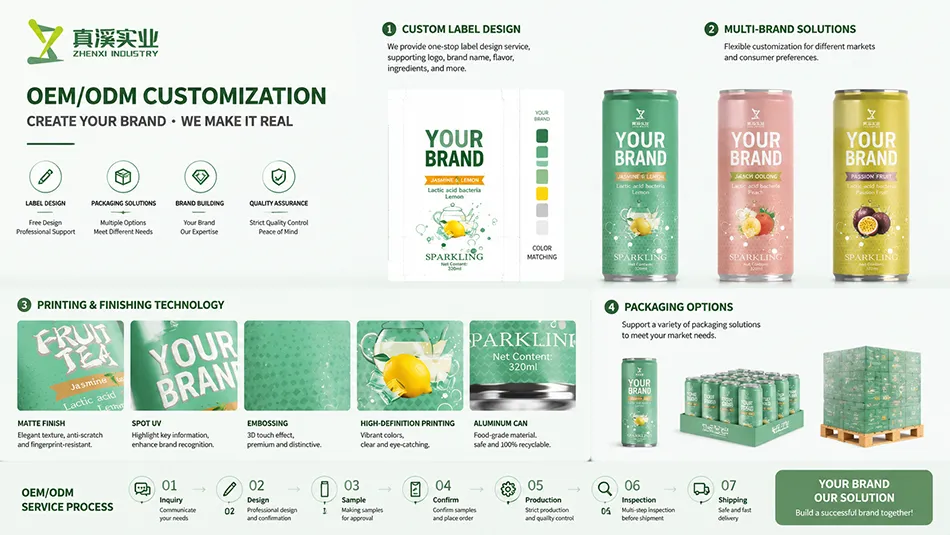
OEM / private-label ordering process
From first inquiry to delivered container — a typical project timeline
Inquiry & quote
Send flavor, can size, label and destination. Quote in 30–45 minutes.
Sample & formula
Free samples and tuning (flavor, sweetness, tea strength) for your market.
Can artwork
Free full-wrap CMYK proof with your brand, logo and language.
Confirm & deposit
Approve mock-up, sign PI, pay deposit to schedule production.
Filling & QC
Filling, seaming and inspection with in-line quality checks.
Export & docs
Container shipment in 20–25 days with full export paperwork.
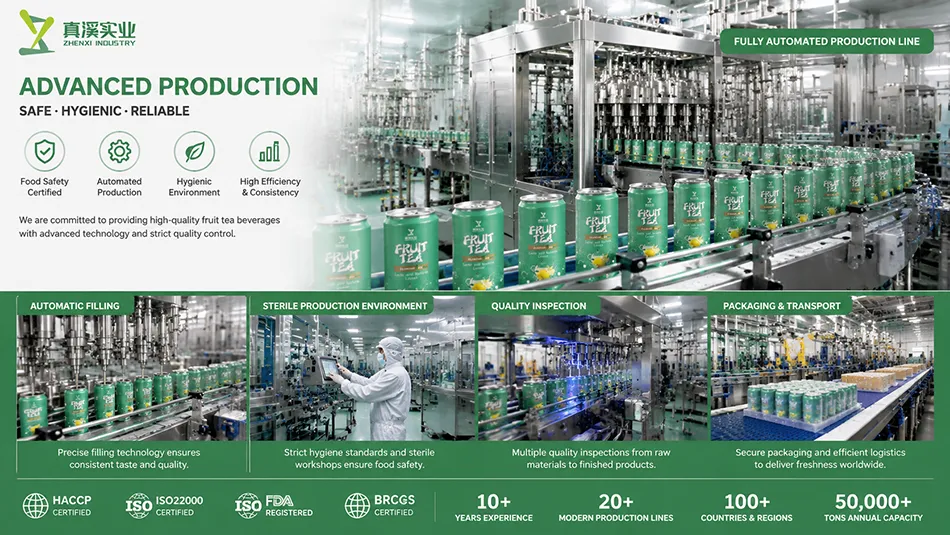
Proof: facility, printing & export record
Filling & seaming
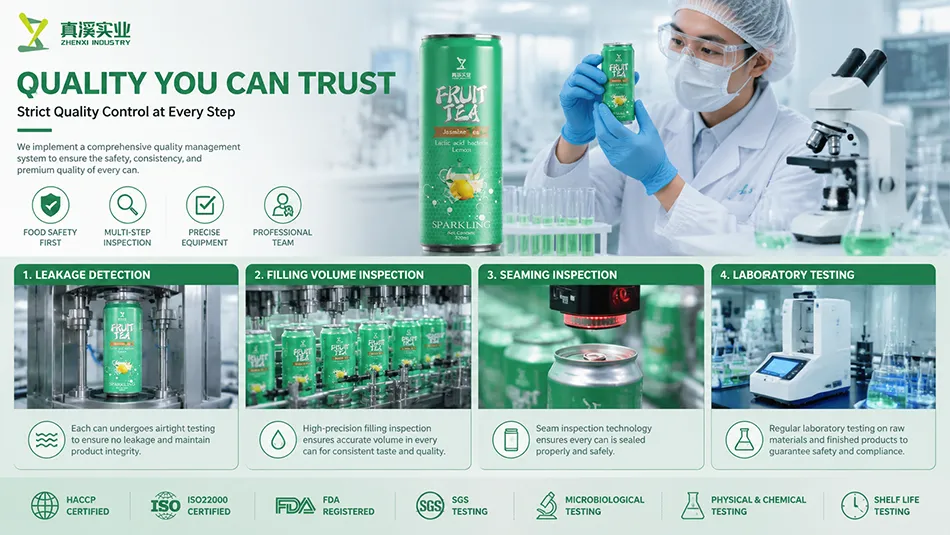
Cans filled, double-seamed and date-coded under food-safety control.
Can printing
Full-wrap CMYK with per-batch color proofing for shelf consistency.
In-line QC
Checks on seal integrity, fill level and leak prevention each run.
Certificates
Food-safety certifications supplied with numbers on request.
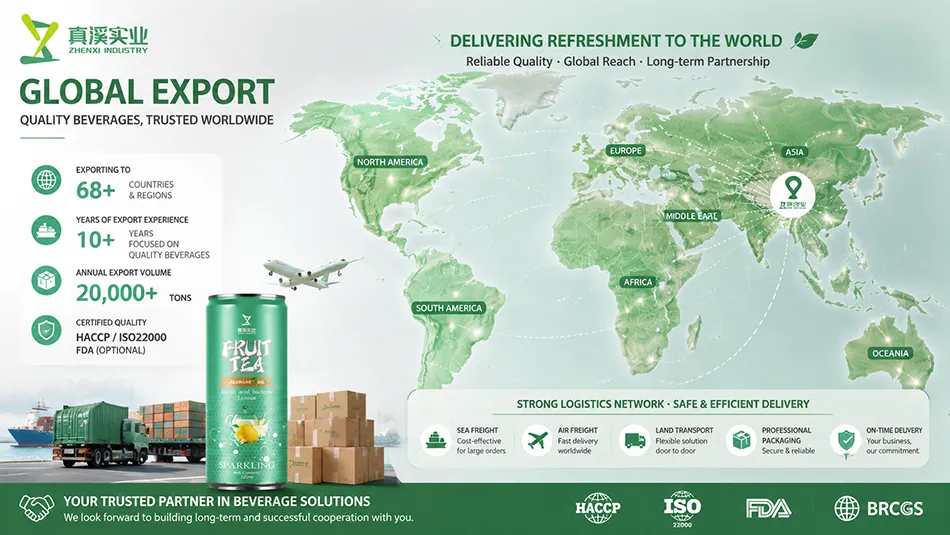
Note: ZhenXi exports across the Middle East, Africa and Central Asia.
Export terms, payment & quality
Standard terms for B2B orders. Flexible arrangements for established accounts.
Payment options
- L/C (Letter of Credit)
- T/T (bank transfer) — deposit + balance
- Western Union & MoneyGram
- PayPal — sample / small orders
Shipping & delivery
- Delivery 20–25 days
- MOQ from 1 container
- Export-standard carton packing
- Incoterms FOB / CIF / DDP on request
Quality & safety
- Food-grade raw materials
- Secure sealing, leak prevention
- In-line inspection each batch
- International food-safety standards
Customization
- OEM / ODM & private label
- Full-wrap CMYK, glossy / matte
- Custom flavor, sugar & tea strength
- Dairy / dairy-free fermented option
Frequently asked questions
Common questions from distributors, importers, and brand owners
Is the 320ml aluminum can suitable for fruit tea beverages?
Which flavors are available, and can I develop a custom one?
Does the fermented-style flavor contain real fermentation or dairy?
What is the minimum order quantity (MOQ)?
What is the shelf life of the 320ml canned fruit tea?
Do you offer private label and full-wrap can printing?
Is aluminum can packaging environmentally responsible?
Why choose 320ml rather than 250ml or 330ml?
Related formats & flavors
This 320ml can format sits within the ZhenXi fruit tea and canned-beverage range
Grape Oolong 320ml
A worked single-flavor example in this exact 320ml can format — see the finished product page.
Fruit Tea Range
Other fruit-and-tea blends across canned and bottled formats for a fuller private-label line.
202 SOT Can Ends
The easy-open ends used on this format, produced in-house — source cans and lids together.
Fruit tea cluster — by flavor & format
Supporting guides
Ready to launch your own 320ml canned fruit tea?
Request free samples, download the catalog, or send your flavor and label brief for an OEM review. Our B2B team replies within 30–45 minutes during business hours.
WhatsApp / Tel: +86-133-1066-8557 · sales@zhenxindustry.com


