


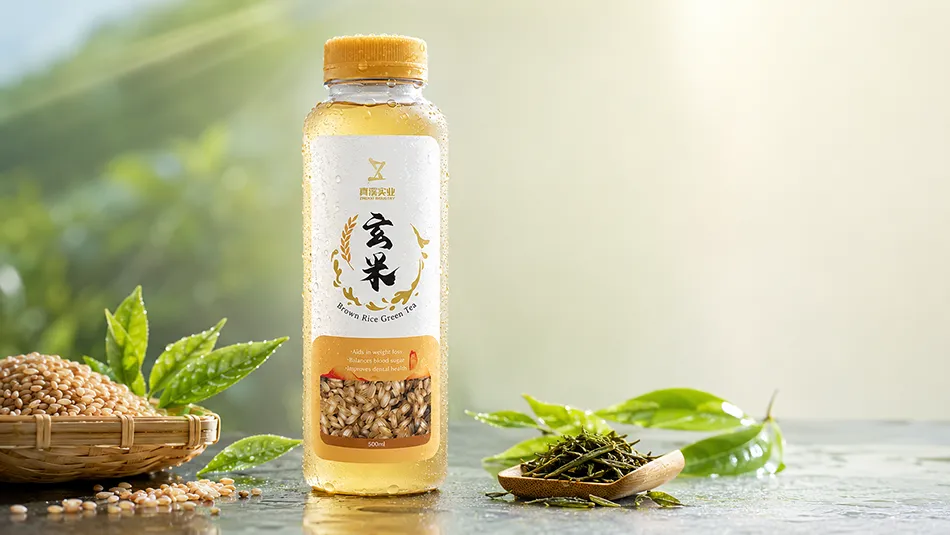

Product specifications
Standard specs below. Recipe, roast level, sweetness and label are all customizable.
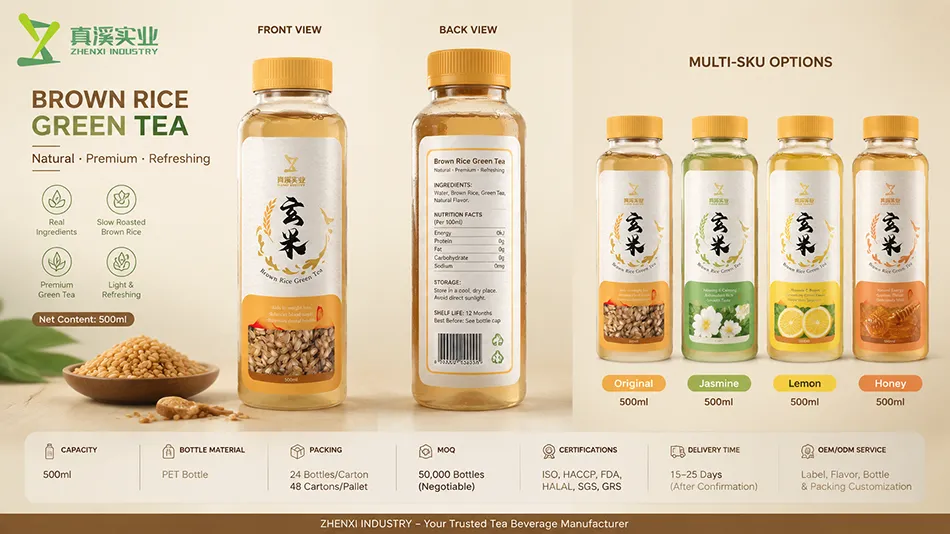
What is ZhenXi brown rice green tea (genmaicha)?
Product overview for distributors, importers, and private-label brand owners
ZhenXi brown rice green tea is a 500ml bottled ready-to-drink (RTD) tea that blends roasted brown rice with green tea. Internationally this style is known as genmaicha — also called Japanese brown rice tea or roasted rice tea — a familiar, recognizable category for retail buyers, especially in markets with an interest in Japanese and East Asian beverages. The roasted brown rice gives a warm, toasty, lightly caramel-like aroma, while the green tea keeps the cup clean and refreshing.
The result is a mild, comforting, low-intensity tea that suits all-day drinking. Because the roasted rice softens the briskness of green tea, brown rice green tea is often chosen by shoppers who find plain green tea too sharp, which makes it an easy everyday SKU for convenience retail and foodservice.
The product is made to order, so the recipe, roast level, sweetness and label can be set to a brand's specification rather than sold as a fixed formula. Sourcing, brewing, filling and export are handled in a single facility, which keeps the supply chain short and the specification consistent from sample to shipment.
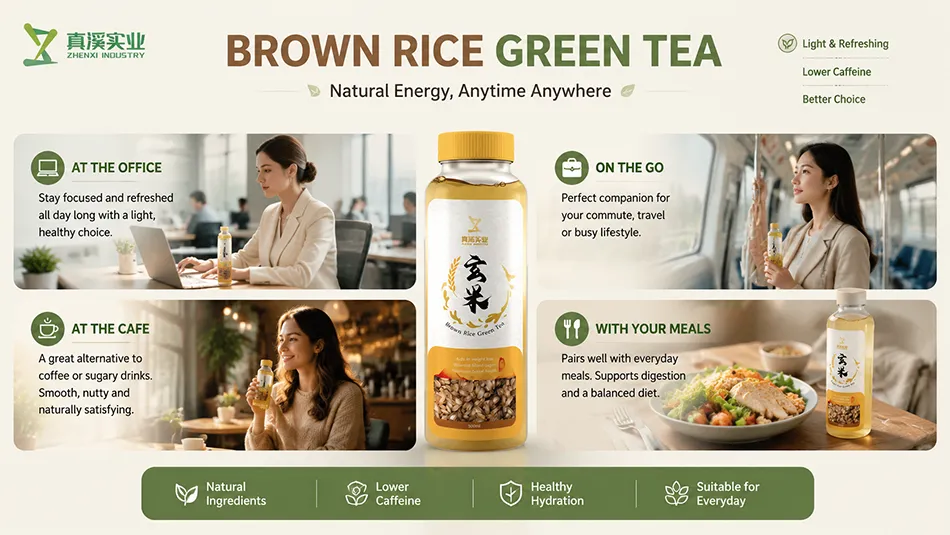
Suitable occasions
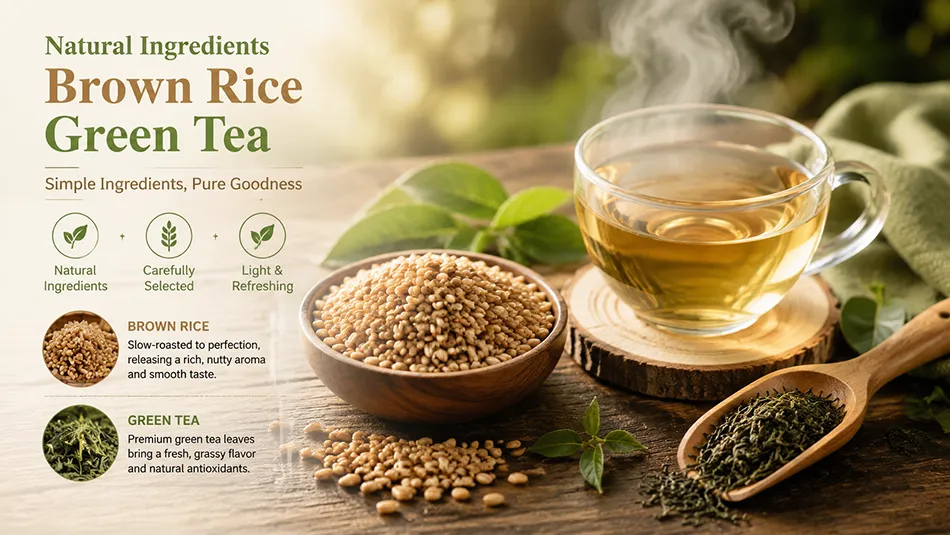
Ingredients & nutrition (typical)
Representative values for the standard brown rice green tea recipe. Final values are confirmed per formula and printed on your label — all parameters below are customizable.
| Parameter | Typical value (per 100 ml) | Customizable |
|---|---|---|
| Base | Brewed green tea | Yes — green tea grade / origin |
| Roasted ingredient | Roasted brown rice | Yes — roast level |
| Energy | To recipe (e.g. low calorie) | Yes — incl. low / zero calorie |
| Sugars | To recipe | Yes — incl. low-sugar / sugar-free |
| Tea polyphenols | Naturally present from green tea | — |
| Caffeine | Low (naturally from green tea) | Yes — decaf option |
| Preservatives / colors | None added | — |
Note: the values above are indicative placeholders for illustration. Send us your target specification or destination market and we will confirm exact ingredient declarations and nutrition values for your label. Any on-pack health or nutrition claims are set only to what your recipe and certificates can substantiate under your market's regulations.
The tea behind the bottle: origin, craft and sourcing
Background detail buyers can use in their own brand story and listings
A short history of genmaicha
Genmaicha began in Japan as a thrift tea. Roasted rice was originally added to stretch leaf tea so it lasted longer for ordinary households, which is why it was once nicknamed "people's tea." What started as economy became taste: the toasty grain rounded off green tea's edge so well that the blend earned a permanent place on the everyday table, and later on café and convenience-store shelves across East Asia. That heritage is useful on a label — it gives the product a genuine story rather than an invented one.
How the roasted-rice character is built
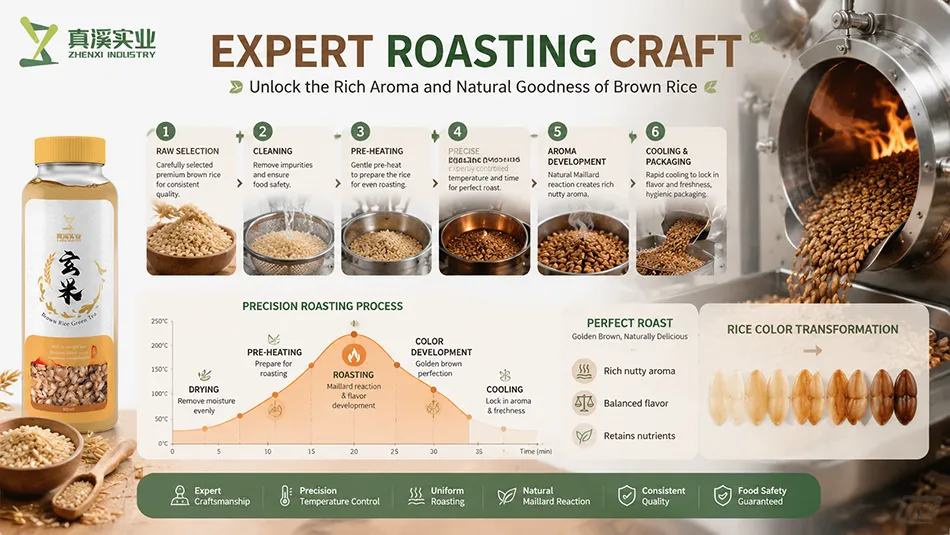
The defining aroma comes from roasting. As rice is roasted, its starches and amino acids brown and develop toasty, popcorn-like, faintly caramel notes; some grains pop, much like puffed rice. Roast it lightly and the cup stays delicate and cereal-sweet; push the roast darker and the toasty, bittersweet edge comes forward. In an RTD bottle the brew is then balanced so the rice does not overwhelm the leaf — the rice sits underneath, and the green tea stays legible on top. Adjusting roast depth is one of the clearest levers a buyer has to differentiate a private-label SKU from a generic one.
The roasting chemistry, briefly
The toasty aroma is mostly the Maillard reaction: when the rice is heated, its reducing sugars react with amino acids to form hundreds of new aroma compounds, including the pyrazines responsible for the roasted, nutty, popcorn character. Run alongside it is a degree of caramelization of the rice's own sugars, which adds the sweet, biscuity edge. Both are temperature- and time-dependent — a hotter or longer roast pushes color darker and aroma toward bitter-roast, while a gentler roast keeps it light and grain-sweet. This is why two genmaicha products from the same ingredients can taste noticeably different: the roast curve, not just the recipe, defines the flavor. On the green-tea side the goal is the opposite — minimal heat damage — so the leaf is brewed to protect its fresh, slightly grassy top notes rather than cook them off.
Tea grade and what it changes
The green tea base is usually a steamed Japanese-style green (sencha-type) or a comparable steamed green leaf. Higher grades — younger, more uniform leaf — give a sweeter, smoother, less astringent liquor and a brighter color; coarser, more mature leaf brews stronger and more vegetal but costs less. Some versions add a pinch of matcha for color and body, sold as matcha-iri genmaicha. Choosing the grade is a direct trade between cup quality and landed cost, and it is worth deciding deliberately rather than defaulting to the cheapest leaf.
Sourcing and traceability
Two raw streams sit behind the bottle: the green tea leaf and the brown rice. Leaf is selected by grade, harvest and origin; brown rice is selected and roasted to a target color. For markets that demand organic, both streams have to sit within the relevant organic certification scope — not just one of them — so the chain of custody, from field to roast to fill, is documented end to end. Buyers exporting into the EU or other strict markets should confirm that scope early, because it determines which on-pack claims are permissible.
How shoppers actually drink it
In practice this is a low-drama, repeat-purchase tea. Commuters reach for it as a softer alternative to plain green tea or coffee; office and study sessions favor it because the roasted-rice smell is comforting and the caffeine is light; and it is a natural pairing with rice-based and savory meals, which is why it shows up next to onigiri and bento in convenience formats. None of these are medical claims — they are usage patterns, and they are the scenarios a brand can lean on in its own marketing without overstating benefits.
Sensory profile, in tasting terms
On a simple sensory map the cup reads: aroma — toasty, nutty, popcorn, light caramel; taste — mild, smooth, low bitterness, low astringency; body — light to medium; finish — clean and short with a faint grain sweetness. Compared with a straight steamed green, brown rice green tea trades some of the bright, vegetal "greenness" for warmth and roundness. The practical implication for a buyer is that it is an easy first tea for people who find green tea too sharp, and it holds up well chilled in a bottle, where over-astringent greens can taste harsh.
Market preference: EU vs US (and beyond)
Preference shifts by market. In the EU, demand skews toward unsweetened or very low-sugar, clean-label and organic-certified tea, sold on authenticity and ingredient transparency — front-of-pack sugar labelling and sugar taxes in several countries reinforce this. In the US, the RTD tea shelf has historically been sweeter and more flavor-forward, though the fastest growth is now in unsweetened and "better-for-you" lines, so a lightly sweetened or zero-sugar genmaicha can suit both a mainstream and a health-positioned listing. GCC markets prioritize HALAL and often a touch more sweetness, while East and Southeast Asian markets already recognize the genmaicha taste and reward authenticity over novelty. The takeaway for sourcing: set sweetness and claims per destination rather than shipping one global recipe.
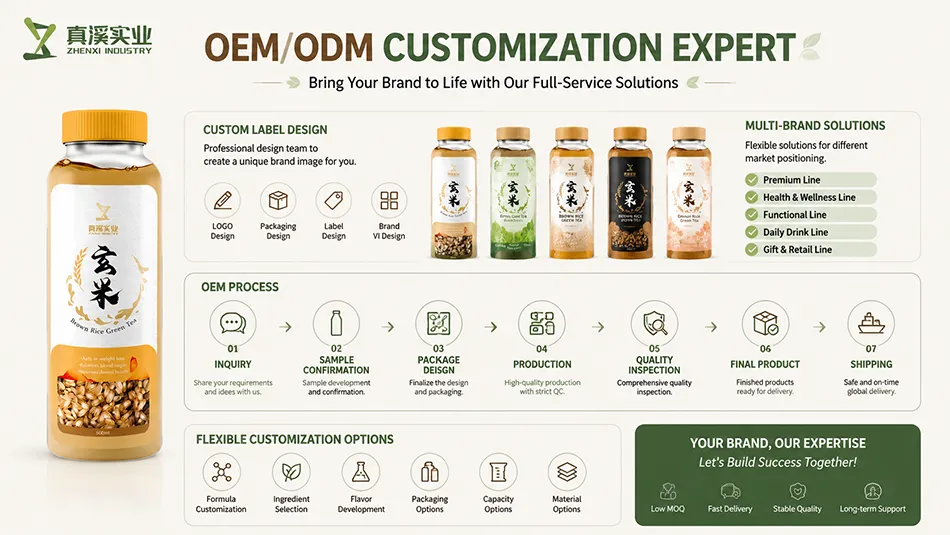
Working with ZhenXi: what the OEM service covers
The practical scope of a private-label project — certification, formulation, design, and logistics
EU Organic certified
A genuine differentiator for premium and health-focused retail. EU Organic plus FDA, FSSC, GMP, HACCP, HALAL and ISO supports clearance and shelf positioning in demanding markets.
Authentic genmaicha style
Roasted brown rice blended with green tea for a recognizable, familiar flavor profile that retail buyers already understand and can position clearly on shelf.
Integrated brewing & filling
Tea extraction, blending, bottling and export documentation run inside one facility, so the recipe stays identical from approved sample to shipped batch and lead times stay predictable.
Free label design
Private-label artwork, brand logo, multi-language packaging and custom bottle sizes. Our design team prepares a digital proof before production at no extra cost.
Custom recipe & sweetness
Adjust sweetness (low-sugar / sugar-free), change the roast level or vary the green tea base — tuned to your market and its labeling regulations.
Export experience
Container-load export with full documentation. Flexible payment terms (L/C, T/T, Western Union, MoneyGram, PayPal) for retailers, distributors, and importers.
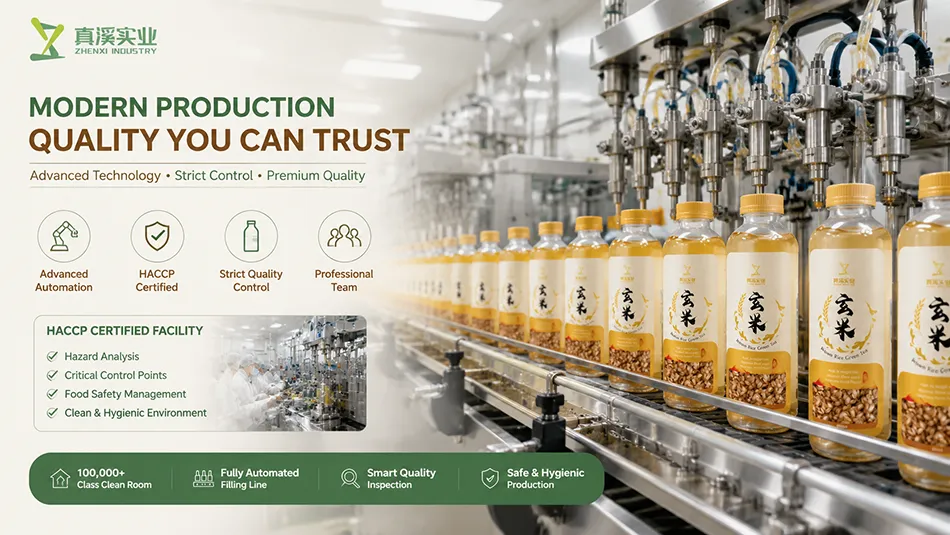
Proof: facility, certifications & export record
Filling line
Bottling line where the brewed tea is filled, sealed and date-coded under HACCP control.
Brewing & extraction
Tea is brewed and blended in-facility, then balanced against the roasted-rice base before filling.
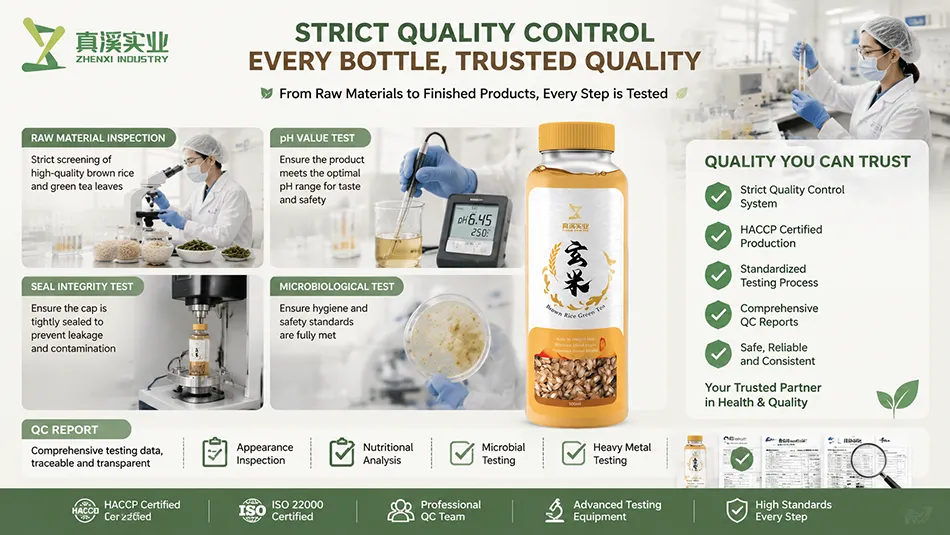
In-line QC
Per-batch checks on fill level, seal integrity and label registration, recorded in a QC report.
Certificates
EU Organic, FDA, FSSC, GMP, HACCP, HALAL and ISO — supplied with certificate numbers on request.
Representative export record
| Region | Typical buyer type | Common pack / claim focus |
|---|---|---|
| GCC / Middle East | Importers & distributors | HALAL, Arabic label, low/no sugar |
| Southeast Asia | Convenience & retail chains | Familiar genmaicha taste, value pack |
| EU | Private-label & health retail | EU Organic, clean label, unsweetened |
| North America | Brand owners & e-commerce | Better-for-you positioning, FDA |
Note: the table shows typical buyer patterns by region as a planning reference.
Bottled genmaicha buyer's guide
Practical guidance for brands and importers sourcing a private-label brown rice green tea
What brown rice green tea (genmaicha) is — and who buys it
Genmaicha is green tea combined with roasted brown rice. The roasting step gives the rice a toasty, nutty, lightly caramel aroma that mellows the natural briskness of green tea. For buyers, the appeal is twofold: it is a recognizable category with an existing audience (Japanese-tea and East-Asian-beverage shoppers), and its mild, comforting taste broadens appeal to people who find plain green tea too astringent. As a bottled RTD, it fits convenience, foodservice, and e-commerce equally well.
How much sugar should a bottled tea contain?
Sweetness is the single biggest formulation decision, because it drives both taste and regulatory outcomes — several markets apply sugar taxes or front-of-pack warnings above set thresholds. Many modern bottled teas target a noticeably lower sugar level than soda, and unsweetened or sugar-free versions are popular in health-focused markets where an authentic, clean tea taste is expected. We set sweetness to your market's rules and consumer preference for each order.
Why clean-label and EU Organic claims matter
Clean-label positioning — no added preservatives, no artificial colors or flavors — and credible certifications such as EU Organic are strong shelf differentiators in premium and health-focused retail. They support higher price positioning and smoother customs clearance in strict markets. Importantly, any health or nutrition claim on the pack must match what your specific recipe and documentation can substantiate; we confirm exactly which claims are permissible for your formula and destination before printing, rather than printing claims that cannot be supported.
Bottle vs can: choosing the right format
This product is offered in a 500ml bottle, which suits resealable, larger-serve, grab-and-go positioning and clear visual branding. Cans offer a stronger light/oxygen barrier and faster chilling. If your market or channel favors cans, we can also produce in canned formats — tell us your target channel and we recommend the best pack.
Sourcing this product without the usual pitfalls
How this differs from a generic OEM order, and the mistakes that cost importers money
How a serious OEM run differs from a generic one
Many factories will quote a genmaicha and ship whatever house recipe they already run. The differences that matter downstream are less visible: whether the roast curve is fixed and documented so batches match, whether the green-tea grade is specified rather than substituted for the cheapest lot, whether both the rice and the leaf sit inside the same organic scope when an organic claim is printed, and whether a QC record travels with each batch. A run that controls those four things looks identical on a quote sheet but behaves very differently across reorders — which is where private-label brands either build trust or lose it.
Common mistakes importers make with bottled tea
Printing claims the recipe can't carry
- Putting "organic" on-pack when only one raw stream is certified
- Health or function claims with no substantiation for the destination market
- Fix: confirm claim scope before artwork sign-off
Choosing sweetness for the wrong market
- Shipping one global sweetness level into a sugar-tax market
- Unsweetened recipe into a market that expects a sweeter cup
- Fix: set sugar per destination, sample locally first
Ignoring the roast curve
- Approving one sample, then accepting drifting roast across reorders
- Flavor inconsistency that erodes repeat purchase
- Fix: lock a documented roast spec, not just a recipe
Underestimating documentation
- No COA or certificate numbers ready at customs
- Label missing mandatory declarations for the market
- Fix: request the document pack with the pre-production sample
Case study format
Brief: A Iranian importer wanted to launch a private-label bottled genmaicha for convenience chains, targeting an unsweetened, clean-label position with an organic claim.
What was done: Selected a Grade II steamed green base and a medium roast for a rounded, low-bitterness cup; set sugar to sugar content ≤0.5g per 100ml.; confirmed organic scope across both rice and leaf; produced a digital label proof and a pre-production sample for sign-off.
Outcome: 300,000 units shipped in the first order with a 45-day turnaround; reorder placed within 6 Months.
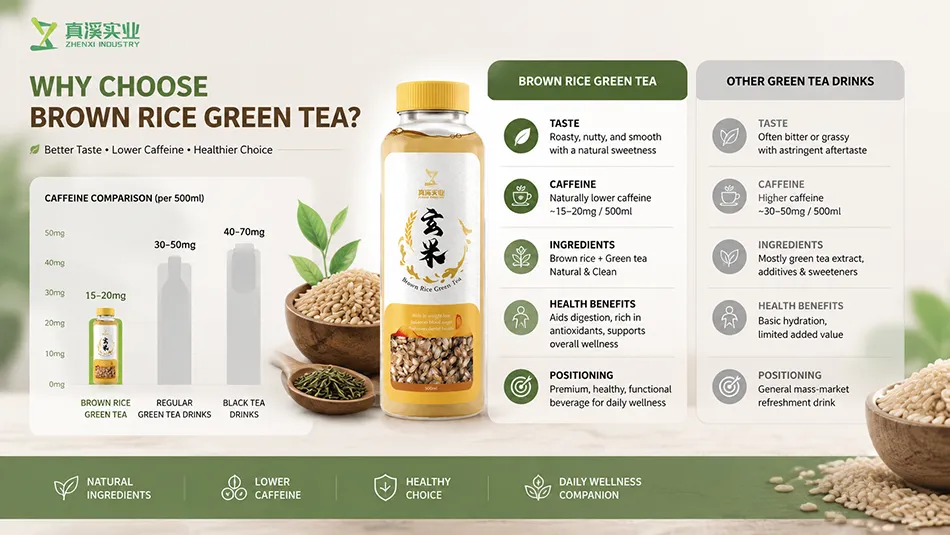
How brown rice green tea compares
Quick reference for buyers weighing tea styles and formats
| Attribute | Brown rice green tea (this product) | Plain green tea |
|---|---|---|
| Aroma | Toasty, nutty, lightly caramel | Fresh, grassy |
| Taste intensity | Mild, smooth, mellow | Brisker, can be astringent |
| Caffeine | Low (rice dilutes tea) | Low–moderate |
| Shelf positioning | Comforting, everyday, Japanese-style | Light, refreshing |
| Packaging | Bottle (this product) | Can |
|---|---|---|
| Resealable | Yes | No (standard) |
| Light/oxygen barrier | Good | Excellent |
| Branding surface | Clear visual / shrink label | Full-wrap print |
| Best for | Larger serve, grab-and-go | Chilled single serve |
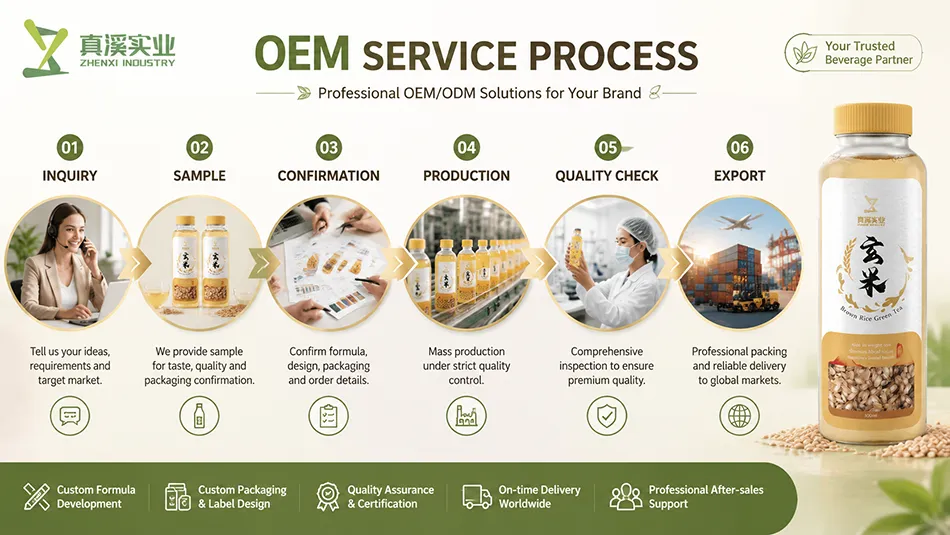
OEM / private-label ordering process
From first inquiry to delivered container — a typical project timeline
Inquiry & quote
Send recipe, volume, label and destination. Quote in 30–45 minutes.
Sample & recipe
Free samples and tuning (roast, tea base, sweetness) for your market.
Label design
Free artwork proof with your brand, logo and language.
Confirm & deposit
Approve mock-up, sign PI, pay deposit to schedule production.
Brewing & filling
Production under EU Organic / HACCP systems with in-line QC.
Export & docs
Container shipment in 20–25 days with full export paperwork.
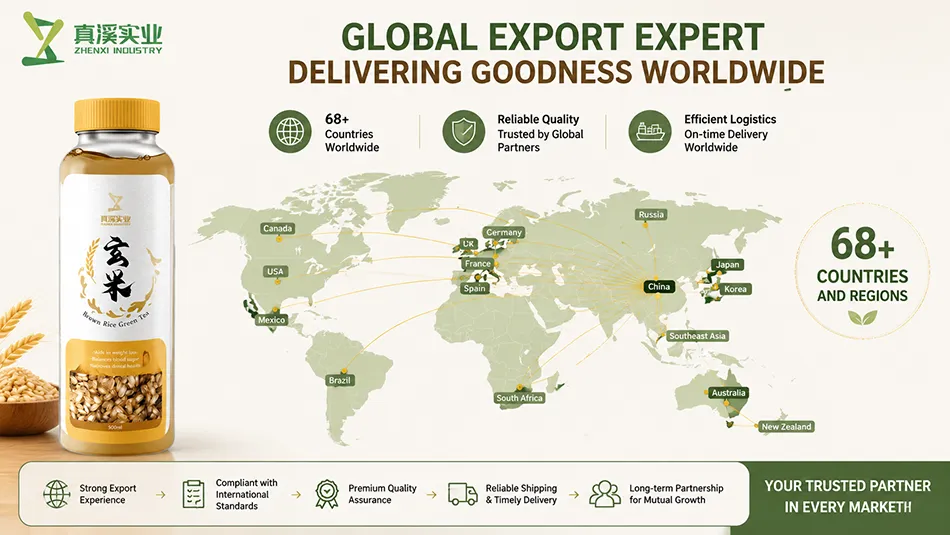
Export terms, payment & certifications
Standard terms for B2B orders. Flexible arrangements for established accounts.
Payment options
- L/C (Letter of Credit)
- T/T (bank transfer) — deposit + balance
- Western Union & MoneyGram
- PayPal — small / sample orders
Shipping & delivery
- Delivery time 20–25 days
- MOQ from 1 container
- Sea freight, palletized bottles
- Incoterms FOB / CIF / DDP on request
Certifications
- EU Organic
- FDA & FSSC
- GMP & HACCP
- HALAL · ISO — documentation provided
Customization
- OEM / ODM & private label
- Free label & logo design
- Custom recipe, roast & bottle size
- Low-sugar / sugar-free options
Frequently asked questions
Common questions from distributors, importers, and brand owners
How soon can I get a price quote?
What is the minimum order quantity (MOQ)?
Do you offer a product mock-up before mass production?
How much caffeine and sugar does it contain?
How do you keep printing and product quality consistent across batches?
What exactly is brown rice green tea (genmaicha)?
Does the tea contain preservatives, artificial colors or flavors?
Is this product EU Organic and HALAL certified?
Can you customize the sweetness, roast level or tea base?
What is the shelf life and how should it be stored?
Which markets and channels does this product suit best?
What is the difference between OEM and ODM service?
Where this product sits in the ZhenXi tea range
This page is part of the Green Tea cluster under the main Tea Drink hub
↑ Pillar page — Green Tea (OEM & Private Label)
Brown rice green tea is one style within ZhenXi's green tea pillar. Visit the pillar to compare it against sencha-style, jasmine green, and other bottled and canned green teas before shortlisting a recipe.
→ Sibling styles in the tea cluster
Jasmine & Scented Tea
Floral steamed greens — a natural companion SKU to a roasted-rice style on the same shelf.
Oolong Tea
Partially oxidized, aromatic mid-body teas for buyers extending beyond green.
Bottle & Can Formats
Switch the same recipe between bottle and aluminum can without changing supplier.
Tea cluster — by style
Supporting guides (cluster content)
Company
Ready to launch your own bottled green tea?
Request free samples, download the catalog, or send your recipe and label brief for an OEM review. Our B2B team replies within 30–45 minutes during business hours.
WhatsApp / Tel: +86-133-1066-8557 · sales@zhenxindustry.com


