Oat milk has been very popular in the past one or two years. Have you ever had it? Many people think that oat milk is a rare dairy product, similar to a combination of oats and milk. In fact, its raw material is oat pulp, which is a plant protein beverage without any milk. The soy milk, almond milk, walnut milk, etc. that we often drink are all plant protein beverages. They are made from protein-containing fruits, seeds, and kernels, with some food supplements or food additives (optional), and then processed or fermented... From this point of view, oat milk is not really a rare drink. It's just that maybe because the texture of oat milk is white and silky, just like milk, everyone gradually calls it "oat milk".
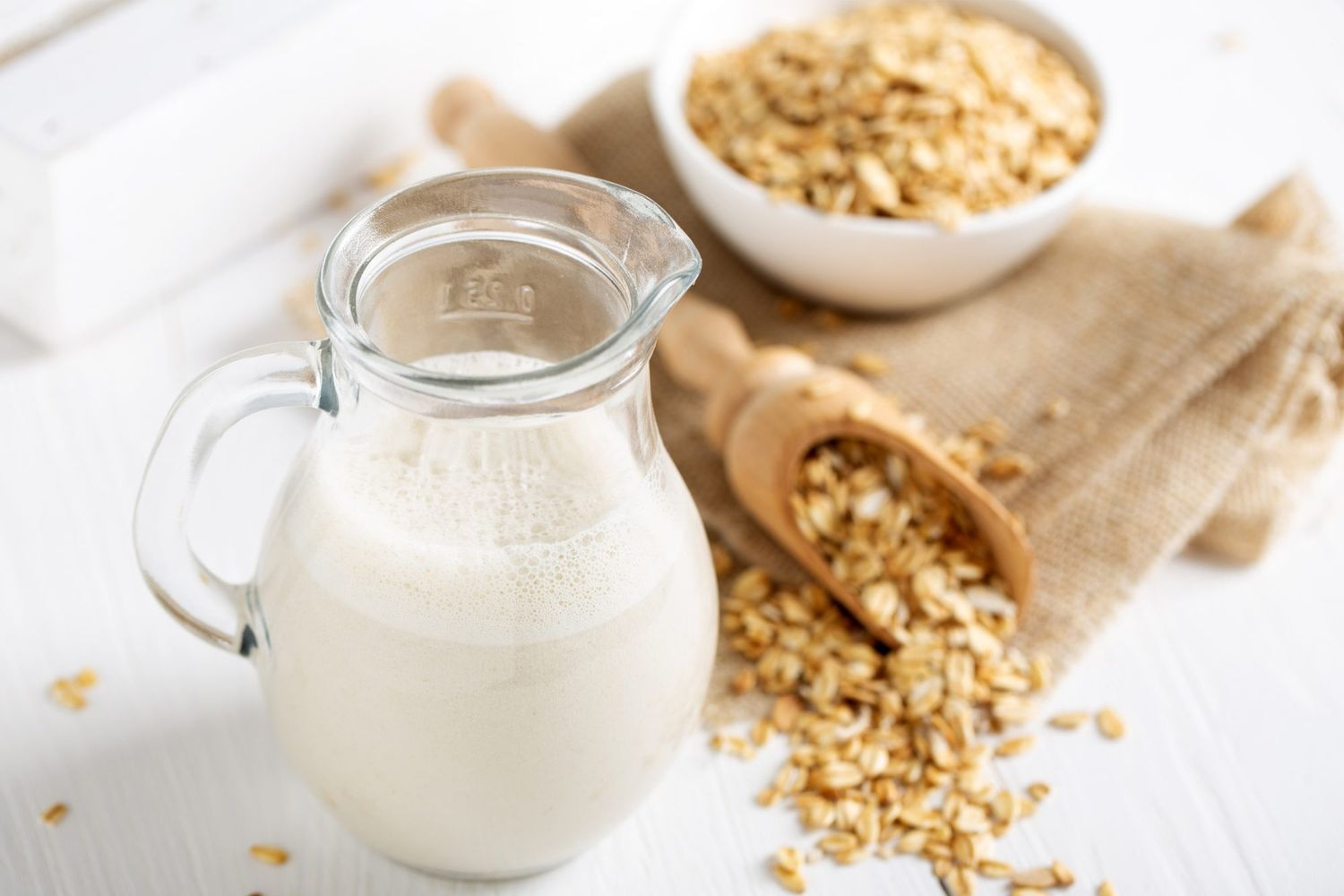
Oat milk is a plant protein milk made from oats as the main raw material, through soaking, grinding, filtering and other processes. Using special enzymatic hydrolysis technology to directly convert solid oats into liquid oats, to be more specific: first harvest the oats, then use technology to mix the oats with water, add special enzymes to decompose the oats, so that the oat milk without additional sugar will also have a hint of sweetness, and well retain the water-soluble dietary fiber β-glucan in the oats. At the same time, it is rich in dietary fiber, 0 lactose, 0 cholesterol, 0 trans fat, and low in saturated fat, so it is regarded as a standard for fitness people, and is also deeply loved by lactose intolerant and vegetarian friends. Oat milk is also rich in B vitamins and minerals, such as calcium, iron, zinc, etc. Oat milk is not milk in essence, but a plant-based drink. It is just because the texture is similar to milk, so it is called oat "milk".
Before oat milk, perhaps in everyone's eyes, oats were a familiar and unfamiliar crop. Familiar because of the oatmeal on the supermarket shelves, or a bowl of thick and plain oatmeal porridge. Unfamiliar because we know too little about the value of oats... It is speculated that oats may have originated in the Mediterranean basin and the Middle East. There are four major varieties of oats commonly grown worldwide: oats, red oats, naked oats, and long-grained oats, which are distributed in different planting areas of the world. In terms of growth conditions, oat varieties are generally suitable for cool, humid climates and moderately humid soils. Compared with other crops, such as corn and barley, the requirements for the growth environment are relatively low. Although oats themselves are not a precious crop, they have their own unique rich structure and special effects in terms of nutritional value. As a world-recognized health product, oats have a relatively rich and diverse nutritional structure. Although there are slight differences based on the type of oats, climate, soil, and other natural environments, the general nutritional structure is as follows:
| Composition and content of oats and other whole grains (representative values/100 grams) | |||||||
| Table 1 | Oats | Wheat | Corn | Brown rice | Rye | Barley | Sorghum |
| Water (g) | 8.5 | 12.0 | 11.2 | 12.2 | 13.0 | 10.3 | 11.6 |
| Carbohydrates (g) | 58.7 | 60.2 | 70.6 | 73.9 | 58.7 | 69.7 | 65.6 |
| Protein (g) | 14.0 | 13.5 | 8.8 | 7.4 | 11.2 | 9.2 | 11.0 |
| Fat (g) | 8.0 | 2.1 | 3.5 | 2.8 | 2.8 | 1.6 | 3.3 |
| Dietary fiber (g) | 9.0 | 10.6 | 4.8 | 2.3 | 12.8 | 8.0 | 6.9 |
| Ash (g) | 1.8 | 1.6 | 1.1 | 1.4 | 2.0 | 1.2 | 1.6 |
| Energy (KJ) | 1473 | 1270 | 1409 | 1412 | 1215 | 1331 | 1359 |
| Calorie (Kcal) | 363 | 314 | 349 | 350 | 300 | 330 | 336 |
1. Oat milk retains the β-glucan in oats, a plant-based water-soluble dietary fiber
Dietary fiber, as a very important part of the human diet, refers to edible plant carbohydrates that are not digested in the small intestine but can be partially or completely fermented in the large intestine. Oats are rich in dietary fiber (17%-21%), especially water-soluble fiber, and β-glucan is the main component of oat water-soluble fiber. Oat β-glucan is concentrated in the cell wall and subaleurone, and is connected by mixed β-(1-3)-glycosidic bonds (30%) and β-(1-4)-glycosidic bonds (70%). The β-glucan content in oats is between 2.3% and 8.5%, which is much higher than other types of grains. β-glucan mainly exists in oat bran, and its content in oat bran is much higher than that in endosperm, with a molecular weight of 240-2600 kDa. Therefore, β-glucan can be extracted from oat bran. Oat β-glucan can lower cholesterol, control blood sugar, improve constipation and resist aging.
| Composition of β-glucan in oats and other grains(g/100g dry weight) | ||||||
| Oats | Wheat | Corn | Brown rice | Rye | Barley | |
| Total β-glucan | 4.40 | 0.83 | 0.30 | 0.11 | 2.07 | 4.20 |
| Soluble β-glucan | 3.88 | 0.33 | 0.20 | Trace | 0.83 | 2.90 |
| Solubility of β-glucan | 88 | 40 | 67 | Trace | 40 | 69 |
2. Oats have a higher protein ratio than other crops (Table 1).
The protein content of common naked oats in China is 11.2%-19.9%, with an average of 14.5%. The protein of oats is distributed in all parts of oat seeds, mainly concentrated in the bran layer (Bran), especially the aleurone layer (Aleurone Layer) adhered to the endosperm (Endosperm), and the germ (Gram). The protein content of the bran layer is higher than that of the endosperm, which can be as high as 30%.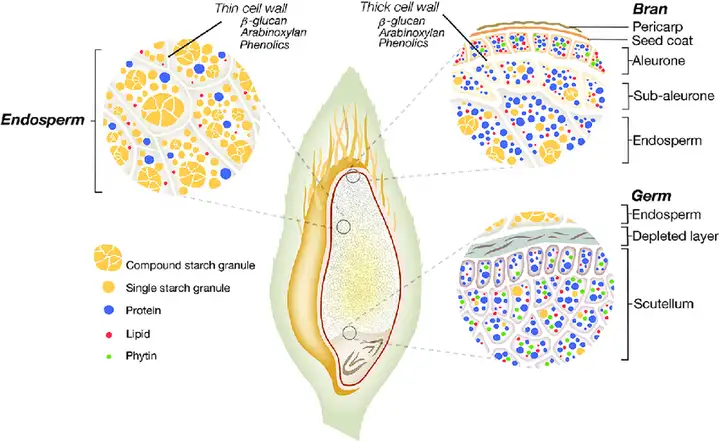
Among the total protein content of oats (11-15%), there are roughly four types of proteins, which mainly include globulins soluble in saline water, prolamins soluble in 70%-80% alcohol, glutenins soluble in acid or alkali, and water-soluble albumin. Albumin is a water-soluble protein with a high content of essential amino acids for the human body and good solubility. It is a high-quality protein that is easy to digest.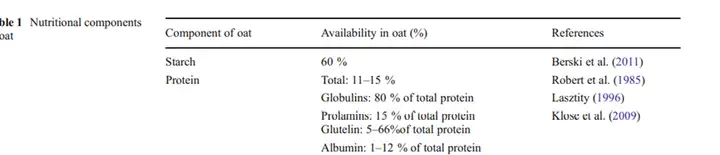
Journal of Food Science and Technology -Mysore-. 52. 10.1007/s13197-013-1072-1.
3. Oat protein is composed of 18 kinds of amino acids, and the amino acid composition is balanced.
It contains 8 essential amino acids for the human body. Essential amino acids are a type of amino acids that cannot be synthesized in the human body and must be taken from the outside, but they play an important role in the human body. They play an important role in promoting human development and improving immunity. Not only oat protein, oats are also rich in antioxidant polyphenol compounds (Phenolic compounds).
Oats contain ferulic acid, p-coumaric acid, caffeic acid, vanillic acid, and 4-hydroxybenzoic acid, as well as their derivatives. Studies have shown that these polyphenolic compounds in oats have antioxidant effects both in vitro and in vivo. In recent studies, these polyphenolic compounds have been found to be beneficial to cardiovascular endothelial function, cell signaling pathways, and anti-inflammatory properties.
4. Oats have their own unique antioxidant, avenanthramides-AWAs

Nutrition Bulletin. 43. 10.1111/nbu.12354.
Avenanthramides-AWAs are a group of antioxidants unique to oats with a ring structure. Their antioxidant activity can be 10-30 times that of other antioxidant phenols, such as caffeic acid/vanillic acid. Among them, there are three with higher content, including alkaloid A (N-4'-hydroxycinnamoyl-5-hydroxyanthranilic acid), alkaloid B (N-4'-hydroxy-3-methoxycinnamoyl-5-hydroxyanthranilic acid) and alkaloid C (N-3', 4'-dihydroxycinnamoyl-5-hydroxyanthranilic acid), accounting for 35%, 21% and 44% of oat alkaloids respectively. These hydroxycinnamoyl alkaloids are only found in oats. They not only act as antioxidants, but also inhibit the pro-inflammatory process associated with the progression of atherosclerotic diseases and reduce the risk of cardiovascular diseases.
| Oat milk ingredient list analysis | |
| Oat pulp | The basic raw material of oat milk, usually composed of oats and water |
| Rapeseed oil | Emulsifies fat particles to help oat milk appear milky white |
| Calcium carbonate Tricalcium phosphate |
Calcium nutritional enhancer, which can increase the calcium content |
| Dimethyl phosphate | Serves as a stabilizer |
| Edible salt | Adjusts the taste and plays a certain stabilizer role |
Oats are not only an ancient grain crop as traditional people believe, but also a "superfood" that is beneficial to health.


