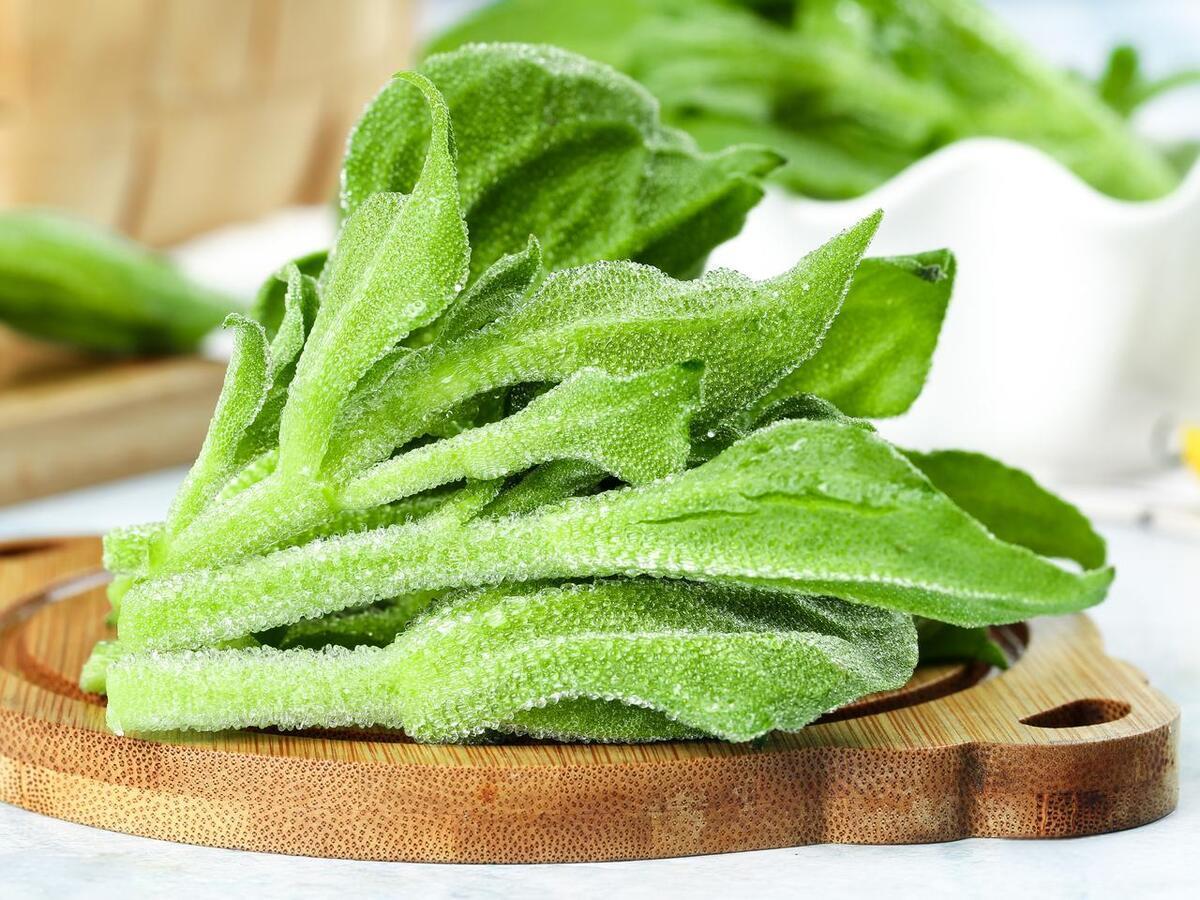
| Nutritional of ice plant | ||
| Nutritional ingredients | Content per 100 grams | Efficacy |
| Calorie | 16 kcal | Low calorie, suitable for people who want to lose weight |
| Protein | 1.3 grams | Provide plant protein and support muscle health |
| Fat | 0.1 grams | Low fat, healthy choice |
| Carbohydrate | 2.2 grams | Provide energy, low sugar suitable for diabetics |
| Dietary fiber | 1.2 grams | Promote digestion and improve intestinal health |
| Sodium | 180 mg | Supplement electrolytes and maintain fluid balance |
| Potassium | 320 mg | Regulate blood pressure and support heart health |
| Calcium | 60 mg | Promote bone health |
| Magnesium | 40 mg | Support nerve and muscle function |
| Vitamin A | 120 mg | Protect vision and enhance immunity |
| Vitamin C | 15 mg | Antioxidant, promote collagen synthesis |
| Vitamin K | 25 mg | Promote blood coagulation and support bone health |
Ice plant, also known as ice leaf daylily, ice flower, and African ice grass, is an annual herbaceous plant of the genus Daylily of the Aizoaceae family. It has densely packed transparent sac cells on its tender green leaves and stems. The cells are filled with liquid and look like sparkling water droplets. When the sun shines on them, the whole plant looks like sparkling ice crystals, hence the name "ice plant".
Ice plant is native to arid areas such as the Namib Desert in South Africa, so it is cold-resistant, drought-resistant, and salt-resistant. It can grow in high-salt soils and on the beach, and can safely overwinter even in high-altitude areas with a temperature of -45℃ in winter.
Ice plant can improve land salinization (land salinization will reduce the water absorption capacity of plants, resulting in the inhibition of plant growth, and in severe cases, the death of plants.), it can absorb and accumulate salt from the soil, and can reduce soil salinity after harvesting. This is because ice plants belong to salt-secreting plants. Under saline-alkali conditions, they can discharge the excess salt absorbed into ice crystal-like vacuoles through the salt glands densely distributed on the surface of stems and leaves, thus forming "small blisters" visible to our naked eyes, which also look like thin ice crystals.
Because ice plants have such characteristics, they have a very unique taste. If you grab a handful of ice plants and put them in your mouth to chew, the taste is quite refreshing and tender, and it feels cool as if the ice plants have melted in your mouth, and there is a light salty taste.
Because ice plants are relatively rare, they have become the "nobles" among vegetables, and the price is relatively high. In China, it is generally as high as 20 yuan per catty. Although it is not common on the daily table, its nutritional value is still relatively high. It is rich in natural plant salts, amino acids, carotene, flavonoids, inositol, pinitol and other substances. It has a light salty taste and a water content of up to 95%. It tastes refreshing and thirst-quenching and can supplement nutrition.
1. High vitamin C
The vitamin C content of ice plant is 20.8 mg/100 g, which is higher than the lettuce, rapeseed, and romaine lettuce we often eat, and is 2 to 10 times higher than them. The key is that it can be eaten raw directly, and the vitamin C is better preserved.
2. Supplement β-carotene
ice plant contains β-carotene. Although it is not rich, it is higher than the romaine lettuce we often eat. This ingredient is not only good for our eye health, but also helps to maintain skin health.
3. Rich in potassium and magnesium, and sodium is not low
The potassium and magnesium content of ice plant is excellent among vegetables, with a potassium content of 1825 mg/100 g, which is 7 times that of bananas; the magnesium content is as high as 137 mg/100 g, which is higher than pakchoy, spinach, amaranth, lettuce, romaine lettuce, etc.
This means that eating 100 grams of ice plant can meet 91% of the daily potassium requirement and 42% of the magnesium requirement of the general population. Adequate potassium and magnesium intake are helpful for us to control blood pressure and maintain cardiovascular health.
However, ice plant can absorb and accumulate salt in the soil during its growth process, so the sodium content is naturally not low, up to 2965 mg/100 g, which is equivalent to nearly 7 grams of sodium salt per 100 grams of ice plant. The sodium content of common green leafy vegetables generally does not exceed 100 mg/100 g. Although some literature mentions that the salt in ice plant is low sodium salt, low sodium salt is beneficial for patients with diabetes, hypertension, and hyperlipidemia. But it is still necessary to remind everyone that people with high blood pressure should still pay attention to it. You can try to eat it. If you have ice plant in the meal, don't eat other salty foods.
Some researchers have also used ice plant to make sports drinks, which takes advantage of the high natural sodium and potassium content in it, and can replenish the electrolytes needed by the body without adding potassium and sodium salts.
4. Good calcium content
When it comes to calcium supplementation, what we often think of is drinking more milk. In fact, in terms of calcium supplementation, the intake of green leafy vegetables should not be ignored.
They contain vitamin K, which is good for bones. Although the calcium content is not as good as milk, many green leafy vegetables have good calcium content. For example, the calcium content of rapeseed, wolfberry leaves, kale, Chinese cabbage, beet leaves, and green radish leaves exceeds 100 mg/100 g, which is higher than ordinary milk, and the calcium content of ice plant is even higher, at 288 mg/100 g, which is 2.5 times that of Chinese cabbage.
5. High iron content
The iron absorption rate of plant-based foods is not as good as that of animal foods, usually not exceeding 5%, but for vegetables with high iron content, it is still helpful in iron supplementation.
The iron content of ice plant is good, richer than spinach, which is known to have a high iron content. It is 17.6 mg/100 g, which is 6 times that of spinach, and its rich vitamin C can promote the absorption and utilization of iron.
6. Excellent zinc content
Zinc deficiency in the body may lead to picky eating, pica, affect brain function, affect wound healing, affect male fertility, make people susceptible to respiratory infections, induce hyperactivity, hair loss, rough skin, etc.
The zinc content of ice plant is very high, 33.9 mg/100 g, which is 30 times or even 60 times that of ordinary vegetables. The zinc content of celery leaves, long beans, rapeseed, and coriander we usually eat is only 1.14 mg/100 g, 0.94 mg/100 g, 0.87 mg/100 g, and 0.35 mg/100 g.
The daily zinc requirement for healthy adult men and women in my country is 12 mg/day and 8.5 mg/day respectively, which can be met by eating only 50 grams of ice plant.
7. Rich in flavonoids
The main component of ice plant flavonoids is quercetin, which can help us remove excess free radicals in the body, play an antioxidant and anti-inflammatory role, improve the body's condition, enhance immune function, delay aging, protect cardiovascular health, and inhibit tumor growth.
In addition, ice plant contains 16 kinds of amino acids, with the highest content of glutamate, so it has a strong umami taste and is also delicious when eaten raw.
Ice plant can be eaten raw directly after washing, or it can be made into ice plant fruit and vegetable juice. It is often used as a side dish for various dishes, such as Japanese and French cuisine, and is a high-end ingredient for Western food in hotels.
Among them, eating it raw can maximize the retention of the nutrients of ice plant, and the taste is good, fresh, juicy and cool, slightly sour and lightly salty, and it can also maintain its unique appearance with "ice crystals", which looks very appetizing; if you don't like to eat it directly, you can also squeeze juice, dip it in sauce, stir-fry it, make salads, etc.
Summary:
ice plant is a vegetable that "speaks for itself", with a crisp and refreshing taste and thirst quenching. It is best to buy less at a time and eat it as soon as possible, one because it is not cheap; the other is that it is not resistant to storage. Generally, it can be stored for 5 to 7 days under 0~5℃ refrigeration conditions.


