During the Spring Festival, it’s time to visit relatives and friends! When it comes to the flavor of the New Year, how can we miss a glass of wine? Whether it’s the “opening remarks” of the elders at home or the “warming wine” at a gathering of friends, a glass of wine instantly warms up and the atmosphere becomes lively. Drinking, as one of the warm moments in winter, often carries a reputation of being “harmful to the body”. When many people hear the word “drinking”, their first reaction is to shake their heads and refuse, and what comes to mind is either dizziness and fatigue, or health warnings. However, if “a small drink” may not be so terrible, and may even help cardiovascular health, isn’t it a bit unexpected?
The latest study published in the European Heart Journal puts forward a subversive view: moderate drinking, especially light to moderate wine intake, can significantly reduce the risk of cardiovascular disease (CVD).
When it comes to CVD, it is an absolute “health killer”. Every year, 17.9 million people worldwide lose their lives due to it, accounting for 32% of the total number of deaths. In order to fight this "killer", the academic community has been looking for effective prevention methods. At this time, the "Mediterranean diet" was pushed into the spotlight. This diet pattern that emphasizes eating more fruits, vegetables, nuts and fish, and is paired with olive oil, is known as the "cardiovascular umbrella". However, there is one thing in the Mediterranean diet that people are particularly talking about - wine.
Can wine really protect cardiovascular health? The academic community has been arguing for decades, and there is still no unified answer. On the one hand, some studies say that drinking some wine every day is good for cardiovascular health; on the other hand, some people think that the view that "drinking is harmful to the body" is the truth. The problem is that most studies rely on everyone's "self-report" - how many glasses do you drink a week? To be honest, who can remember this clearly? In addition, some people think that "drinking" may not be decent enough, so they report less. This error directly reduces the reliability of the research results.
In order to solve this problem, the researchers finally found the "secret detective" - tartaric acid. This substance is mainly found in grapes and their derivatives, and is basically not contained in other foods. Previous studies by the research team have verified that the concentration of tartaric acid in urine is well correlated with the actual level of wine intake in the short term (several days to a week). In other words, as long as we don't eat a lot of grapes or drink grape juice, the concentration of tartaric acid in urine can directly reflect our recent wine intake. Doesn't it sound more reliable than memory?
Then, the researchers used a case cohort study nested in the PREDIMED trial (the largest study to date to evaluate the effects of the Mediterranean diet on cardiovascular health). This prospective case cohort analysis study is "not small", spanning multiple research centers, with a large number of participants and an average follow-up time of 4.8 years.
In the end, the study included 1,232 participants (657 women and 575 men). These participants were mainly elderly people living in the Mediterranean region (average age 68 years old), who were classified as high CVD risk groups, and most participants followed the Mediterranean diet pattern.
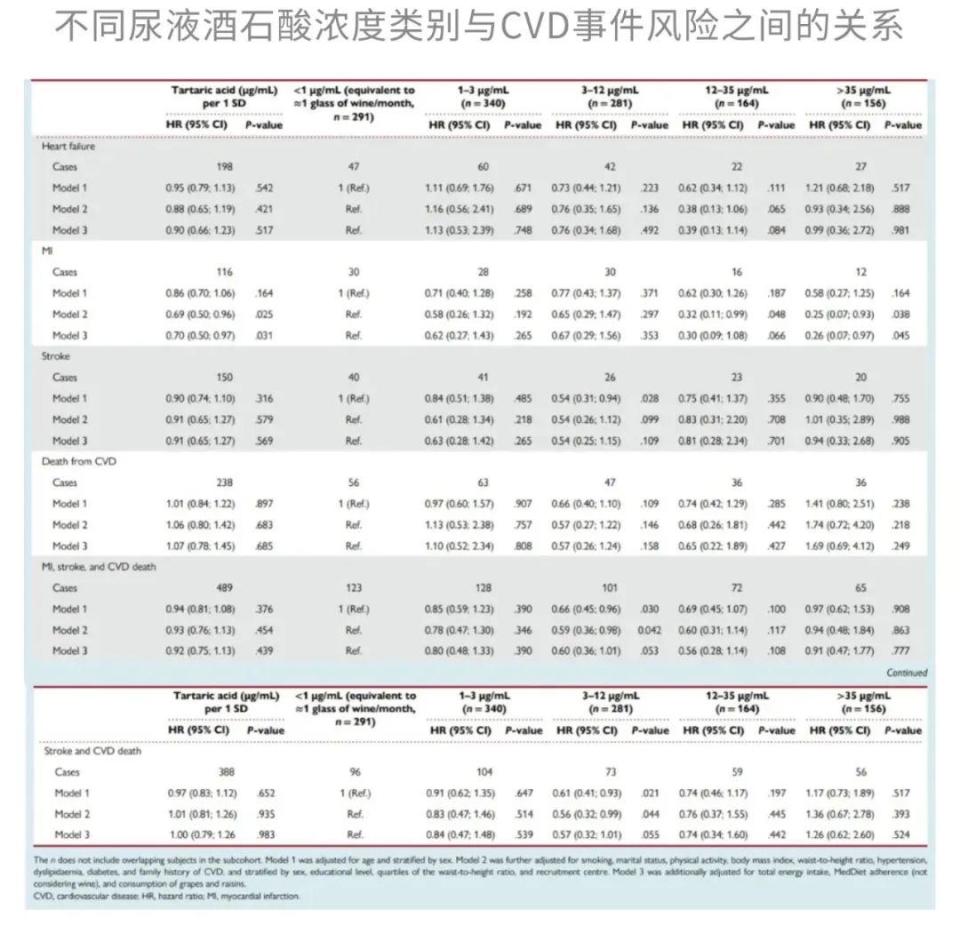
During the follow-up period, the study recorded in detail the type of each cardiovascular event, such as heart failure (222 cases), non-fatal myocardial infarction (138 cases), non-fatal stroke (190 cases) and cardiovascular-related death (286 cases).
In order to more accurately reflect the level of wine intake, the researchers divided the participants' urine tartaric acid concentration (baseline level) into five groups based on the "meaningful threshold" in previous studies: <1 ug/mL, 1-3 μg/mL, 3-12 ug/mL, 12-28 μg/mL and >28 μg/mL.
We talked about the tartaric acid concentration in urine can directly reflect the short-term wine intake, then let's take a look at the specific association between tartaric acid concentration and wine intake. This study shows that there is a significant positive correlation between tartaric acid concentration and wine intake. Specifically, every time the tartaric acid concentration in urine increases by one standard deviation (SD), the wine intake increases by 0.47 ug/mL. This means that if a person has a high concentration of tartaric acid in their urine, then he or she is likely to be a wine lover.
When the researchers divided wine intake into three levels (light, moderate, and heavy), they obtained similar results. Those participants who consumed the most wine had much higher concentrations of tartaric acid in their urine.
The most surprising finding in this study is that there is an inextricable link between tartaric acid concentration in urine and the incidence of CVD events.
Specifically, compared with participants with tartaric acid concentrations <1 μg/mL in urine, participants with tartaric acid concentrations of 3-12 ug/mL (light drinking, that is, about 3-12 glasses per month, about less than half a glass per day) had a 38% lower risk of CVD.
And those with tartaric acid concentrations of 12-35 μg/mL (moderate drinking: half a glass to no more than one glass per day) had a 50% lower risk of CVD. Notably, urine tartaric acid concentrations >35 μg/mL (more than 1.25 cups per day) did not show further reductions in CVD risk.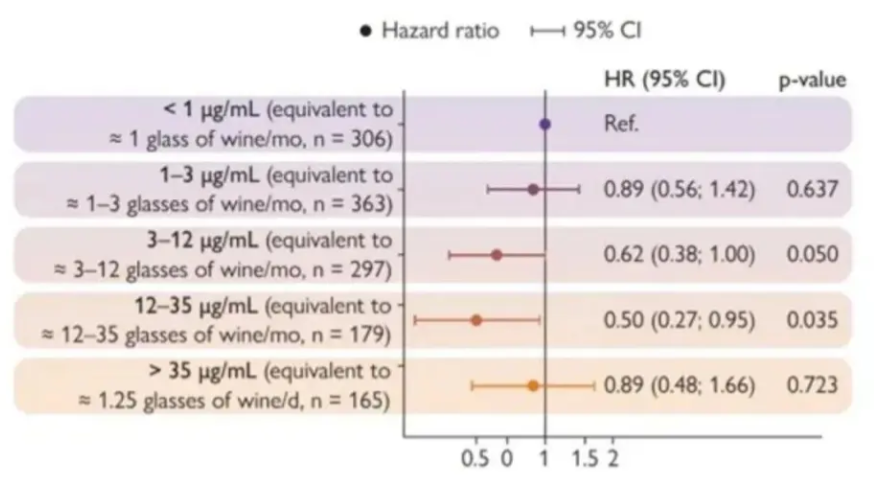
However, when the researchers dug deeper into the data, an interesting phenomenon emerged: this "tartaric acid effect" was more pronounced in men among light and moderate drinkers.
Specifically, when men had tartaric acid concentrations of 3-12ug/mL, their risk of CVD was reduced by 59%; when tartaric acid concentrations were 12-35 ug/mL, their risk of CVD was reduced by 69%. Although women also showed some trends in reducing CVD risk in the light drinking group, these trends did not reach statistical significance. The researchers believe that this gender difference may be related to the fact that there are more CVD events in the male group, so the "benefits" of drinking are more obvious. Women, however, have fewer CVD events, so the results seem to be "bland".
But don't rush to open the bottle to celebrate, the researchers also did something very important. They were worried about whether this "tartaric acid effect" would bring other health problems. Therefore, they broadened their horizons and explored the relationship between tartaric acid concentration and death from other causes. Fortunately, within the tartaric acid concentration range of 3-35 µg/mL, that is, the light to moderate drinking level, no significant association with increased risk of other causes of death was found. This not only makes us feel relieved, but also means that moderate drinking not only reduces the risk of CVD events, but also has no obvious negative impact on overall health.
Since light to moderate wine intake can reduce the risk of CVD, does the influence of "a little drink" cover every branch of CVD (such as myocardial infarction, stroke, heart failure, etc.)? Or is it more like a "student who is biased towards science"? More "favorite" for a specific type of CVD?
Next, we will focus on an important member of the "CVD family" - myocardial infarction.
The results show that there is a significant negative correlation between light to moderate drinking and the incidence of myocardial infarction. That is: for every SD increase in drinking, the risk of myocardial infarction will decrease by 30%.
However, when researchers tried to analyze the impact of light to moderate drinking on other cardiovascular events (such as stroke or heart failure), the results were not significant. In other words, this way of drinking is particularly "specific" in its protective effect on myocardial infarction, and its The impact on other cardiovascular diseases is relatively mild.
So why can light to moderate drinking of wine reduce the risk of myocardial infarction? Researchers speculate that this may be related to some key ingredients in wine, such as resveratrol and polyphenols. These ingredients have "super powers" such as anti-inflammatory and antioxidant, which can help improve vascular health, especially in diseases such as myocardial infarction that specifically "trouble" blood vessels. Their effects are particularly significant.
In general, this study accurately measured the intake of wine by measuring the objective indicator of tartaric acid concentration in urine, and explored its relationship with CVD risk. Conclusion The results showed that among people at high risk of CVD in the Mediterranean region, mild to moderate wine intake was associated with a significantly lower incidence of CVD. And this association was particularly significant in men. However, it should be pointed out that this is an observational study, because causality cannot be directly inferred.
Such results undoubtedly bring good news to friends who love to have a drink during the Spring Festival: moderate drinking, especially moderate wine, may be the invisible guardian of our cardiovascular health. But remember, moderation is the key, just like the aroma of wine needs to be savored slowly, this "moderate" secret also requires us to carefully grasp it.