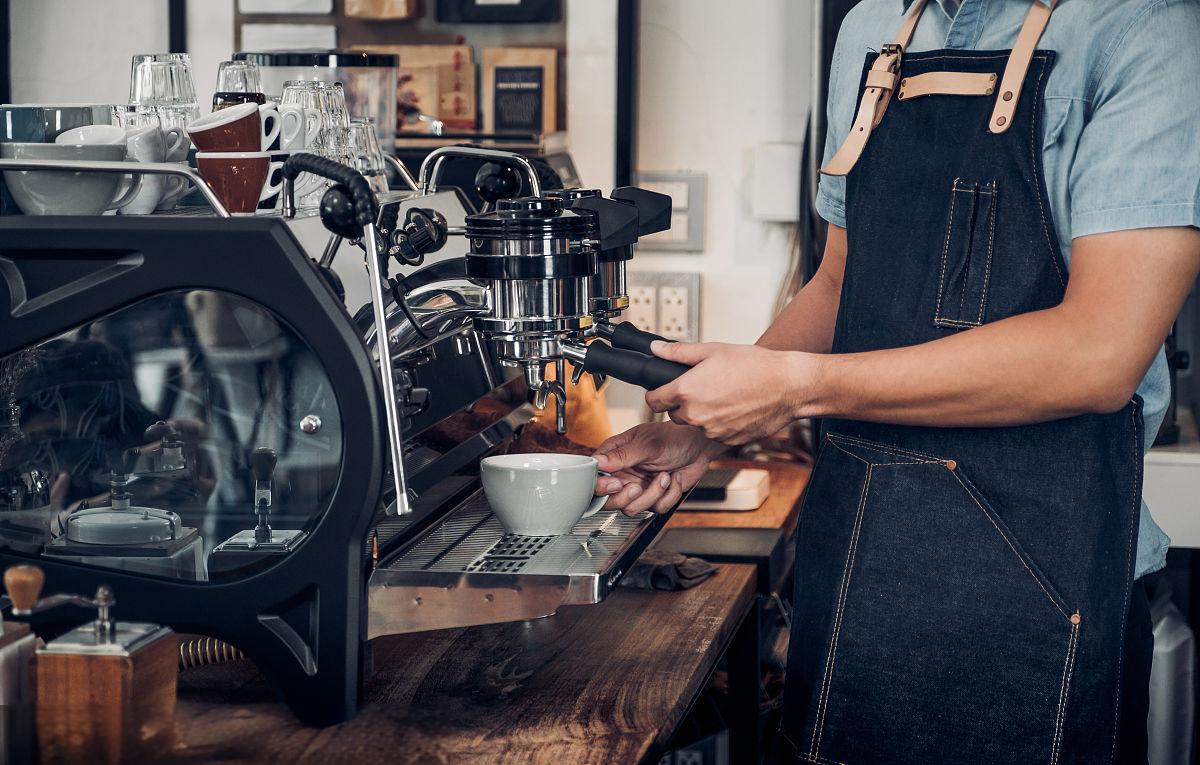
If you often "hang out" in a coffee shop, you may hear some people say to the barista when ordering, "add a shot". I don't think you will misunderstand that he wants to add a "bullet"! So, what is a "shot"? How many are there in a "shot"? Looking through the Oxford Dictionary, among the many meanings of the word shot, you can see one about drinks, that is, "a small portion of a drink", especially spirits, such as "a shot of whiskey"; it can also refer to "a small portion of a strong non-alcoholic drink", such as the "a shot of espresso" we use here. In fact, the word shot originated from the bar. Although its etymology is still controversial (most people think it is related to paying for spirits), after a complex evolution, it refers to a small cup of high-strength spirits (such as whiskey, tequila, etc.) that can be "drunk in one gulp". Such a glass is called a "shotglass". Although the capacity varies from country to country, it is basically 1 ounce, which is about 30 ml.
The early lever coffee machine invented by Achille Gaggia also stored 1 ounce (about 30 ml) of water, which determined the standard cup size of Italian espresso. At the same time, probably because its flavor is as strong as liquor, it is not surprising to describe it as a shot. Espresso, also known as Italian coffee or Espresso, is a coffee drink with a strong taste and high concentration. A traditional Italian espresso uses 7 grams of coffee powder to extract 1 ounce (about 30 ml) of coffee liquid, which is called solo in Italian, that is, a single shot of espresso. Correspondingly, 14 grams and 21 grams are double [doppio (double shot)] and triplo (triple shot)], corresponding to 60 ml and 90 ml of coffee liquid. However, with the adoption of weight units and the upgrade of coffee machines, the amount of liquid output no longer needs to be judged by the barista's naked eye, and the extraction of coffee can be controlled more accurately. More and more baristas no longer follow the traditional ratio and use a precise powder-liquid ratio to calculate (the commonly used ratio is 1:2). Each coffee shop will make adjustments based on its own experience and the taste of its customers.
Now, espresso made with 6-10 grams of coffee powder can be considered a single shot, while a double shot usually uses 14-18 grams (or even 20-22 grams) of coffee powder. Many cafes assume that espresso is a double shot. If you specifically request a single shot, the barista will use a handle with a diverter nozzle to connect it to two cups and give you one of them.
As long as the same powder-liquid ratio is used, the taste of a single shot and a double shot is not much different. However, if the drink is changed from a single shot of espresso to a double shot, the caffeine content will increase significantly, making the coffee taste in the drink more obvious.
1. The amount of coffee powder used:
Single espresso: usually 7-10g of coffee powder is used to extract 15-20g of coffee liquid.
Double Espresso: Use 10-19g of coffee powder to extract 20-38g of coffee liquid. This means that double espresso uses twice as much coffee powder as single espresso, which may result in a stronger taste.
2. Taste and flavor:
Single espresso: The taste is lighter and more balanced, with relatively low acidity and bitterness, and the aroma and taste are clearer, softer and smoother. For those who like to taste the original flavor of coffee beans and feel their subtle flavor, single espresso is a good choice.
Double espresso: The taste is richer and mellower, with relatively high acidity and bitterness, but at the same time it also retains more of the original aroma and taste, with a stronger depth, richness and smoothness. Double espresso is suitable for those who enjoy the strong taste and aroma of coffee.
3. Applicable people:
Single espresso: Suitable for those who are sensitive to caffeine or can't tolerate the strong taste of coffee, and those who want to taste coffee slowly.
Double espresso: Suitable for those who like the strong taste and aroma of coffee, and also for those who need to improve their energy and concentration. However, for those who can't tolerate caffeine very well, double espresso may bring some discomfort.
4. The capacity of the coffee cup:
Single espresso: Usually served in a smaller coffee cup, which is convenient for one or two sips.
Double espresso: It may be necessary to use a slightly larger coffee cup to accommodate its larger amount of coffee liquid.
In summary, there are obvious differences between double espresso and single espresso in terms of the amount of coffee powder used, taste and flavor, applicable population, and the capacity of the coffee cup. These differences enable them to meet the needs of different people for coffee taste and flavor.

Espresso does have some potential benefits to health, although its benefits can only be reflected under the premise of drinking in moderation.
Refreshing: Espresso is rich in caffeine, a central nervous system stimulant that can stimulate the cerebral cortex and improve alertness, attention and reaction speed. Drinking espresso in moderation can help people better cope with the stress of daily work and study.
Improve mood: Caffeine can stimulate the release of neurotransmitters such as dopamine in the brain, which are related to people's pleasure. Therefore, drinking espresso in moderation can help improve mood and relieve mild depression and anxiety.
Increase metabolic rate: Caffeine can stimulate the body's metabolism and accelerate the decomposition and consumption of fat. Therefore, drinking espresso in moderation can help people control weight and promote weight loss.
Antioxidant effect: Coffee contains a variety of antioxidants, such as cafestol and kahweol, which can remove free radicals in the body and reduce the damage of oxidative stress to the body. Drinking espresso in moderation can help improve the body's antioxidant capacity and prevent a variety of chronic diseases.
Reduce the risk of diabetes: Some studies have shown that drinking coffee in moderation can reduce the risk of type 2 diabetes. Certain components in coffee may help improve insulin sensitivity and lower blood sugar levels.
Reduce the risk of certain cancers: Some epidemiological studies have found that drinking coffee in moderation may be associated with a reduced risk of certain cancers, such as liver cancer, colon cancer, and breast cancer. However, this conclusion needs more research to confirm.
It should be noted that the above benefits are all based on moderate drinking. Excessive consumption of espresso may lead to a series of adverse reactions, such as insomnia, palpitations, anxiety, stomach discomfort, etc. In addition, caffeine may have potential risks for special groups such as pregnant women, breastfeeding women, heart patients and hypertension patients, so these people need to pay special attention when drinking espresso.
Neurasthenia and insomnia:Caffeine is the main ingredient in espresso, which can stimulate the central nervous system and keep people awake. However, if consumed in excess, especially at night, it may cause overexcitement of the nervous system, causing insomnia, decreased sleep quality and other problems.Long-term and large-scale drinking may also lead to neurasthenia, manifested as irritability, anxiety, generalized depression, memory loss and other symptoms.
Osteoporosis:Caffeine will hinder the intestinal absorption of calcium ions, and long-term excessive drinking may lead to calcium loss. This is more significant for menopausal women, because they are already at risk of calcium loss, and long-term and large-scale intake of espresso may increase the risk of osteoporosis.
Cardiovascular problems:Caffeine can cause abnormal excitement of the cardiovascular system, leading to increased heart rate and blood pressure. For patients with underlying heart disease, drinking a lot of espresso may induce serious consequences, such as myocardial infarction.
Stomach discomfort:Caffeine is a stimulant. Excessive drinking may stimulate gastric acid secretion and cause stomach discomfort, such as stomach pain and acid reflux.
Obesity risk:If you drink espresso containing additives such as sugar and creamer without restraint, you may consume too many calories, which may lead to weight gain in the long run and increase the risk of obesity.
Other effects:Excessive consumption of espresso may also cause headaches, irritability, rapid heartbeat and other discomfort symptoms.
In order to stay healthy, it is recommended to drink espresso in moderation. The specific amount of drinking varies from individual to individual, but generally speaking, drinking 1-2 cups a day (about 30-50 ml per cup) is more appropriate. At the same time, pregnant women, breastfeeding women, heart patients and hypertension patients need to pay special attention when drinking espresso, and it is best to do so under the guidance of a doctor.
How much espresso is appropriate to drink in a day depends mainly on personal caffeine tolerance, weight, health status and lifestyle habits.
1. Recommendations on caffeine intake:
The Moscow Health Department recommends that daily caffeine intake should not exceed 300 mg.
The FDA (US Food and Drug Administration) recommends that a healthy adult consume 400 mg of caffeine per day.
Some doctors point out that consuming 600 mg of caffeine per day may cause anxiety, breathing difficulties and even arrhythmia.
2. Caffeine content of espresso:
The caffeine content of a cup of espresso is about 80 mg (according to data from the Moscow Health Department).
3. The amount of espresso consumed based on caffeine intake:
If you follow the advice of the Moscow Health Department and consume no more than 300 mg of caffeine per day, you can drink about 3 to 4 cups of espresso (80 mg of caffeine per cup).
If you follow the FDA's recommendation to consume no more than 400 mg of caffeine per day, you can drink about 5 cups of espresso (80 mg of caffeine per cup).
4. Notes:
Caffeine tolerance varies from person to person, so the above suggestions are for reference only.
Pregnant women, patients with cardiovascular disease, patients with stomach problems and patients with mental illness should consult a doctor before deciding whether to drink coffee and how much to drink.
The time of drinking coffee is also important. Try to avoid drinking it at night or before going to bed to avoid affecting sleep.
5. Other caffeinated beverages:
In addition to espresso, other beverages such as tea, cola, energy drinks, etc. also contain caffeine. Therefore, when calculating the daily caffeine intake, these drinks need to be taken into account.
In summary, how much espresso is appropriate to drink a day needs to be determined based on personal caffeine tolerance, weight, health status and lifestyle habits. Generally speaking, drinking 3 to 5 cups of espresso (about 80 mg of caffeine per cup) a day is a more appropriate range. But please note that this is only a rough reference range, and the specific amount of consumption needs to be adjusted according to personal circumstances.