Tea is a Chinese treasure and a well-deserved Chinese cultural business card. Mr. Liang Qiushi once wrote in "Drinking Tea": "Wherever there are Chinese people, there is tea." Tea originated in China and is popular in the world. Data shows that in 2020, the global tea consumption was about 6.3 billion kilograms, and about 3 billion people like to drink tea, basically one in every three people loves to drink tea. Therefore, it is not an exaggeration to say that "tea is the second largest beverage in the world after water." With the widespread spread of tea culture, modern scientists are also constantly exploring the mystery of tea for human health. More and more studies have confirmed that because tea contains flavonoids, catechin polyphenols, L-theanine and other ingredients, drinking tea can promote public health in many ways.
If water ranks first and tea ranks second, the third is coffee. Statistics from the top journal Science show that the world consumes an average of 2.25 billion cups of coffee every day, and the cups can be connected to circle the earth 7.5 times. Of course, coffee is not only popular in Europe and the United States. In recent years, my country's coffee industry has also been rising, and more and more people love to drink coffee. Coffee has many health benefits, which can be seen by looking through the official account of Metz Medicine. In addition to the "most basic" refreshing, regular coffee drinking is beneficial to reducing the risk of cancer, type 2 diabetes, controlling weight, improving depression, preventing Parkinson's disease and Alzheimer's disease, etc. Drinking tea is very healthy, and coffee is not bad.
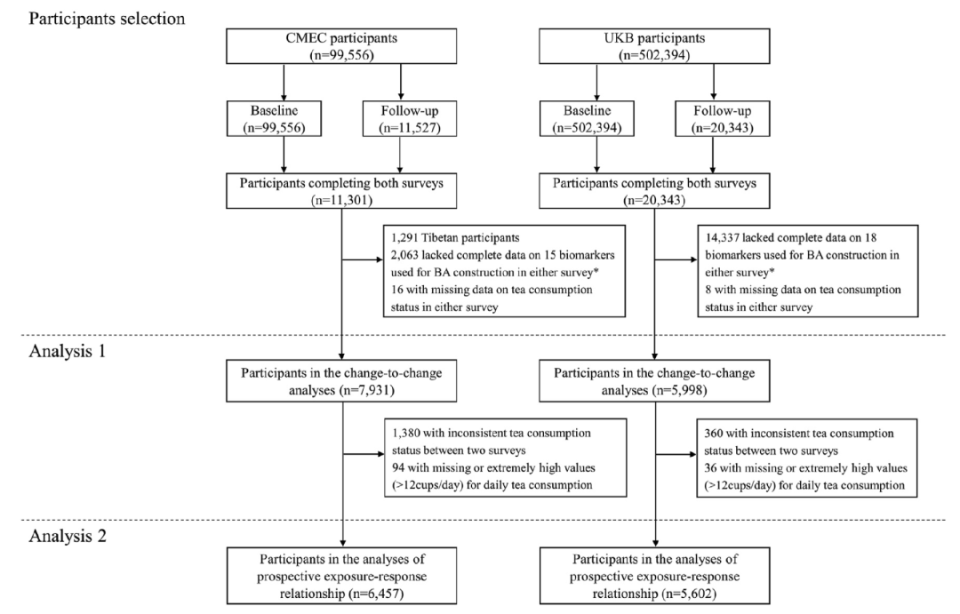
There are many kinds of bioactive substances in tea, and the most concerned one is "tea polyphenols". Previous studies have shown that tea polyphenols have antioxidant, anti-inflammatory, apoptosis inhibition and epigenetic changes, thereby delaying the occurrence of aging. At the same time, animal experiments have shown that flavonoid polyphenols rich in tea can prolong the lifespan of worms, fruit flies and mice. The anti-aging effect of drinking tea can also be extended to humans. A research team from the West China School of Public Health at Sichuan University found that moderate tea drinking can delay the growth of human biological age. Among them, drinking about 3 cups of tea a day, or 6-8g of tea, has a particularly obvious anti-aging effect. Considering the diversity of Chinese tea drinking, the study covers many types of tea, including green tea, scented tea, black tea, sweet tea, dark tea, oolong tea, yellow tea and white tea. According to different tea drinking frequencies, participants were divided into those who do not drink tea at present, 1-2 days/week, 3-5 days/week and almost every day; and the participants' daily tea drinking amount was calculated based on a standard cup of 200ml. The innovative point is that when Chinese people drink tea, the tea is often in bulk rather than in bags. Therefore, the researchers specifically measured the amount of tea (in grams) when collecting data.
The results show that compared with those who do not drink tea, participants who insist on drinking 2-3 cups of tea a day have the lowest KDM-BA acceleration. When the amount of tea was used as the exposure, drinking 6-8g of tea per day showed the strongest correlation, that is, the aging rate was the lowest at this time. What is the concept of KDM-BA acceleration? The multivariable adjustment model showed that the risk of death increased by 56% for every 1-year increase in KDM-BA acceleration. In addition, KDM-BA acceleration has a good performance in predicting most age-related diseases, such as cardiovascular disease, diabetes, and frailty.
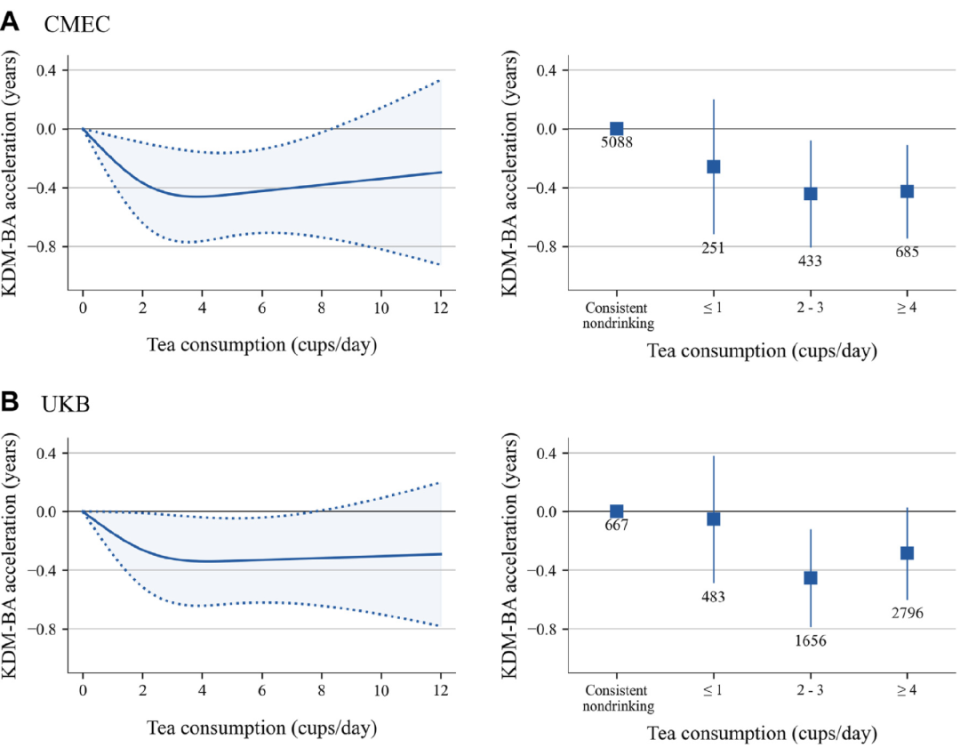
In summary, there is a close connection between tea drinking and the decrease in biological aging acceleration measured by KDM-BA - the dose-response relationship shows that drinking 3 cups of tea or 6-8g of tea per day can maximize the anti-aging benefits.
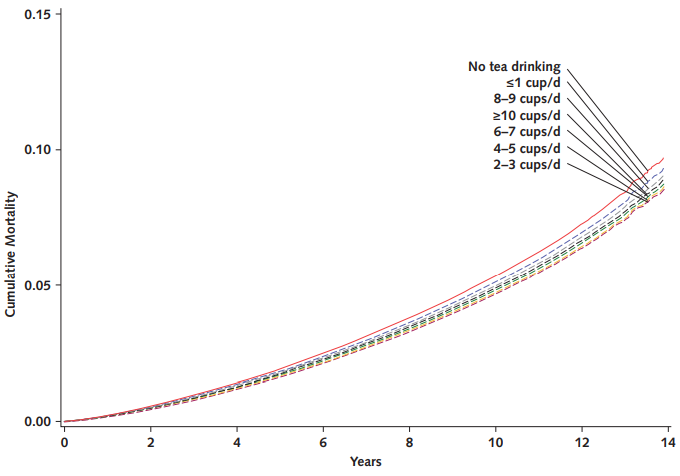
In China, there are many people who love to drink black tea. Previously, most of the research on tea focused on green tea. This fresh tea can bring many benefits to human health, including improving cognitive ability, reducing the risk of certain cancers, protecting cardiovascular function, etc. But how many health benefits can black tea, which has been obtained after a series of steps such as withering, rolling, fermentation, and baking, still retain? A large prospective study involving nearly 500,000 people conducted by researchers at the National Institutes of Health answered this question: drinking black tea does have health benefits! People who drink 2 or more cups of black tea a day have a 9-13% lower risk of all-cause mortality, with 2-3 cups a day having the greatest health benefits. Even adding milk or sugar to black tea will not offset this health benefit.
The risk-adjusted model shows that compared with those who do not drink black tea, even drinking less than 1 cup a day can reduce the risk of all-cause mortality by 5%. When the daily tea consumption reaches ≥2 cups, the effect of reducing the risk of death will be more obvious. Among them, drinking 2-3 cups of tea a day can maximize the "health cost-effectiveness" and significantly reduce the risk of all-cause mortality by 13%. In addition to the risk of all-cause mortality, compared with those who do not drink tea, drinking ≥2 cups of black tea a day has a reduced risk of cancer, all-cause cardiovascular disease, respiratory disease and other diseases.
However, what interests many young people more than drinking tea is: Can black tea with milk or sugar still retain its health benefits? The research team seemed to have heard the voice of the public (perhaps some researchers in the team are also milk tea lovers), and continued to explore the effects of black tea with milk or sugar on health. Among people who drink "milk tea", researchers observed a negative dose-response correlation between tea consumption and all-cause mortality risk. When the amount of black tea milk consumed was ≥2 cups, the risk of all-cause mortality of participants was significantly reduced by 10-22%. Sure enough, tea is healthy, milk is not bad, so why is milk tea not healthy? In fact, when controlling 2-3 cups of sugared black tea per day, the risk of all-cause mortality will be significantly reduced by 11%, but as the number of cups increases, the disadvantages of sugar will become apparent, affecting the health benefits brought by black tea.
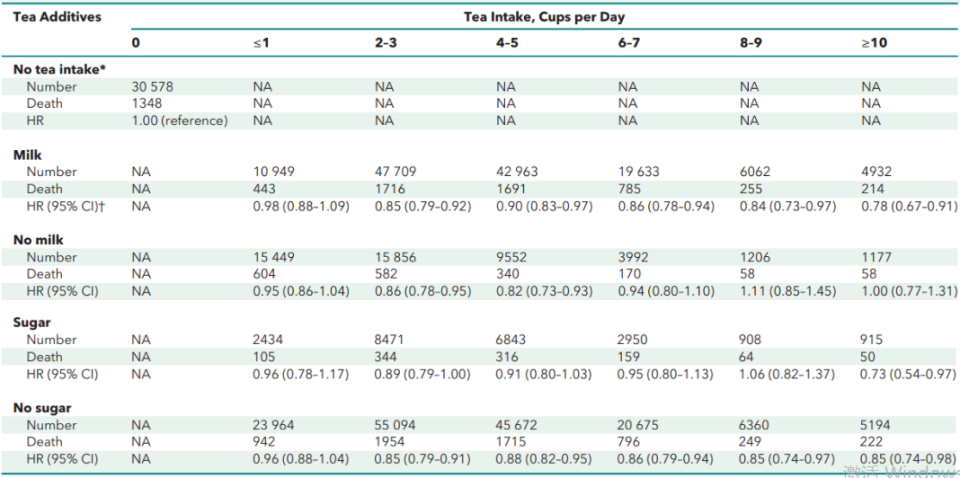
In summary, a large -scale forward -looking study with over 500,000 people and more than 11.2 years of follow -up shows that no matter whether milk or sugar is added or not, whether or not they drink coffee, the higher the amount of black tea drinks and the lower cause of death, and all causes all deaths. Cardiovascular disease, cancer, stroke and other diseases are related to the risk of death. The beginning of autumn has passed, is everyone drinking the first glass of milk in autumn? When you order milk tea next time, remember to order it this way: black tea+pure milk+sugarless!
Recently, I saw a "anger" cold knowledge -in the early 1960s, in order to increase productivity, they mixed caffeine into the feed of livestock. After eating the feed containing caffeine, the cattle became energetic. It is strong, and the land is even more laborious. Some netizens commented, "Niu and horse are tired to know the rest, and Niu Ma will give yourself a cup of coffee." "Is this why you call us a social animal?" The editor who is drinking coffee and writing an article) ... However, the coffee is drinking a lot of disease!
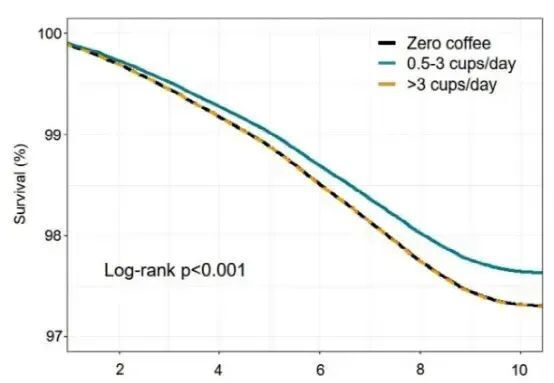
The research published in the "European Prevention of Cardiology" pointed out that drinking 0.5-3 cups of coffee every day is related to the decline in the mortality rate of 12%and the death rate of cardiovascular disease by 17%. Compared to people who do not drink coffee, people who drink coffee have better heart blood vessel health; but the benefits are caffeine -free coffee and grinding coffee, and it has nothing to do with instant coffee...
The analysis of the multi-variable COX ratio risk regression model shows that compared with people who do not drink coffee, people who drink 0.5-3 cups of coffee daily decreased by 12%due to death risk; Risk dropped by 21%. However, people who drink more than 3 cups of coffee a day compared to those who do not have coffee habits, the above aspects are not obvious. In other words, although drinking coffee is good for health, it is not a lot of goodness. 0.5-3 cups per day is the best dose for coffee.
Next, the highlights of this study came -researchers deliberately distinguished the impact of different types of coffee on health.
Of all the volunteers who drink coffee, 19.5%of them are used to drinking caffeine -free coffee, 23.3%of people are used to drinking coffee, and 55.1%of people are used to drinking instant coffee. After adjusting the mixed factor that may exist, the researchers found that compared with people who do not drink coffee:
People who drank 0.5-3 cups of decaf coffee a day had a 16% lower risk of all-cause mortality (P=0.001);
More than 3 cups of decaf coffee a day had a 17% lower risk of all-cause mortality (P=0.022);
0.5-3 cups of ground coffee a day had a 25% lower risk of all-cause mortality and a 25% lower risk of cardiovascular disease mortality (P<0.001);
Even more shockingly, more than 3 cups of ground coffee a day were associated with a 49% lower risk of cardiovascular disease mortality (P=0.008);
Compared with non-coffee drinkers, volunteers who drank decaf and ground coffee had improved multiple cardiac function parameters. Unfortunately, the researchers did not find evidence that long-term drinking of instant coffee can improve cardiovascular health.
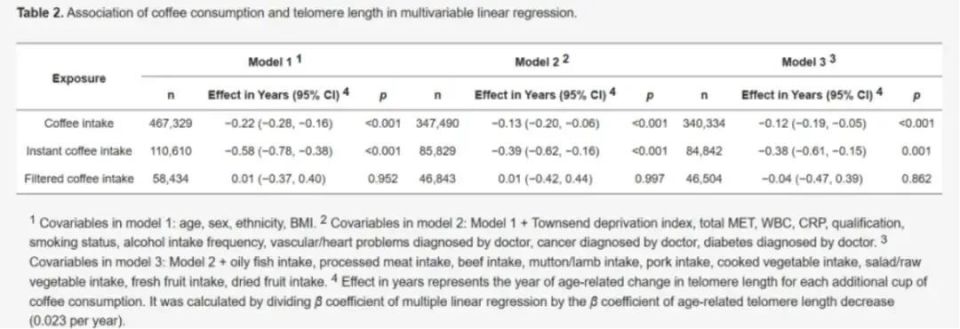
Even more "shocking" is that the previous study published by the Xi'an Jiaotong University research team in Nutrients strongly criticized instant coffee! Research has found that drinking instant coffee can actually shorten telomere length, leading to the occurrence and development of diseases, thus shortening one's lifespan!
Specifically, for every extra cup of instant coffee consumed, telomere length will decrease by 0.38 years with age, while there is no significant correlation between filtered coffee and telomere length.
The researchers explained that instant coffee contains more minerals (such as lead) than other types of coffee, and long-term drinking can lead to excessive lead; while the flavors and creamer additives added to the more popular commercial instant coffee are more likely to cause health risks.
How should workers drink coffee? In summary, drinking 0.5-3 cups of ground coffee per day is the best!
Long-term sitting has become the norm for contemporary people. As we all know, long-term sitting is the "gentlest chronic suicide". Sitting for more than 6 hours a day is associated with an increased risk of 12 non-communicable diseases.
But the good news is that the research team from Soochow University found an interesting phenomenon that drinking coffee can offset the harm caused by long-term sitting - the risk of death for those who sit for ≥6 hours a day and do not drink coffee is 1.58 times that of those who sit for <6 hours a day and drink coffee.
More interestingly, the association between long-term sitting and increased risk of death only exists in adults who do not drink coffee; that is, among people who do not drink coffee, the longer they sit, the higher the risk of all-cause death. But this association was not observed in people who love to drink coffee. To exaggerate, drinking coffee can make you "not afraid of sitting for a long time."
A comprehensive analysis of the relationship between coffee consumption and long-term sitting found that drinking coffee can offset the health damage caused by long-term sitting. Specifically, the association between long-term sitting and increased mortality only exists in adults who do not drink coffee; among people who are accustomed to drinking coffee (such as those who drink more than 540g of coffee per day), longer sitting does not increase the risk of death.
Of course, drinking coffee + reducing long-term sitting has greater health benefits. The multivariate Cox proportional model showed that the all-cause mortality rate of people who sat for ≥6 hours a day and did not drink coffee was significantly higher than that of coffee drinkers who sat for <6 hours a day, and the former was 1.58 times that of the latter.
The researchers speculated that the reason behind this is closely related to inflammation. Previous studies have shown that long-term sitting can impair glucose metabolism and increase inflammation levels, induce pro-inflammatory markers and reduce anti-inflammatory markers. For example, long-term sitting time is positively correlated with C-reactive protein levels, and increased C-reactive levels are positively correlated with adjusted all-cause mortality and cardiovascular disease mortality.
The "magic coffee" contains more than 1,000 compounds, the most common of which are naturally caffeine, chlorogenic acid, caffeic acid, cafestol and other polyphenols with anti-inflammatory properties. Unfiltered coffee contains cafestol and cafestol, which can reduce inflammatory responses to prevent multiple diseases; chlorogenic acid is another important compound that can regulate many important biochemical pathways related to inflammation...
Based on the above studies, tea has its own advantages, and coffee has its own advantages, and it is impossible to tell which is better. Based on multiple studies, the amount of tea and coffee consumed and health show an (inverted) U-shaped relationship, and moderate drinking has the highest cost-effectiveness. Of course, if you can't give up both, why not drink them together!