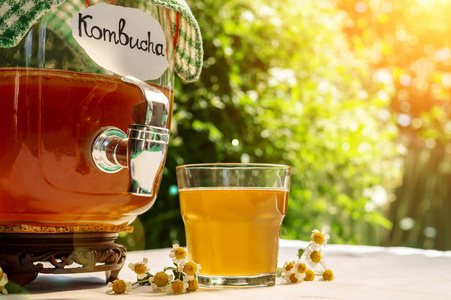
Kombucha, also known as tea fungus or mushroom tea, is a sweet carbonated beverage. It is made by adding bacteria and yeast to sugar and tea, and then fermenting the mixture. Recently, the new tea variety "Kombucha" has been very popular. It is advertised that it not only contains probiotics, can protect the intestines, and lower blood sugar, but also can "control oil" when drinking it before a big meal. Is this really the case? Should we follow this new trend of tea drinks?
Kombucha, in simple terms, is a tea drink made from black tea water, with a lot of white sugar or rock sugar, a small amount of fruit pieces, and bacteria strains added to allow it to ferment naturally. This tea drink, which became popular in the European and American celebrity circles, is said to have first appeared in the Qin Dynasty in my country. After spreading overseas, it has gone through many years and has finally been exported and sold domestically. Because of its unique taste and the "healthy tree" of tea drinks, it is called "healthy and happy water" by young people.
Since Kombucha is fermented with black tea as the base, is it healthier and more healthy than black tea?
First of all, from the perspective of probiotics, kombucha contains acetic acid bacteria, yeast and lactic acid bacteria, which is indeed better than black tea. However, it is difficult to determine the content and strain type of various species in different kombucha, and whether it can play a role in the intestine and to what extent are still unknown.
Some laboratory studies have found that kombucha has a certain antibacterial effect on Escherichia coli and Staphylococcus aureus. Some studies have also found that kombucha can indeed reduce oxidative stress and inflammatory response, regulate intestinal flora, and help reduce intestinal flora imbalance and control obesity caused by it, but most of them are animal experiments. Whether it can play a similar role in human intestinal flora, there is currently a lack of sufficient research results.
In addition, regarding the regulatory effect of probiotics on intestinal flora, it is also necessary to consider the situation that it is destroyed by digestive juices such as gastric acid after entering the gastrointestinal tract. In other words, it is difficult to say how many probiotics in kombucha can safely reach the human intestine and play a role.
Second, if the production of organic acids, amino acids, and polyphenols during the fermentation of kombucha is an advantage, then ordinary black tea also has the above ingredients. However, the fermentation process may increase the content of these ingredients.
Third, about the sugar content.
Ordinary black tea water does not contain sugar at all. In order to ensure the normal fermentation, the amount of white sugar or rock sugar (sugar is the food of fungi) added to kombucha is not small. The amount of white sugar given in some homemade kombucha recipes can reach 10% or more, and some pre-packaged kombucha on the market has a sugar content of more than 6% in the ingredient list.

Compared with sugary drinks such as cola, the sugar content of kombucha is not too high, but even so, drinking only one bottle of such kombucha a day (300 ml) will consume 19.5 grams of sugar, which is very close to the standard recommended in the "Dietary Guidelines for Chinese Residents" to "control the intake of free sugars to less than 25 grams per day". This is not good news for friends who really look forward to health and wellness.
Fourth, about the alcohol content.
Black tea does not contain alcohol, but the production of kombucha has to go through two fermentation processes. If the fermentation time happens to be at the stage where sugar is metabolized into alcohol by fungi, drinking kombucha at this time will ingest alcohol. Although the alcohol content is not high, about 3% to 5%, it is still a risk factor for pregnant women and children, and it is not recommended to drink it. If you want to drink non-alcoholic kombucha, you can buy commercially available kombucha marked "non-alcoholic", or appropriately extend the fermentation time of homemade kombucha (usually more than 2 weeks) to metabolize the alcohol more completely.
Fifth, about bacteria contamination.
In the process of homemade kombucha, if the container or raw materials are not ensured to be hygienic and the temperature is not controlled well, it is easy to introduce bacteria to cause contamination. Not only can the fermentation process not be completed smoothly, drinking kombucha contaminated by bacteria may also cause diarrhea, vomiting and other discomfort symptoms. It is recommended that you must strictly clean and disinfect the raw materials and containers during the fermentation process, and ensure that the storage environment is in good hygienic conditions and the temperature is suitable to avoid mold and deterioration.

Sixth, about fermentation gas production.
Although this has nothing to do with food safety, I still want to remind everyone that kombucha produces gas during fermentation, and if it is not stored properly, it is likely to explode. When homemade enzymes were popular, many people's enzyme bottles at home exploded, and now they are starting to explode kombucha bottles...
It's a small matter to blow up the kitchen, but if you accidentally get hurt, it's really not worth it.
Image source: Xiaohongshu
In general, kombucha is a drink that is more or less inferior to the best. Compared with sugar-free, alcohol-free, ready-to-drink, and non-contaminated beverages such as black tea and green tea, which contain polyphenol antioxidants, it seems less healthy; but compared with carbonated beverages such as cola, and high-sugar beverages such as iced black tea and rock sugar snow pear, it seems to be slightly better because of probiotics and low sugar content.
When you treat kombucha, you might as well remove the health filter first and treat it as an ordinary low-sugar beverage, just drink it occasionally. Don't place your hopes for health and wellness on this drink and ignore other actions to protect your health.
Beware of commercial traps! "No added sugar" does not mean sugar-free: residual fructose from fermentation often reaches 8-12g per bottle. Choose products with a total acidity ≥4g/L (pH ≤3.5), as acidity is negatively correlated with residual sugar.
Kombucha tea carries several risks, including mold and harmful bacteria contamination, excessive alcohol content, lead poisoning, and improper acidity control. Beginners are advised to strictly control fermentation time and pH, terminating the fermentation when the pH is <3.2. Use glass fermentation containers, disinfected with food-grade hypochlorous acid (200 ppm), and avoid using ingredients such as honey. Certain groups, such as pregnant women and those with weakened immune systems, should avoid home-brewed kombucha to ensure food safety.
Some "health drinks" often exaggerate the effects of certain ingredients when promoting them, focusing on a single ingredient or combination of ingredients and claiming that they have extraordinary therapeutic effects. Although it sounds convincing, there is actually a lack of reliable scientific evidence to support them.