A dated outlook should open a beverage planning record, not a stock-up order. The operational risk is not missing an El Niño headline; it is moving from a global probability to an irreversible inventory, packaging, route or claim decision without checking the regional exposure and the project facts that make the decision real.
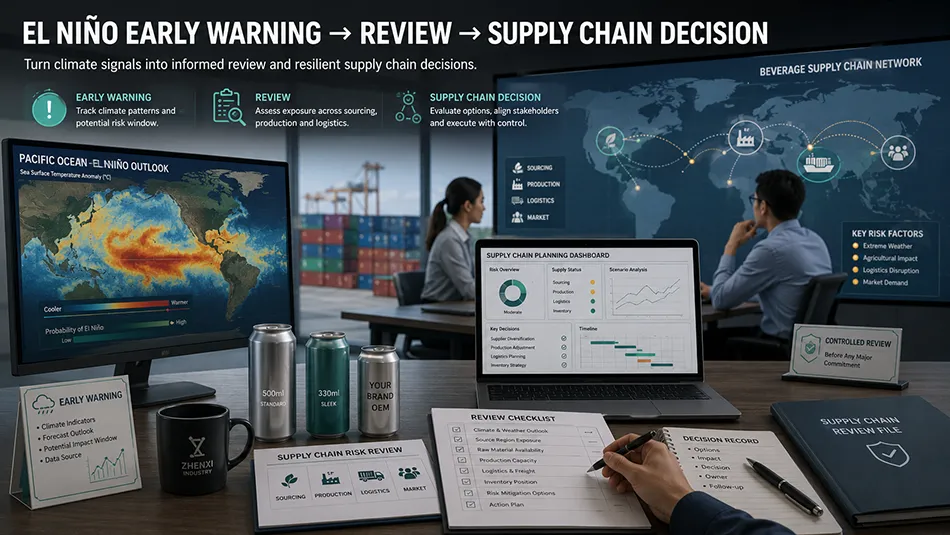
For supply-chain managers, importers and distributors, the useful response is deliberately narrow. Keep the official wording and date. Identify which market, route, input or launch is actually exposed. Then confirm the commercial inputs that are still unknown. That sequence supports preparation while avoiding a false promise that a seasonal signal can forecast one location, one shipment or one beverage outcome.
The record is most useful when it travels with the decision. A planning lead can open it after a current update, a logistics owner can add a route-specific question, and a commercial owner can name the next commitment date. If the evidence changes, the record changes with it. If the evidence is incomplete, the record makes that visible instead of allowing an old assumption to become an operational instruction.
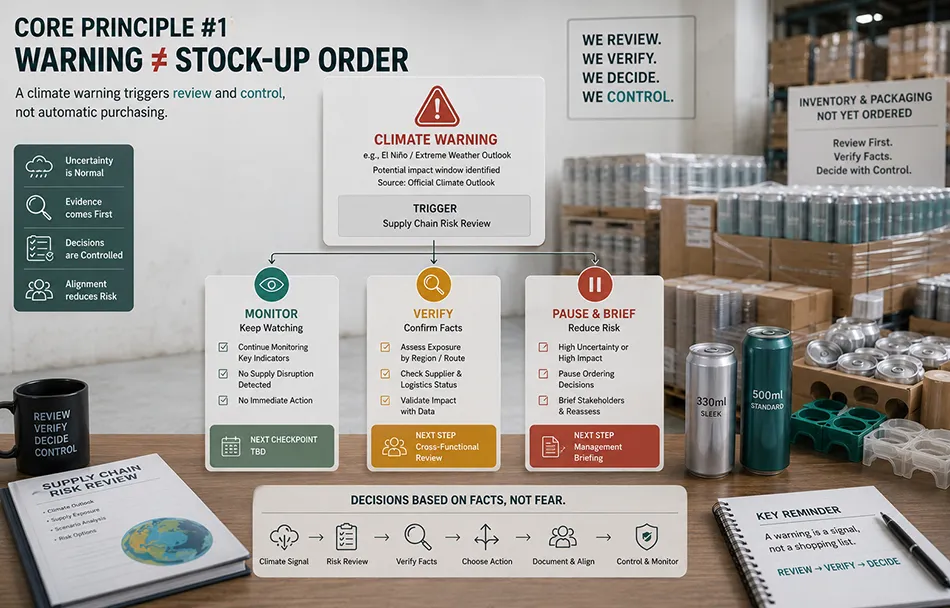
A warning should start a review, not a stock-up order.
Use this checklist when an official update becomes relevant to a market, a sourcing dependency or a launch calendar. It does not calculate a safe inventory level. It gives the team a common record so that the climate monitor, commercial planner, logistics owner and product lead are answering the same question: what is known, what is only possible, and what must be checked before a commitment is hard to reverse?
That distinction matters for regional hydration planning as well. A category team may review local demand context, heat exposure or communications risk, but it should not translate climate context into a beverage health, prevention or treatment claim. The public message and the procurement action need their own evidence.
Start by recording the decision that is actually on the calendar. It may be a packaging discussion, a route review, a product-brief deadline or a communications sign-off. Naming that decision gives the team a test for relevance: a climate source matters only when it helps determine which question must be answered before that specific decision becomes difficult to reverse.
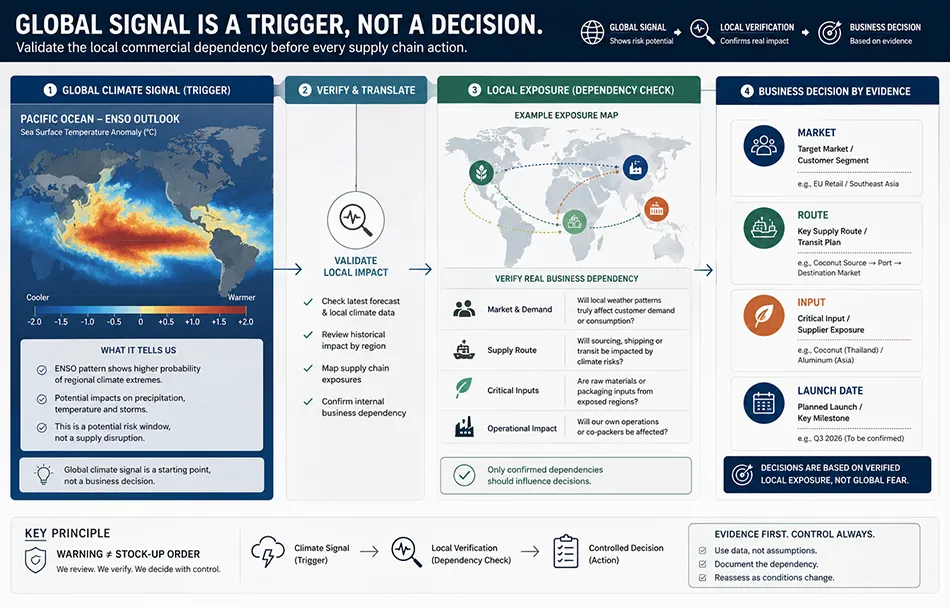
On 13 August 2026, NOAA's Climate Prediction Center said El Niño was strengthening and gave a greater than 90% chance of a very strong event during the Northern Hemisphere fall and winter of 2026-27. Read the CPC diagnostic discussion.
This is the right kind of input for a planning record because it is dated, probabilistic and explicit about its horizon. It is not an instruction to increase stock, change a packaging material or redirect a shipment. The commercial question begins only after the buyer connects that outlook to a real market, route, input or project deadline.
For a ZHENXI project, the same discipline keeps an early warning in its proper place: it can open a project review, but it cannot choose a beverage formula, packaging format, destination or quantity. Those remain project inputs that the buyer and supplier must confirm. The advantage is not certainty; it is a clearer sequence for deciding what to ask next.
WMO says El Niño impacts vary by event intensity, duration, development timing, interaction with other climate patterns and location; not all regions are affected. See WMO's June 2026 update.
ENSO is the Pacific Ocean and atmosphere pattern that includes El Niño, La Niña and neutral phases. A seasonal outlook is a dated, probability-based view of likely conditions over a future season. Neither term means a local weather forecast. A team should therefore preserve the authority, issue date, probability language and stated geography rather than rewrite the signal as a certain business result.
Use the authority's time horizon as written. A season-level probability does not identify the week when a port, crop area or consumer market may be affected, and it does not establish whether a buyer's dependency overlaps that area. Treat the official update as a trigger for a review agenda. The exposure record, not the headline, determines whether any local verification is needed.
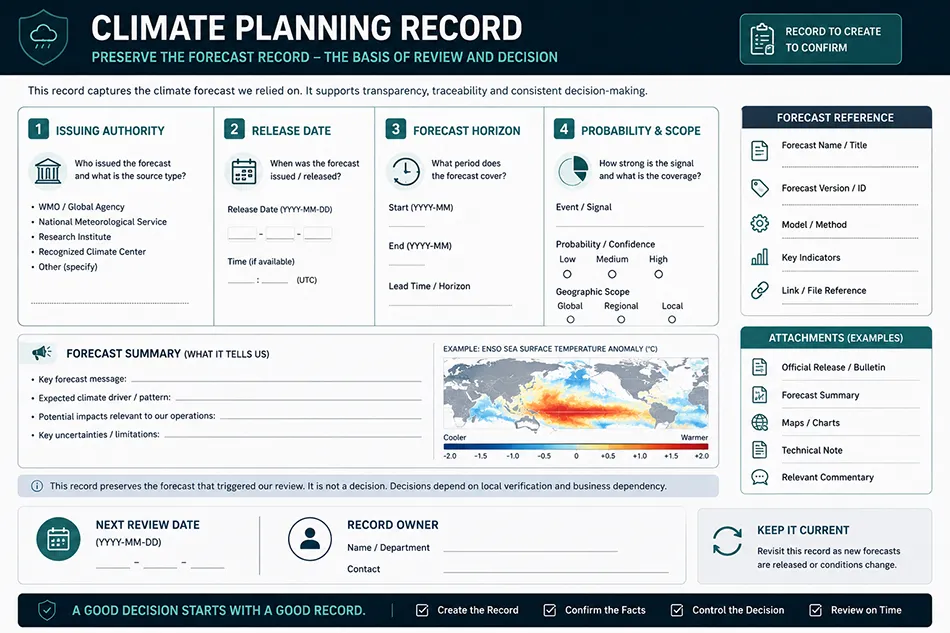
Keep the forecast record dated, scoped and verbatim enough to be checked later.
Use a one-page record with four fields: issuing authority, release date, horizon and the exact probability or scope wording. Add the next planned review date and name the person responsible for updating it. This small discipline stops a June outlook, an August update and an undated social-media summary from being treated as the same thing.
The record should also state what it cannot answer: local rainfall at a warehouse, road access on a specific route, availability of a given can format, or the commercial effect of a launch delay. Those questions belong in the exposure and project records. Keeping them separate protects the team from acting as if a global climate update already contains supplier or logistics proof.
Give each record a short decision label, such as monitor only, local verification open or project brief needed. The label is not a risk score. It is a reminder of the next permitted action. This makes the handoff easier when a team member changes, a new forecast is issued or a commercial deadline moves before the next regular planning meeting.
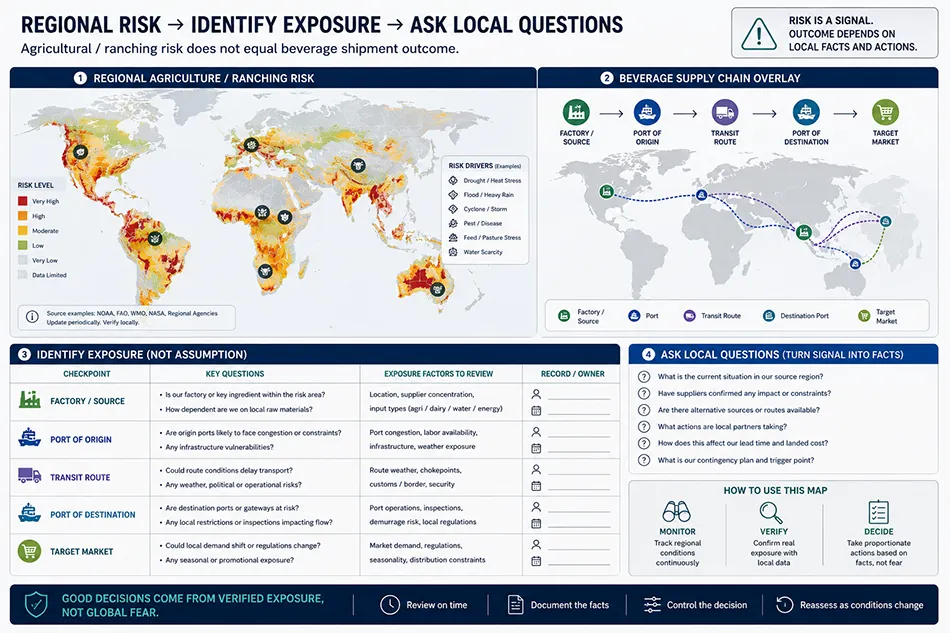
FAO reports that some agricultural and pastureland areas in named high-risk regions face more than a 50% chance of drought over the coming months. Review FAO's regional agriculture-risk analysis.
FAO's scope is important: it identifies agricultural and pastureland risk context, not a beverage shipment outcome. For a beverage buyer, that context can justify asking better questions where the target market, route, ingredient dependency or local operating environment overlaps a region that needs attention. It cannot establish that a plant will be short of water, a port will close or a finished product will be unavailable.
A regional risk map should prioritize local questions, not pronounce a commercial disruption.
Build the exposure record around named dependencies. Write the target market, origin or transit point; the relevant season; the person who owns local verification; and the source needed next, such as a national forecast, carrier notice, supplier confirmation or market-specific regulatory review. If no dependency can be named, keep the action at monitor. If one can be named, the correct action is verify—not assume.
Use a question format that makes the answer auditable. For example: “Does this named route have a carrier notice for the stated period?” or “Does this target market have a local condition that affects the planned launch window?” The record should capture the response date, the organisation that supplied it and any remaining uncertainty. It should not replace local evidence with a generic regional label.
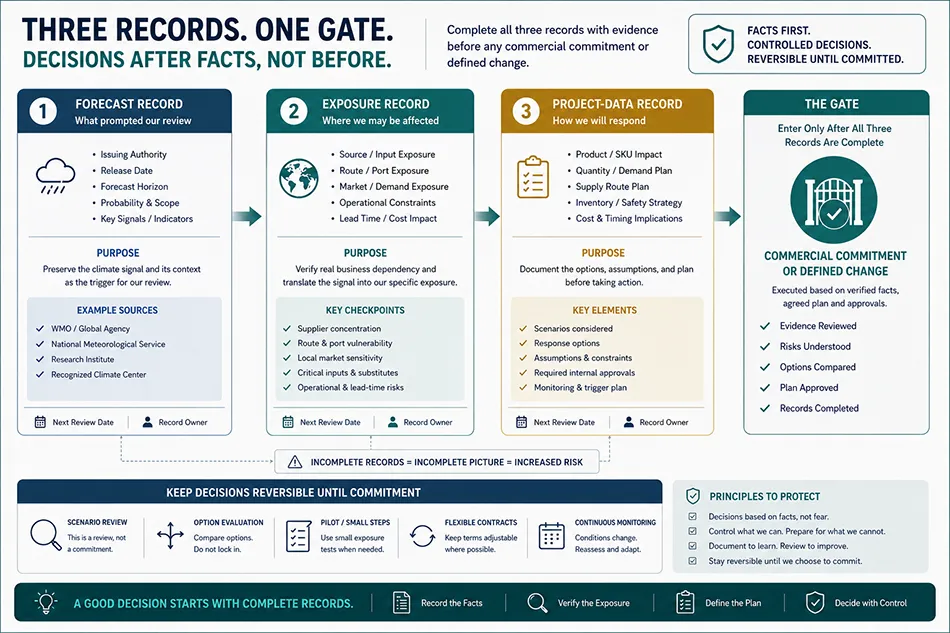
A commercial decision is reviewable only when a dated outlook, a regional exposure record and confirmed project data are present.
A reversible decision is an action that can be changed before commitment, money, inventory or customer claims are locked in. This is the useful boundary for an early-warning checklist. A team can schedule a review, ask for local information or prepare alternative questions while one of the records is incomplete. It should not treat that interim activity as approval to buy more stock, switch a pack, change a route or change customer-facing language.
| Record | What it must contain | What it allows | What it does not allow |
|---|---|---|---|
| Forecast record | Authority, issue date, horizon, probability wording and stated geography | Set a review cadence and keep the signal current | Declare a local disruption or a supplier failure |
| Exposure record | Named market, route, input or operating dependency plus a local verification owner | Prioritize questions and escalation | Estimate inventory, lead time or product availability |
| Project-data record | Confirmed category, packaging format, destination, estimated volume and launch timing | Assess a scoped commercial request | Promise feasibility, shelf life, capacity, MOQ or a health outcome |
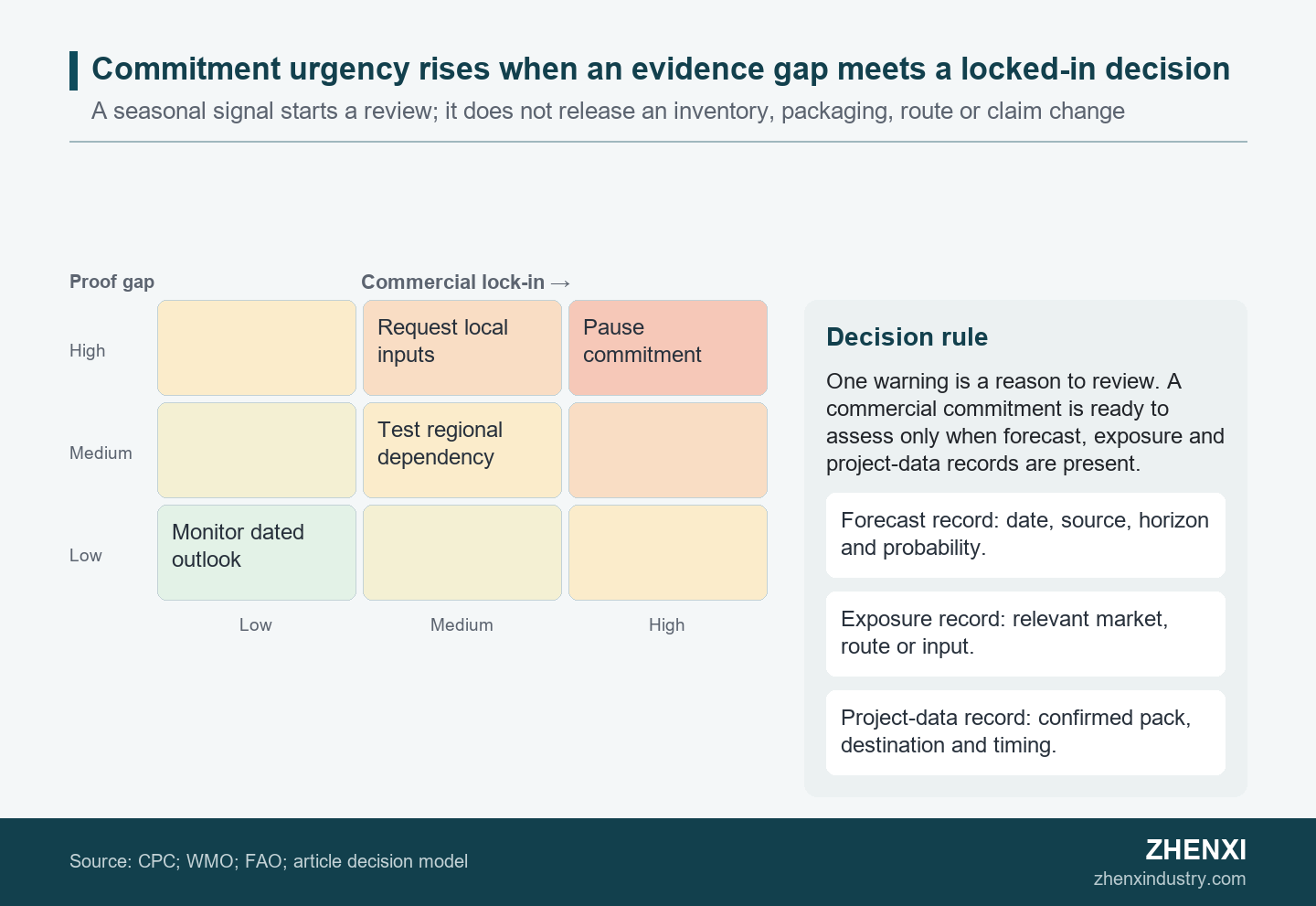
Based on this comparison, the missing record determines the next action. Missing forecast evidence means monitor. Missing local exposure evidence means verify. Missing project data means prepare a brief instead of committing. When all three records exist, the team can assess a defined change with the people who own the facts. That is a better use of an early warning than making a broad supply prediction.
The three records also create a clean escalation trail. The climate owner is accountable for currency and scope, the local or logistics owner is accountable for the exposure question, and the commercial owner is accountable for the project request. No one needs to convert a probability into a promise. The record simply shows which factual check is still open and which decisions must remain reversible until it is closed.
Before a buyer turns the third record into an OEM question, it can check Beverage OEM FAQs to clarify the public process information that is available. The checklist still needs project-specific confirmation for any material commercial decision.
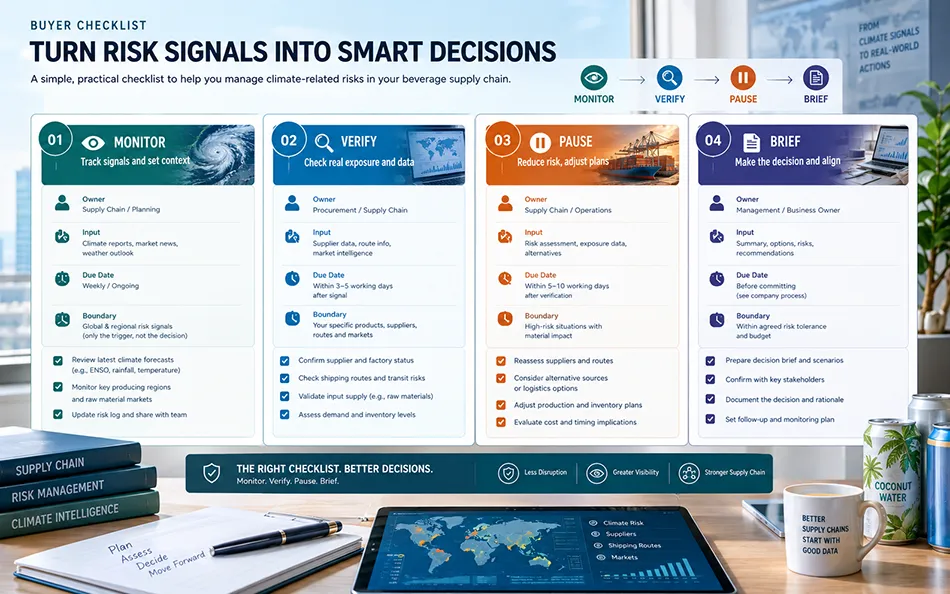
Every checklist action needs an owner, due date, input and boundary.
Use the following template as a working agenda, not as a fixed operating procedure. The owner may sit in planning, procurement, logistics, regulatory or product development, depending on the buyer's structure. The key is that the action names the missing input and the limit of the decision, so an update does not turn into an unsupported instruction.
Set the review cadence against the decision, not against a generic crisis calendar. A launch sign-off next month may need a near-term local check, while an exploratory category discussion may only need the next official outlook date. In both cases, write down what would change the action: a revised official update, a verified local condition, a confirmed project parameter or a decision date that moves closer.
| Action | Owner asks | Input to collect | Boundary to record |
|---|---|---|---|
| Monitor | Has the official outlook changed since the last review? | Current source, date, horizon and probability wording | No local outcome is assumed |
| Verify | Which named market, route or input could be exposed? | Local forecast, carrier notice, supplier update or market signal | Regional context is not proof of disruption |
| Pause | Which proposed change would be hard to reverse? | Decision date, commercial owner and missing record | No inventory, pack, route or claim change is approved yet |
| Brief | What product and destination facts are needed next? | Category, pack, destination, volume and launch timing | Specifications remain subject to confirmation |
| Close or refresh | What changed, and when will the record be reviewed again? | Decision log and next outlook date | The conclusion expires when its evidence changes |
That makes the category conversation useful only after the buyer has moved beyond a climate headline and identified a market and project scope. At that point, the category page can serve as a bridge while availability, specifications and commercial timing remain open for confirmation. It should never be used to infer a fixed configuration from an unverified seasonal risk scenario.
Keep the checklist and the category conversation separate on purpose. The checklist asks whether the buyer has enough current evidence to move forward. The category page helps frame a potential project only after that question has been narrowed to a defined market and direction. Neither one supplies local climate verification, and neither one substitutes for a confirmed brief.
Before opening a category conversation, use the record to test whether its purpose is clear. Is the buyer deciding between a monitor-only review and a defined project inquiry? Is the target market known? Is the relevant packaging question a confirmed project requirement or only a working assumption? Are there local route, label or timing issues that need evidence before a product discussion can be useful? Capture the answer to each question beside its owner and due date. This avoids a common failure mode: a broad climate update triggers a product inquiry, but the inquiry contains none of the market or timing details needed for a meaningful response. Once the project direction is defined, the buyer can review Energy Drink OEM options as a category bridge rather than a shortcut to an assumed specification.
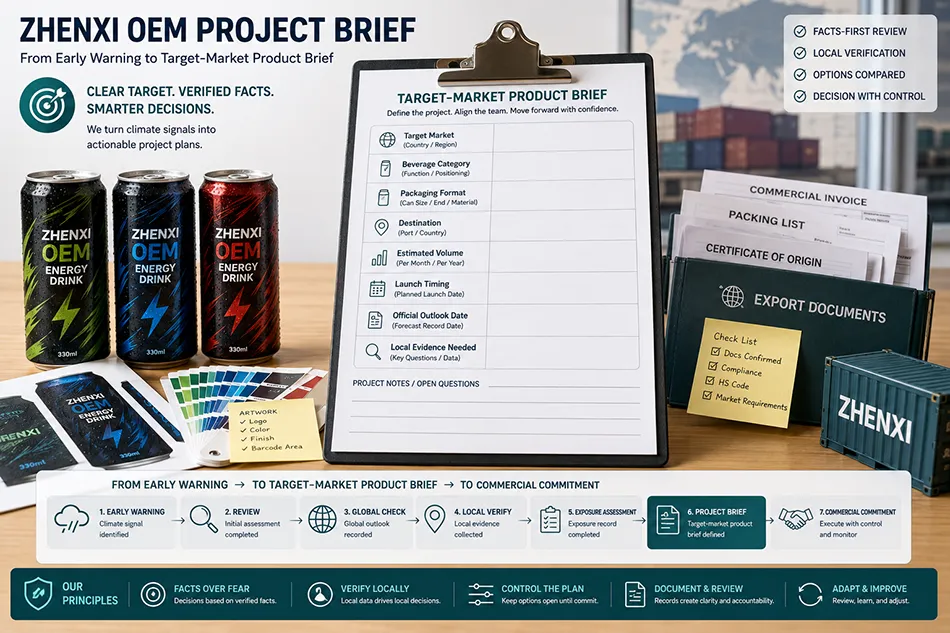
ZHENXI supports private-label energy-drink projects with formula, packaging, sampling and export coordination, subject to project confirmation.
Availability and specifications are confirmed by formula, packaging, quantity and destination. This keeps the buyer's ZHENXI project request scoped to confirmed inputs.
This boundary is practical rather than restrictive. It tells a buyer what to bring to the next conversation and stops a generic checklist from becoming a promise about lead time, MOQ, capacity, shelf life or packaging tolerance. For a climate-sensitive review, it also keeps the commercial discussion separate from public-health or hydration-outcome language.
Make the brief a concise decision document rather than a collection of guesses. State the target market first, then the product category and packaging format under consideration. Add the intended destination or route, the estimated volume, the desired launch timing and the date by which a decision is needed. If the earlier review identified a local issue, identify the local source that is still being checked instead of inserting a speculative disruption into the request.
A target-market brief should name the market, category, packaging format, route or destination, estimated volume and launch timing.
Add the current official outlook date, the local evidence still needed, and the decision date that cannot move. If the buyer is considering an Energy Drink project, include the desired category direction and any label or claim questions that need target-market review. Do not fill the gaps with assumed sizes, formulas, certifications or performance effects.
It is also useful to separate confirmed information from questions for the supplier. A confirmed fact might be the destination market or a planned launch month. An open question might concern package compatibility, documentation, route constraints or the feasibility of a particular configuration. This distinction helps both sides respond efficiently because it makes clear which items need evidence and which items are already part of the commercial brief.
If the review is still at the monitor stage, retain the draft internally and set the next review date. If it has reached the verify or pause stage, include the missing evidence owner and the deadline for returning that information. A brief is ready for supplier discussion when the buyer can describe the commercial context without converting the climate outlook into an assumed product specification or a fixed supply outcome.
When those inputs are ready, the buyer can send a target-market product brief to ZHENXI.
Refresh the record when the official outlook changes and before any decision that commits material inventory, packaging or route capacity. The practical cadence is therefore event-driven as well as monthly: a new official discussion, a new local forecast, a carrier notice or a revised launch date can all change the record. Preserve the previous date and conclusion so the team can see which evidence changed rather than quietly carrying a stale assumption forward. If no relevant dependency is active, a monthly review can remain a monitor-only check.
No, an El Niño outlook alone is not enough to justify a product-specific inventory change; it does not establish a local supply condition or supplier constraint. It can justify a review when the outlook is current and a real market, route or input may be exposed. Before a buyer changes inventory, it still needs the local exposure evidence and confirmed project data that define what is being bought, where it is going and how difficult the decision would be to reverse.
A usable brief names the target market, beverage category, packaging format, destination or route, estimated volume and launch timing. It should also identify the dated official outlook that opened the review, the local information still needed and the decision deadline. This is an information request, not an assumed specification sheet: final availability, product details and compliance wording still require confirmation for the selected formula, pack, quantity and destination. It should distinguish confirmed parameters from questions that need a supplier or local-market response.
No, regional planning should not turn a seasonal climate signal into a beverage health, prevention or treatment claim. A planning team may use a dated outlook to review category context, local conditions and communications risk. Any product-specific health or nutrition wording needs composition evidence and target-market regulatory review. The early-warning checklist exists to separate those questions, not to make an outcome claim from a climate pattern.


