A distributor facing an El Niño drought signal has a harder decision than adjusting stock: it must decide whether the signal points to a local commercial question at all, or to human and public-service priorities that a beverage business must not recast as a product opportunity. Drought can contribute to food insecurity through livelihoods, access, and existing vulnerability, but the path is neither automatic nor uniform. Responsible preparation therefore starts by separating local evidence, public responsibility, and a genuinely private-market project.
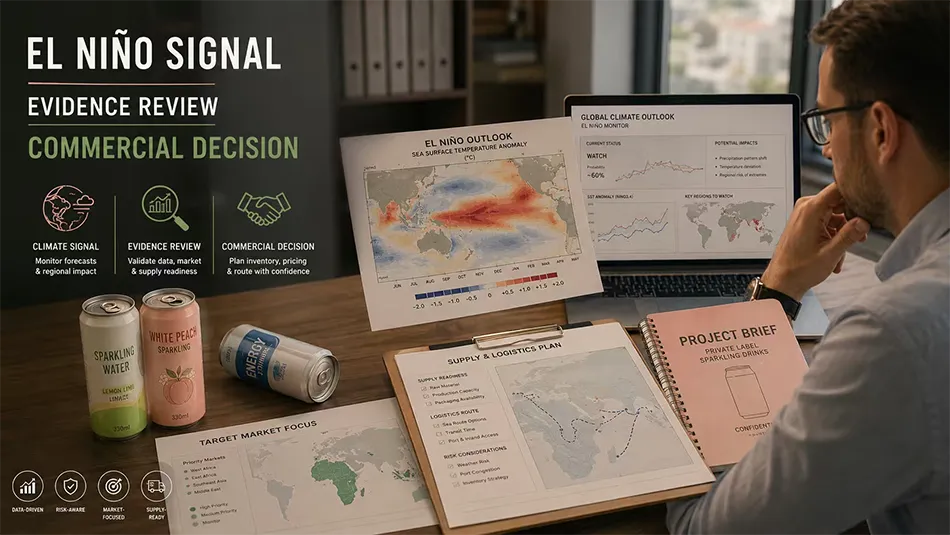
Treat an El Niño signal as a reason to review evidence, not as a reason to predict demand or present a beverage as relief. The first useful question is not “what will sell?” but “what evidence is current, who is affected, and which decisions belong to public authorities or humanitarian actors?” When no target country has been confirmed, a disciplined pause is more useful than a broad regional conclusion.
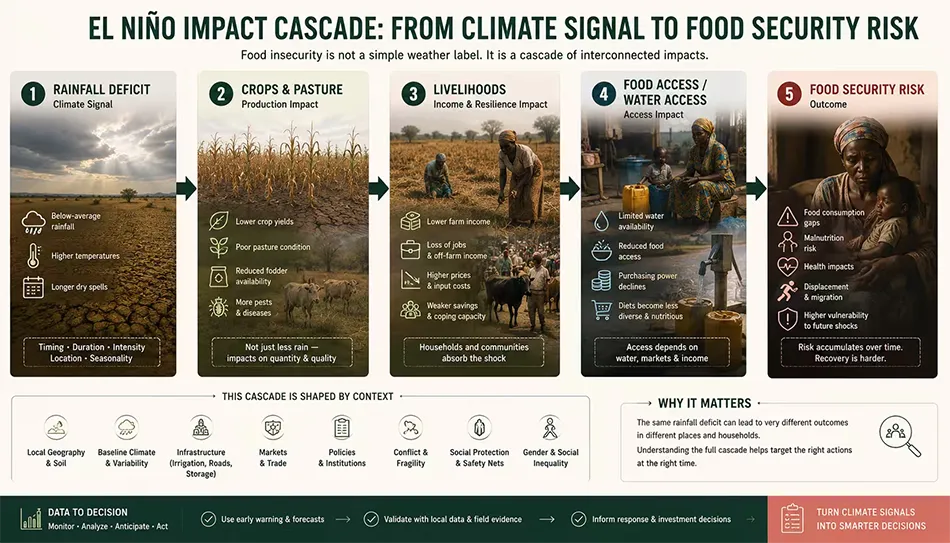
FAO's current map identifies specified agricultural and pastureland areas where drought probability can exceed 50 percent over the coming months. Its scope matters: a mapped agricultural probability is a reason to ask a local question, not a basis for labeling every market drought-affected or food insecure. Research from FAO maps agricultural exposure alongside the conditions that make impacts harder to absorb, which is why the map must stay attached to its stated geography and period.
Food-security risk is rarely about rainfall deficits alone. The relevant chain can include crop or pasture exposure, livestock and household livelihoods, water access, prices, conflict, public services, and a household's room to recover. According to FAO, early action works best when meteorological services, agriculture ministries, and local extension networks are connected. Acute food insecurity means a severe situation in which people cannot reliably meet basic food needs; it is a human condition assessed through much more than a weather event.
| What a drought signal may show | What still needs checking | What a distributor must not infer |
|---|---|---|
| Potential pressure on rain-fed crops or pasture | Which livelihoods, places, and seasons are exposed | That households will face the same outcome |
| Possible water-system or access pressure | Current public-service conditions and responsible authorities | That a beverage is a safe-water response |
| A reason to monitor a route or market | Actual operating constraints and a legitimate commercial use | Demand, availability, or relief claims |
Agricultural drought can affect crops, pasture, livestock, and household livelihoods before a food-security outcome is assessed. For example, lower crop output or pasture stress may reduce income, food production, or the ability to replace losses. According to FAO, agricultural risk becomes more consequential where rain-fed crops, livestock dependence, chronic hunger, conflict, or limited recovery margins are already present. That is a pathway to investigate, not a forecast for a household, a country, or a distribution route. The commercial implication is narrow: do not turn an early livelihood signal into a demand or inventory assumption.
Conflict, prices, access, and existing food insecurity can amplify drought-related risk, so one climate signal does not establish one country outcome. According to FAO, the effect of a rainfall deficit depends on the exposure and existing vulnerability around it, rather than on the deficit alone. A region with stronger services, different cropping patterns, or more household coping capacity may face a different situation from a neighboring region under a similar outlook. This is why a distributor should not use a global label to choose a market narrative, make a public-health statement, or attach humanitarian language to a product plan.
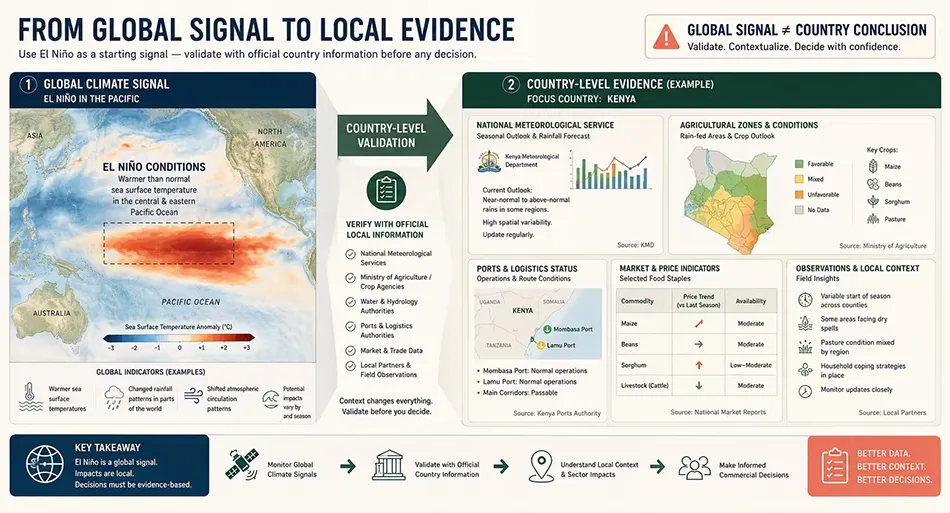
WMO says ENSO effects vary by intensity, duration, timing, other climate modes, and location, and that not all regions are affected. According to WMO, a seasonal signal must therefore be read with the event's timing, local climate drivers, and geographic context. ENSO, the El Niño–Southern Oscillation, is a Pacific climate pattern that can influence rainfall in many regions. Its value for a distributor is as a prompt to localize the question, not as a shortcut to a country conclusion.
WMO says National Meteorological and Hydrological Services and regional climate services issue regularly updated information for decision-making. According to WMO, these services and regional climate forums are the relevant route for updated information rather than a generic global summary. National Meteorological and Hydrological Services are public services that issue weather, climate, and water information for a country. Ask for the outlook relevant to the decision period, then identify the local authorities or humanitarian actors responsible for food, water, or emergency questions. For broader commercial context after that evidence hierarchy is clear, browse ZHENXI beverage resources; they do not replace official local information.
A useful country brief states what is known, the period covered, the source owner, and what remains unverified. It also records a stop condition: if the commercial team cannot distinguish a private-market use from a public-service or humanitarian need, it does not use that uncertainty to expand promotion. This record is intentionally modest. It does not score national risk, estimate the severity of hunger, or prescribe public action.
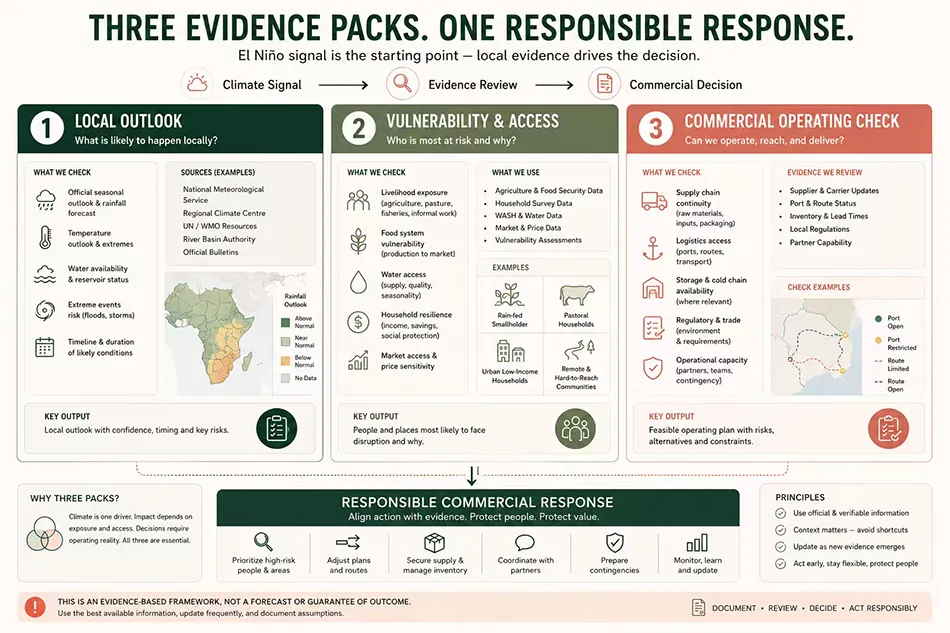
Before a private-market response is discussed, the distributor needs three separate evidence packets: a local outlook, a vulnerability-and-access check, and a commercial-operating check. The local outlook asks what conditions may develop. The vulnerability-and-access check asks whose livelihoods, food access, water access, and services are under pressure and who owns the response. The commercial-operating check asks whether there is a defined private-market use, lawful route, and confirmable project input. This separation prevents one climate signal from being asked to answer three unrelated questions. If any packet is missing, the correct action is to pause the product claim or project advance, not to fill the gap with a forecast headline.
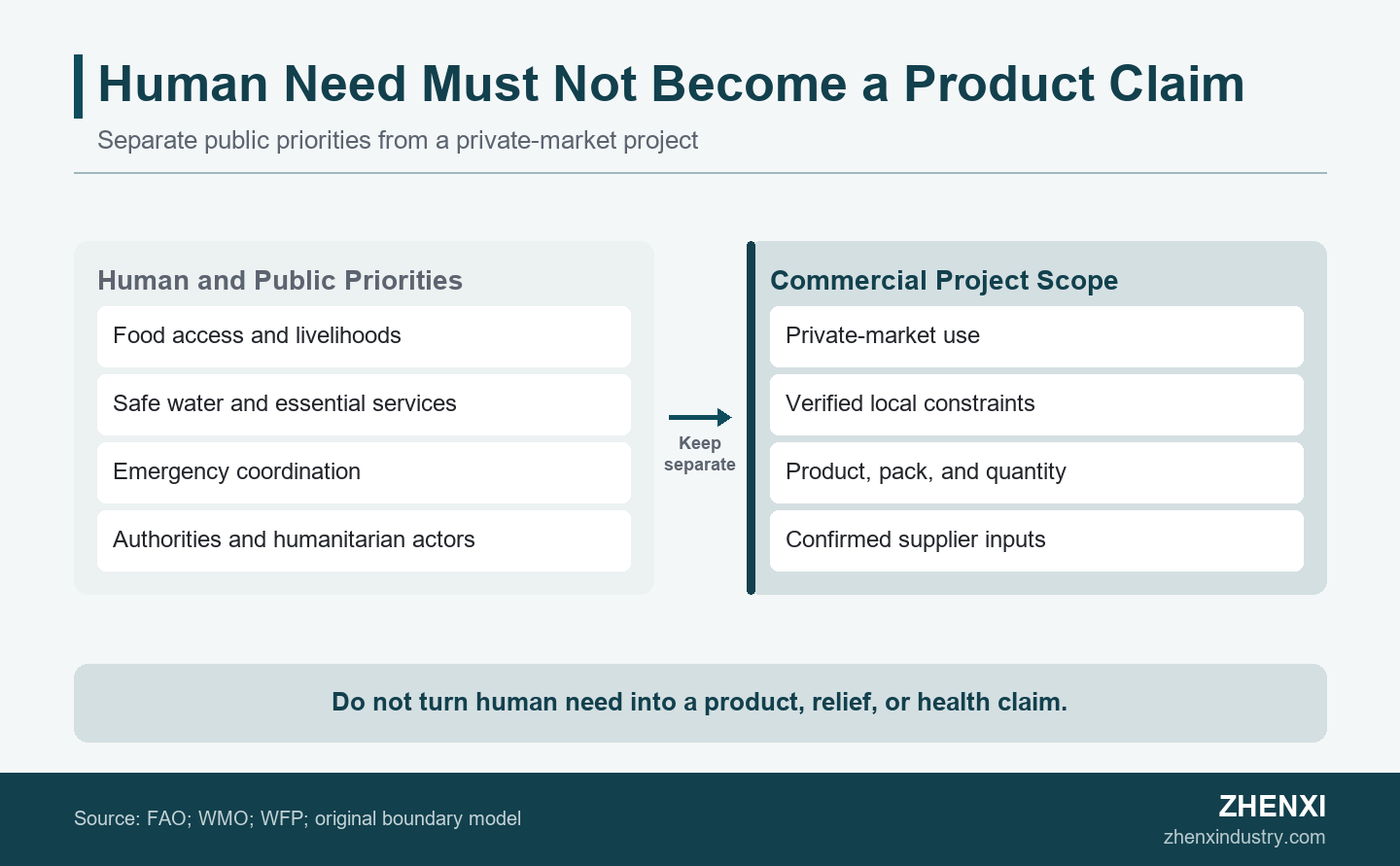
WFP's early 2026-27 analysis focuses on 45 already food-insecure countries and says the impacts will not be experienced uniformly. A report by WFP combines historical evidence, food-security baselines, risk factors, and expert judgement within that defined scope. Even a high-stakes model keeps its country scope, baseline, and method attached. A distributor should apply the same restraint: no global outlook should become a local demand forecast, a relief message, or an assurance about market availability.
An Energy Drink OEM conversation can address confirmed project inputs; it cannot be presented as a food-security, public-water, or health intervention. Once the three packets are distinct and a private-market use is clear, a buyer may review Energy Drink OEM options for that narrower project question. ZHENXI's role begins with confirmed commercial inputs, not with an assertion that its products resolve a drought-related human need.
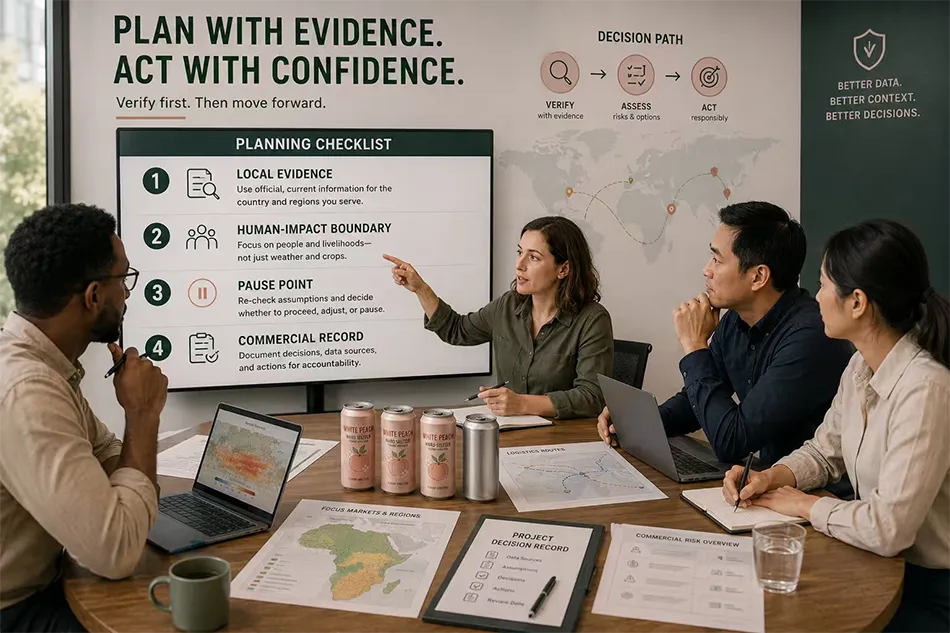
A responsible review names the evidence source, owner, pause point, and communication boundary before a plan changes. This creates a record that a distributor can revisit when a forecast changes, a market is selected, or a commercial conversation becomes more specific. It is not an emergency plan and should not be presented as one.
In this context, anticipatory action means steps taken before a forecast hazard becomes a larger loss. For a distributor, that can mean collecting evidence, clarifying ownership, and withholding unsuitable claims. It does not mean taking over humanitarian coordination, determining who needs aid, or using a consumer product as a substitute for public water or nutrition services.
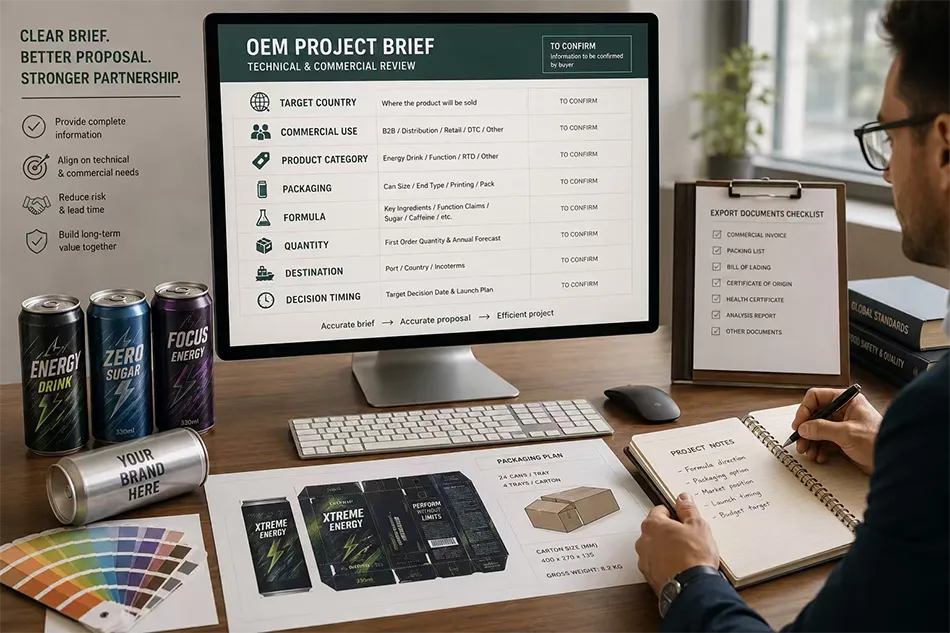
ZHENXI supports private-label energy-drink projects with formula, packaging, sampling, and export coordination, subject to project confirmation. That is a supplier-project scope, not a drought-response offer. A buyer who has already separated its evidence packets can assess those project inputs against the defined commercial use and local constraints.
A project brief is appropriate only for confirmable commercial inputs; it does not replace humanitarian, safe-water, public-health, or country-risk decisions. It should name the target country, commercial use, product category, formula or packaging questions, quantity, destination, decision timing, and the remaining constraints to confirm. It should not imply that a supplier has assessed local needs, set a humanitarian priority, or guaranteed an operating outcome.
Keep the brief auditable by separating confirmed inputs from open questions. Confirmed inputs may include the product category, intended private-market use, target destination, preliminary packaging direction, and a quantity range. Open questions may include local labeling, import requirements, formula suitability, route conditions, or timing. Those open questions should remain questions; they are not a license to claim availability, performance, public benefit, or a response to drought-related hardship.
Assign one commercial owner to the brief and one reviewer to the human-impact boundary. The commercial owner can request project-specific confirmation. The boundary reviewer checks that the language does not borrow terms such as relief, hunger reduction, safe-water supply, or health outcome. This two-owner record helps a team change course when a local outlook, public notice, or access condition makes the private-market context unclear. It also prevents a supplier discussion from becoming an unofficial assessment of food insecurity.
When the question is how an OEM discussion usually proceeds, buyers can check Beverage OEM FAQs while keeping the human-impact assessment with competent local actors. This separation is practical as well as ethical: it keeps a supplier conversation focused on information that can be confirmed rather than inviting it to answer questions outside its authority.
Before a handoff, check whether the destination is stated, the buyer's commercial use is specific, and the product request is separated from any public-service or humanitarian question. Record which specification questions need confirmation and which responsible local organization owns any food, water, health, or emergency matter. A clear “not in scope” note protects both the buyer and supplier from turning a lack of local evidence into a confident claim.
Then check the wording that may travel with the project. A sales sheet, route note, or buyer message should not imply that a beverage solves hunger, restores water access, or reduces a health impact. It should also avoid forecast-based statements about demand, distribution continuity, or product availability. Those limits are not a loss of relevance; they make the project brief more credible because each statement stays tied to an input that a commercial party can actually confirm.
If a clearly private-market project remains after those checks, ZHENXI can review the stated inputs and confirm what is project-specific. For an evidence-led handoff, send a responsible beverage project brief with the country, commercial use, product questions, quantity, destination, decision timing, and any constraints requiring confirmation.
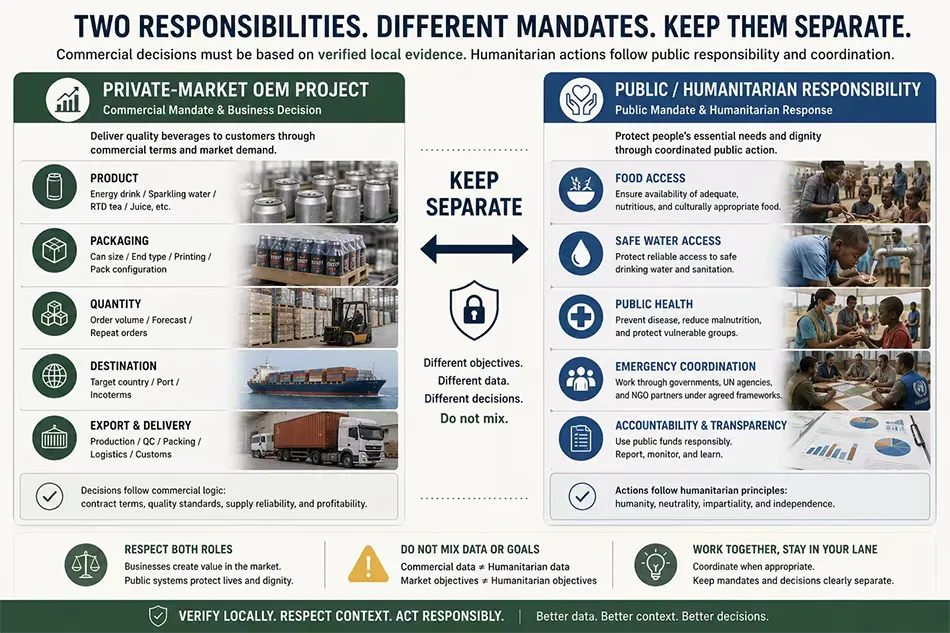
No. El Niño can change drought and rainfall risk, but food insecurity depends on local exposure, livelihoods, conflict, prices, services, and coping capacity. A seasonal signal can justify monitoring, but it cannot establish the outcome in every country or community. Use a current local outlook and locally relevant vulnerability information before changing a distribution assumption or communicating about human impacts.
No. A drought outlook alone does not establish a beverage demand, availability, or relief conclusion. It may reveal a reason to ask more questions, but it does not establish a commercial result or a route-performance prediction. Keep demand, stock, route, and supplier statements tied to confirmed market evidence and a defined private-market project.
Start with a current local outlook, then check who is exposed and whether public water, access, or humanitarian priorities create a boundary for commercial activity. Next, verify whether there is a legitimate private-market use and confirmable operating information. If the evidence points to a public or humanitarian need, hand that question to the appropriate competent actors rather than adding it to a product discussion.
Name the target country, commercial use, product category, packaging or formula questions, quantity, destination, decision timing, and any local constraints requiring confirmation. Describe what the supplier must confirm, not what the product is assumed to solve. A responsible brief leaves food security, safe water, public health, emergency coordination, and country-risk assessment with the actors qualified to address them.


