Heat, drought and flood stories become unreliable when a broad climate signal is promoted into a verdict about one place and one event. A useful risk context can tell readers which conditions may be more likely or more severe; it cannot replace event-specific evidence about what happened locally. For brand content leads and compliance reviewers, the practical task is to keep those two jobs separate: explain the climate context clearly, then state exactly what the available evidence does and does not establish.
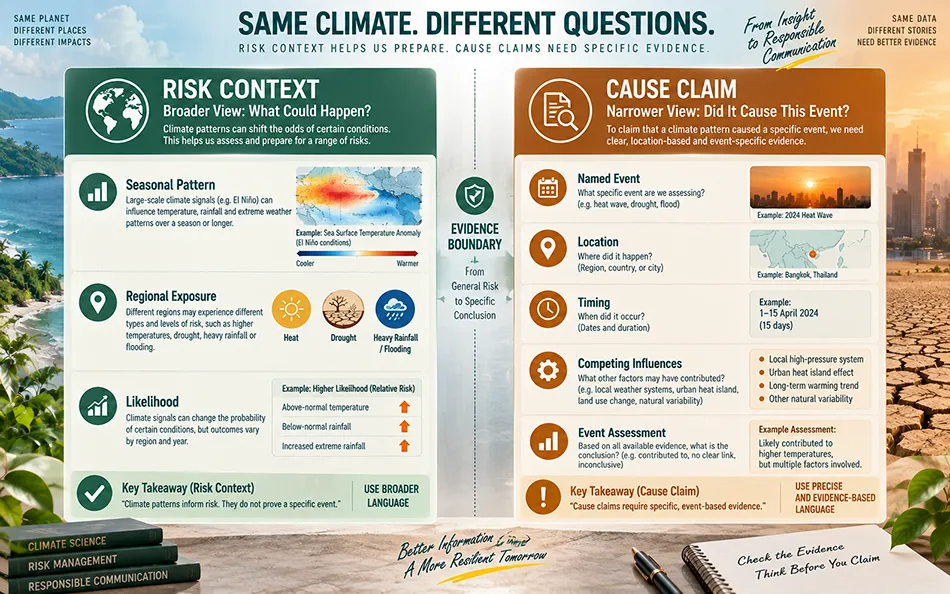
The most misleading climate sentence is often a true pattern used as if it proved the cause of one local event. That move can sound confident because the pattern itself may be real, while still giving the reader a conclusion the evidence cannot carry. Treat a climate reference as a scoped explanation of risk unless a separate, event-specific analysis supports stronger language.
The distinction is especially useful when copy passes through several hands. A market researcher may intend a seasonal observation, a headline writer may shorten it to a causal phrase, and a product team may then reuse that phrase beside a consumer message. Keeping the evidence level in the original brief makes the allowable wording visible at each handoff.
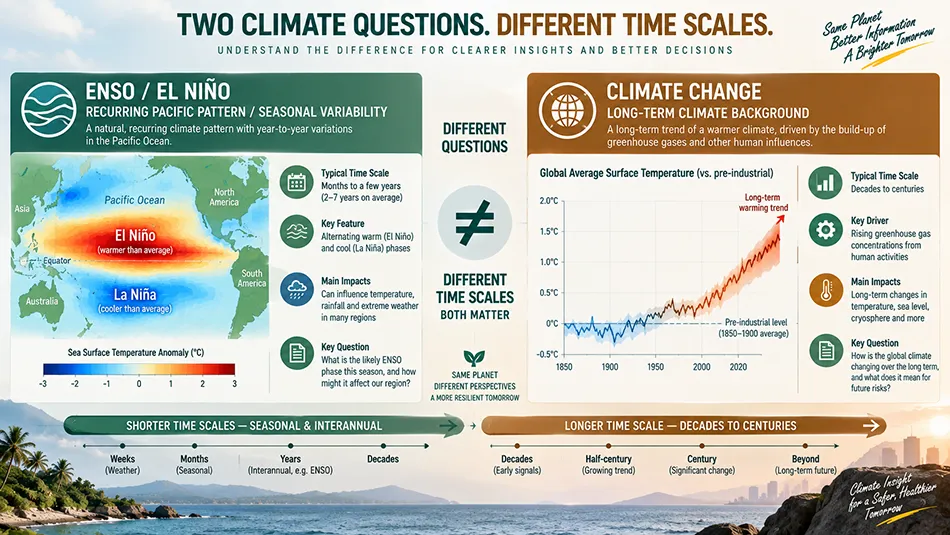
ENSO is a naturally occurring ocean-atmosphere pattern with El Niño, La Niña and neutral phases. In practical terms, ENSO is the recurring tropical Pacific ocean-atmosphere pattern that includes El Niño, La Niña and neutral conditions. It is a source of climate variability, so it can provide a seasonal context without being a synonym for long-term warming.
That boundary matters most when a sentence turns a real warming trend into an explanation for the existence of El Niño itself. WMO says there is no evidence that climate change increases the frequency or intensity of El Niño events. A reviewer can therefore remove any wording that presents El Niño as a direct product of climate change before the claim reaches a public page.
This does not require a false choice between the two ideas. It requires a sentence that assigns each one the right job: ENSO for a variable Pacific pattern, and climate change for the longer-term conditions that may alter associated impacts. The reader can then see the mechanism without being asked to accept an unsupported causal chain.
A pattern statement asks whether conditions can shift odds over a season, while a climate-change statement asks how the long-term background has changed. The first can frame a near-term risk conversation; the second can explain why the environmental setting is different from an earlier baseline. Neither question, on its own, identifies why one town had a specific flood or why one week was exceptionally hot.
| Question for the reviewer | El Niño / ENSO context | Climate-change context |
|---|---|---|
| What is being described? | A recurring Pacific pattern and its possible seasonal effects. | A long-term change in the climate background. |
| What wording fits? | May influence regional conditions or shift seasonal odds. | May alter the background in which weather develops. |
| What wording does not follow? | It caused this named local event. | It caused this named local event without an event study. |
A statement about increased likelihood is not the same as a statement that one event was caused by El Niño or climate change. “Conditions may raise heat risk in this season” has a different evidentiary burden from “El Niño caused this heatwave.” The first sentence identifies a bounded possibility; the second claims a causal finding. When the evidence is broad, keep the verb broad: may influence, can contribute to risk or is consistent with are more defensible than a single-cause verdict. A useful editing check is to ask whether the sentence names an observed event, a location and a basis for ruling out other influences. If it does not, remove the causal verb before publication.
Climate change can amplify associated impacts because a warmer ocean and atmosphere add energy and moisture to heatwaves and heavy rainfall. This gives writers a mechanism for discussing both signals in the same story: one describes a shifting pattern, while the other can change the energy and moisture available within the wider climate setting. It does not collapse those influences into one cause.
Each El Niño event is unique, and its effects depend on its evolution, spatial pattern and interaction with other climate drivers. Regional variability is therefore part of the explanation, not a disclaimer added after the claim. A teleconnection is a recurring statistical link between Pacific conditions and weather patterns in a distant region; it can guide a question about risk, but it is not a local forecast or an attribution finding.
A claims-safe sentence names the mechanism and the scope together. For example: “Pacific conditions may form part of the seasonal risk context for this market, while local weather, infrastructure, exposure and timing still determine the event experienced there.” That construction keeps event-specific evidence visible instead of hiding it behind a global label. Company information can establish who is publishing or supplying a category, but it cannot turn a business page into climate proof. For provider identity, review ZHENXI's public company information.
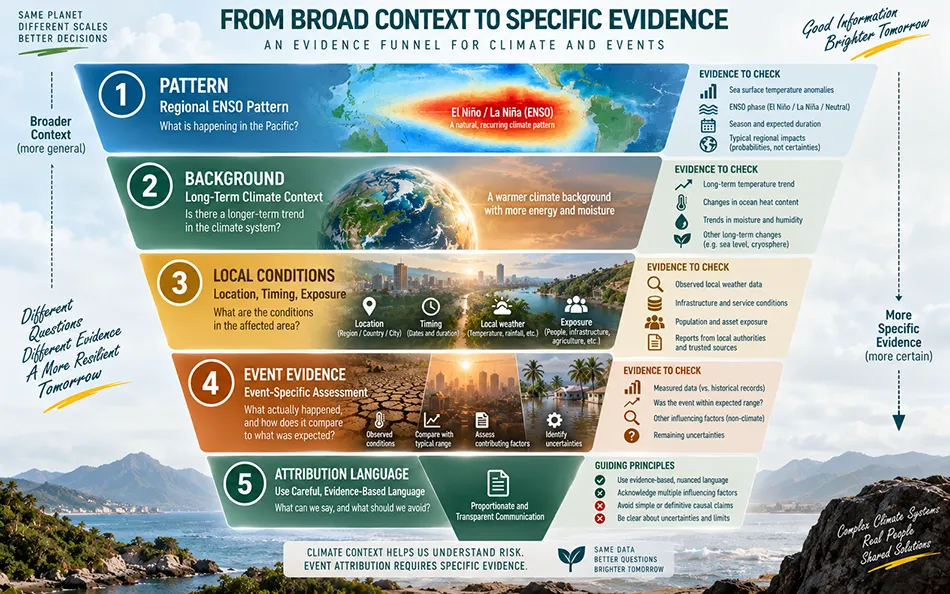
A claims review should separate pattern, background trend, local conditions and event-specific evidence before publishing an attribution. The test does not perform climate science; it shows the writer which missing evidence prevents a broad context statement from becoming a cause claim. If the last two questions cannot be answered, publish a narrower risk statement or hold the sentence.
The outcome should be recorded as a language decision, not a scientific score. If only the pattern and background are available, approve a scoped context sentence. If local conditions are documented but no event assessment exists, describe the observed impact and retain uncertainty. If an event study addresses the specific occurrence, a reviewer may assess whether its conclusions support more precise attribution wording.
For a practical review, copy the proposed sentence into the record and underline every causal verb: caused, triggered, led to or made inevitable. Then match each verb to one of the four evidence classes. A verb with no matching local or event evidence should be replaced with a statement about conditions, likelihood or observed facts.
Pattern and background evidence can set a risk context, but they do not identify the cause of a local event. These first two questions support a bounded introduction such as “the season has a climate signal worth monitoring” or “warming may influence the broader conditions in which heat develops.” They do not authorize a local verdict, because neither statement yet identifies the actual location, event window, observed conditions or alternative influences.
For a drought-risk page, that distinction keeps a regional El Niño drought risk separate from a claim that a named watershed’s shortage had one cause. For a heat story, it keeps a warming background separate from the evidence needed to explain a particular heatwave. The useful editorial outcome is not weaker communication; it is a sentence that tells the reader exactly how far the evidence reaches.
Use the title, image caption and social copy as the same claim surface. A careful body paragraph cannot repair a headline that says an event was “caused by” one signal. When the broader context is the useful fact, write the context in the headline and reserve stronger causal language for a source that has examined the actual event.
A single flood, drought or heatwave should not be attributed to El Niño without event-specific evidence. Event attribution is an evidence-based assessment of how different influences affected a particular event that has been observed. It asks a more demanding question than whether a pattern was present: what can be concluded about this event, in this location, against other plausible influences?
This restraint also matters when climate language is placed beside health or consumer messaging. WHO says observed associations between ENSO and health impacts are not linear or unequivocal. A seasonal pattern is not a shortcut to a health outcome, and it does not create evidence for a product effect.
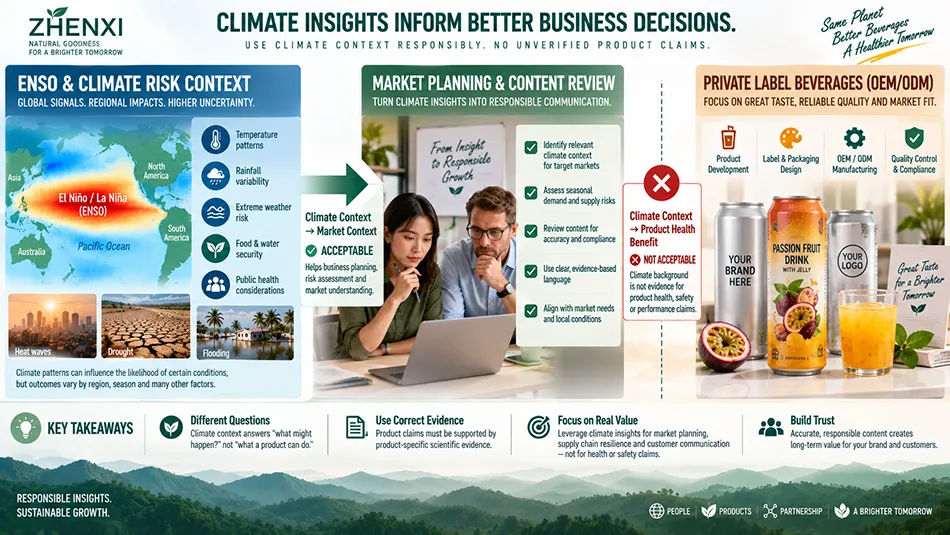
A climate risk narrative does not establish that a beverage prevents, treats or solves a heat, drought, flood or disease risk. Climate context may be relevant to a market calendar, a campaign review or a responsible discussion of conditions. It is not product-specific evidence, and it should never be used to imply a health, safety or performance outcome for a drink.
Keep three review tracks separate. First, verify the climate statement and its geographic scope. Second, decide whether the commercial message is merely contextual or makes a claim about the beverage. Third, subject any product claim to the evidence and target-market legal review it requires. That order prevents a topical climate reference from lending borrowed authority to a product statement.
For example, a calendar note about hotter conditions or disrupted local operations may belong in an internal market brief if its scope is documented. A public message that says a drink protects people from those conditions is a different proposition entirely. It needs evidence about the product, the promised effect and the market in which the statement will appear; climate reporting cannot supply those missing elements.
For ZHENXI, a product-category conversation can begin only after this wording boundary is clear. A team that has settled its market context can review Energy Drink OEM options as a category discussion, while keeping formulation, label, health and performance claims in their own evidence and compliance workflow. The category link is not a promise that any beverage resolves climate-linked risk.
This separation also helps teams keep regional logistics or demand planning from becoming consumer-facing efficacy language. A business may decide to monitor heat, rainfall or water stress as part of its operating context. That internal decision does not entitle marketing copy to suggest that a drink changes the weather-related outcome for the person who consumes it.
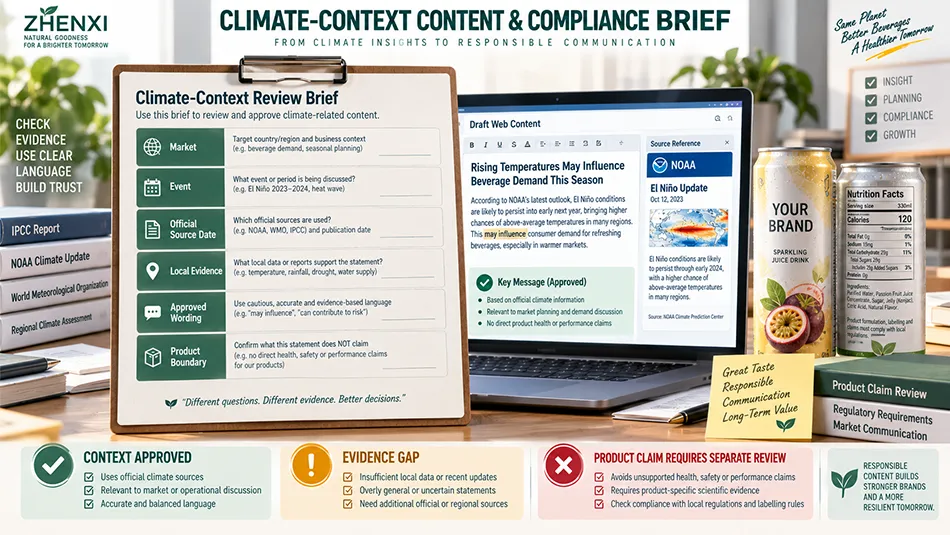
A compact review record should name the market, event, official source date, local evidence, proposed wording and product-claim boundary. It gives the content lead and compliance reviewer one shared record of what is known, what is inferred and what must be removed or softened. The record can be brief, but it should stay with the copy until publication.
This small handoff is more useful than a generic “climate checked” label because it can be updated when new official information or local evidence appears. It also leaves a clear reason for rejecting an overly broad sentence, rather than asking a later reviewer to reconstruct a decision from memory. For current published context, read the current ENSO monitoring guides.
No, current WMO wording does not show that a warmer climate increases the frequency or intensity of El Niño events. Climate change can still matter when discussing the wider conditions in which associated impacts occur, but that is different from saying it causes El Niño. Keep the two ideas in separate sentences when the source scope is different.
No, an El Niño headline identifies a possible climate pattern, not the local observations and event-specific assessment required for causation. A causal statement needs evidence about the named event, its place and timing, and other influences that may have shaped it. Without that record, use a risk-context statement rather than a cause claim.
El Niño may shift seasonal weather patterns, while warming changes the background in which those patterns and their impacts develop. Both may be relevant to the story’s mechanism, yet neither label alone explains a particular local heat event. The wording should make that scope clear.
Remove any claim that a beverage prevents, treats or solves a climate-linked heat, drought, flood or disease risk. Separate product-specific evidence and legal review would still be needed before any benefit wording could be used. A climate reference may frame a market conversation, but it does not validate a product benefit. Keep contextual language, product evidence and compliance approval as distinct review steps.


