A drink cooler can support a heat plan, but it cannot decide whether a crew should keep working in smoky air. During a wildfire smoke and heat event, the controlling decision is whether the employer can reduce exposure, change the task, provide a cleaner-air option, and follow current local guidance. Dehydration, smoke irritation and heat strain can overlap in a shift, yet they are not the same problem. Treating them as one “hydration issue” can leave the most important control undone: reducing the air and workload exposure that created the risk.
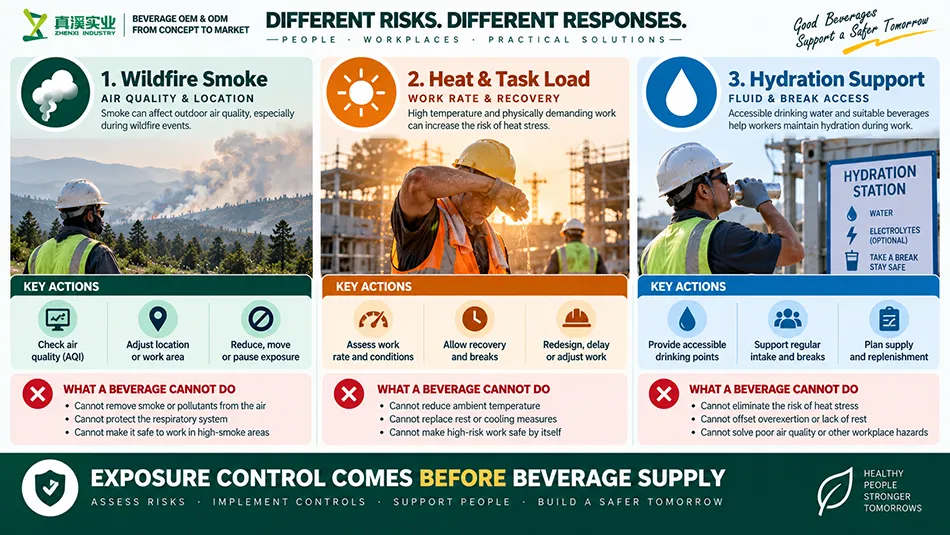
A useful pre-shift review asks three separate questions: what is in the air, what work will add heat load, and whether the crew can reliably access ordinary fluids and breaks. The questions affect one another, but each points to a different owner and control. That distinction prevents a well-stocked cooler from becoming a false signal that the whole shift is safe to run.
| Risk path | What changes first | Primary control question | What a beverage cannot do |
|---|---|---|---|
| Wildfire smoke | Air quality and location | Can exposure be reduced, moved or paused? | Filter smoke or improve indoor air |
| Heat and task load | Work rate, timing and recovery access | Can the job be redesigned, delayed or broken up? | Replace work design, shade or rest planning |
| Hydration support | Routine access and logistics | Are normal fluid and break arrangements reliable? | Determine smoke safety or treat an illness |
The commercial boundary follows directly from the table: electrolyte drinks do not protect against smoke exposure. They do not filter particles, improve local air quality, or make an outdoor task acceptable when the relevant authority or the environment, health and safety (EHS) plan calls for a different control. Keep symptoms and exposures separate as well; smoke-related discomfort should not be casually labelled as dehydration, and a beverage supplier should not diagnose either condition.
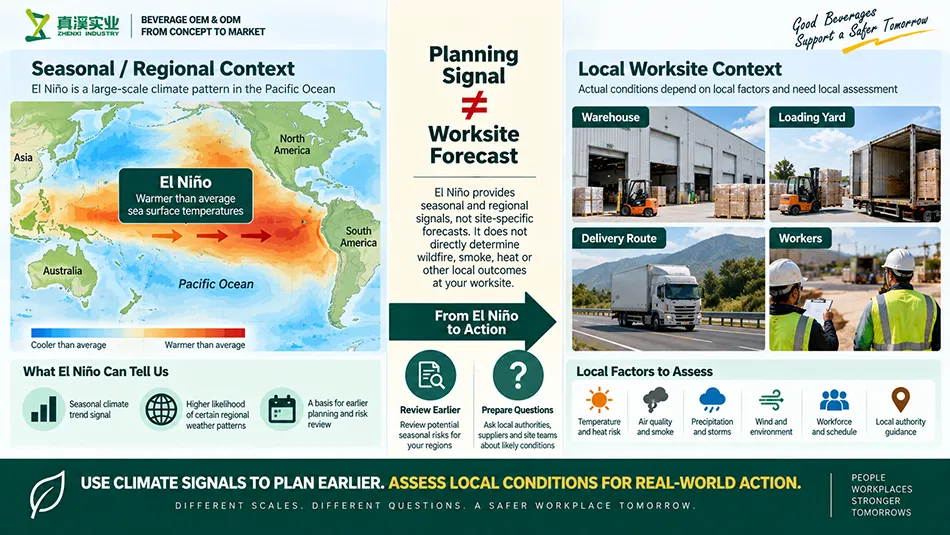
Seasonal context can be useful when it helps a team prepare questions earlier, but it cannot answer those questions for a specific yard, warehouse or route. The World Meteorological Organization notes that El Niño effects can differ by region and even within a region. That is a reason to avoid turning a broad climate label into a forecast of a local fire, smoke episode, heat burden or workforce outcome.
For an employer, El Niño is a planning signal, not a worksite forecast. The practical move is to check current local guidance, current conditions and the actual task before each decision window. A seasonal outlook may justify reviewing a heat plan, communication route or indoor-air contingency earlier; it does not justify a claim that a particular drink, schedule or worksite is protected.
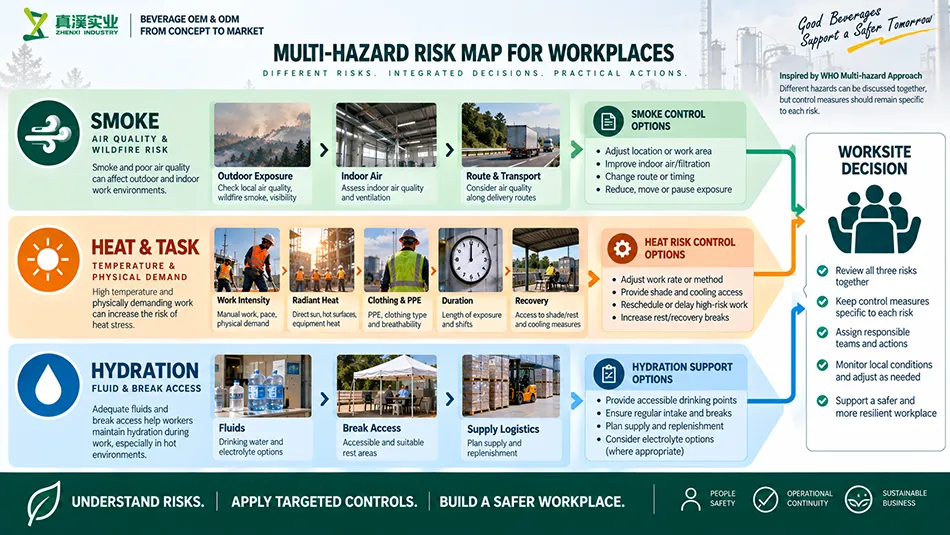
Wildfire smoke and heat deserve to be viewed together, but not blended into one vague wellness message. WHO advises a multi-hazard approach—information about more than one hazard at once—covering fire, smoke pollution and heat. For a workplace, that means one shared decision meeting can coordinate the response while the controls remain in separate lanes.
Smoke is first an exposure question: who is outside, who must move between buildings, and who has no practical access to a protected indoor space? PAHO identifies outdoor workers as a group with greater exposure to polluted air during wildfires. A worksite review therefore begins with the job location, duration, exertion and route—not with a drink format. The review should also establish how workers receive an updated instruction if conditions change during the shift.
Indoor access needs its own verification. EPA’s commercial-building wildfire guidance addresses HVAC operation, filtration and indoor-air monitoring considerations. That does not prescribe a universal building setup, especially outside the United States. It does show why “go indoors” is incomplete unless a facilities owner has confirmed what the indoor-air plan can actually provide.
Heat is not simply a weather number. Work intensity, radiant conditions, clothing, task duration and recovery access can change the burden of the same afternoon. WHO recommends occupational heat action programmes tailored to local weather, particular jobs and worker vulnerabilities. The employer should therefore decide whether to alter timing, staffing, task sequence, rest access or supervision before treating fluid availability as the full response.
For example, a low-exertion indoor task and a high-exertion loading task should not inherit the same response simply because they begin under the same weather forecast. The supervisor needs a clear change point: when the task, clothing, travel route or break access changes, the heat review must be refreshed. That keeps an ordinary fluid arrangement connected to a specific work plan instead of turning it into a stand-alone assurance.
Reliable access to normal fluids can support a heat-control plan, particularly when work, travel and break arrangements make access difficult. Its role remains limited: hydration does not remove smoke from the air, provide a protected indoor space, change a high-exertion task, or substitute for local emergency guidance. That boundary matters most when an urgent procurement request uses phrases such as “smoke-ready” or “wildfire-safe.” Those phrases imply a protection outcome that routine beverage logistics cannot credibly deliver.
A useful procurement question is therefore logistical rather than clinical: can the planned supply reach the intended crew, in the intended market, on the schedule set by the employer? Keep any answer to that question separate from the decision about exposure, work stoppage, treatment or return to work. This preserves a practical role for supply planning without asking it to prove a public-health outcome.
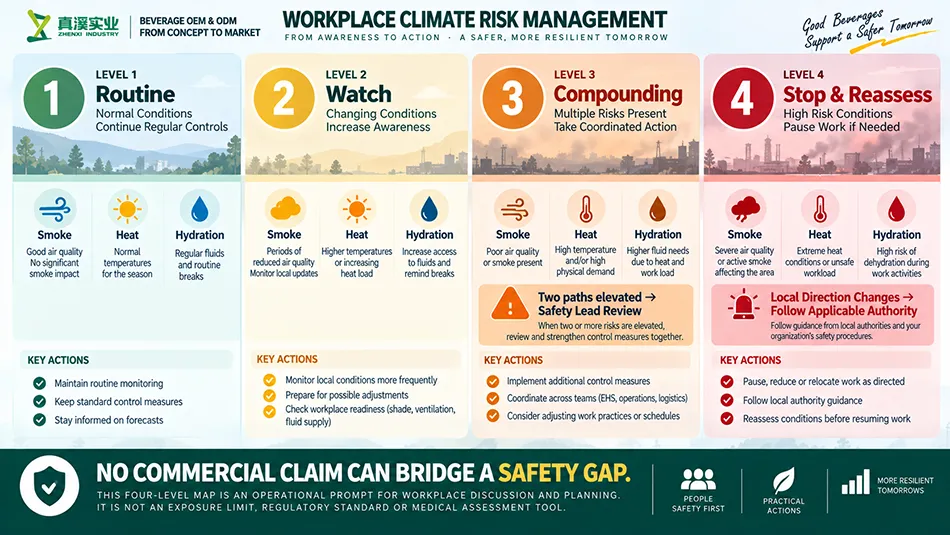
The map below is an operational prompt, not an exposure limit or medical tool. Before a shift, review three paths—smoke, heat and hydration operations—and mark each as clear, watch, elevated or changing. The purpose is not to convert uncertain conditions into a fake score. It is to expose whether a task decision rests on only one input when several inputs have changed at the same time.
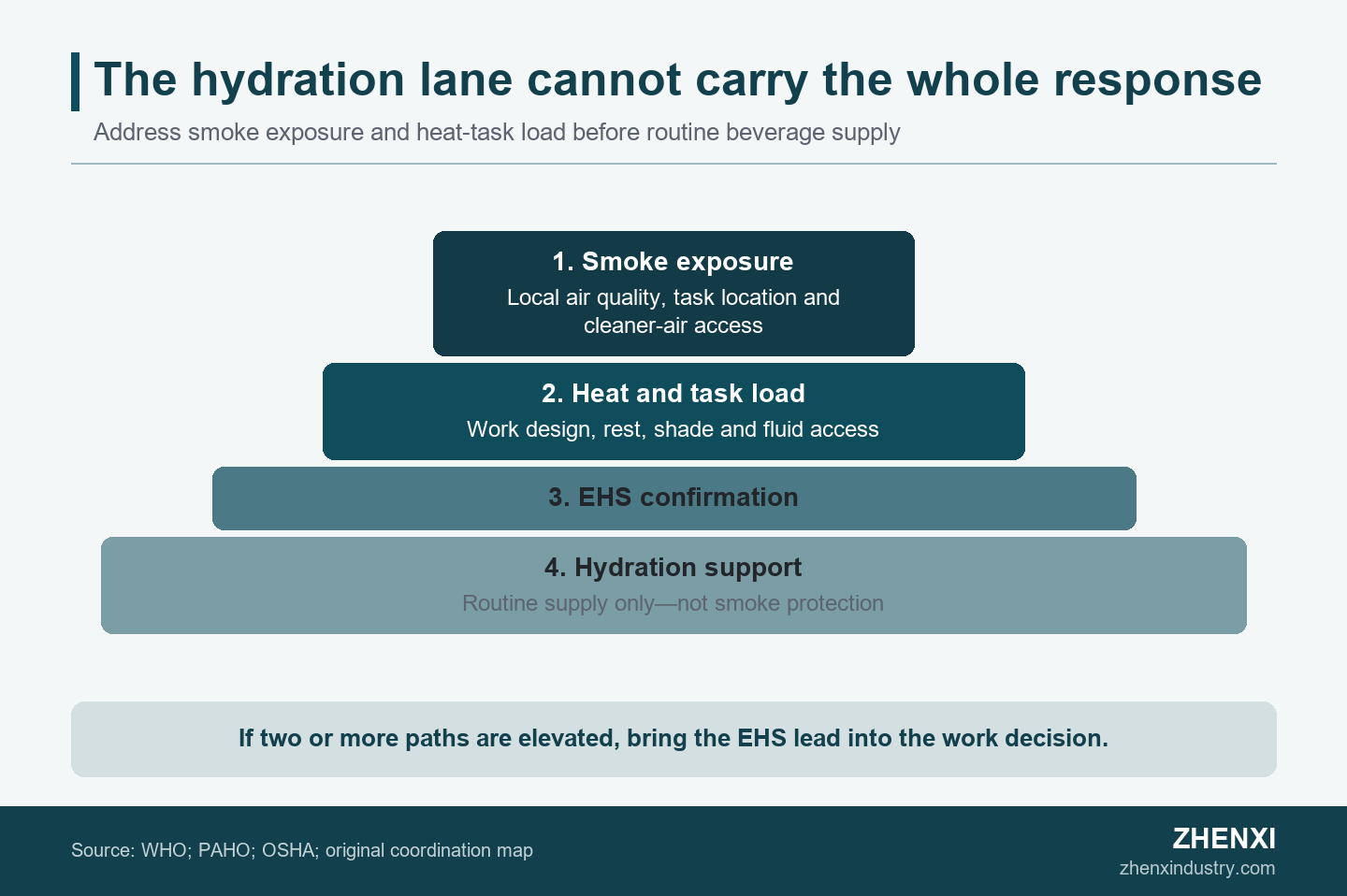
That separation also gives a supplier an honest role early in the process. ZHENXI should receive a commercial request only after the map has shown which hazard controls remain with the employer. A level-three or level-four review does not become safer because the category brief is complete; it first requires the named safety lead to settle the task and exposure response. This prevents commercial timing from pulling the risk decision toward a premature product promise.
| Level | What the review shows | Employer response | Distributor boundary |
|---|---|---|---|
| 1. Routine | No path is elevated; local information is stable. | Maintain the normal plan and communication route. | Routine supply planning only. |
| 2. Watch | One path needs attention or conditions may change. | Assign an owner and set the next check time. | Do not add protective wording. |
| 3. Compounding | Two paths are elevated, such as smoke plus high-heat work. | Bring the assigned safety lead into the task, timing and cleaner-air decision. | Pause any “event protection” message. |
| 4. Stop and reassess | Three paths are elevated or local direction changes. | Follow the applicable authority and assigned safety route before work resumes. | No commercial claim can bridge the gap. |
When two or more paths are elevated, bring the assigned safety lead into the work decision before adding a single beverage measure.
Consider an illustrative loading window in which smoke conditions are worsening, a heat-intensive task cannot be moved easily, and the scheduled break area is not yet confirmed as a cleaner-air option. The count is three operational warnings, not three diagnoses. The right result is a managed reassessment of task, timing, location and communication—not a larger drink order. If only the hydration-operation path is weak, improve that access while continuing to monitor the other two paths; do not use it to infer that the air and workload are acceptable.
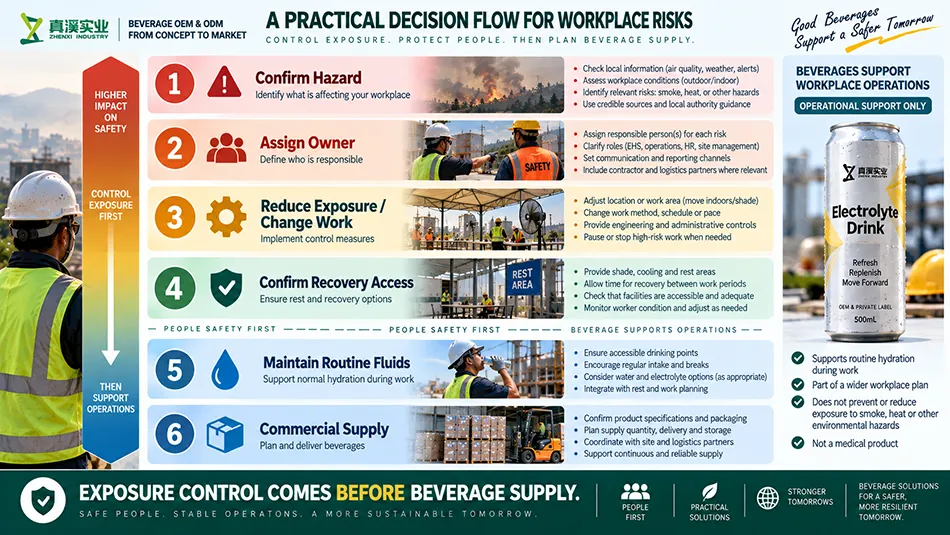
The order of controls should be visible in the shift plan. OSHA’s heat-prevention guidance includes engineering and administrative controls, along with rest, shade and fluids. In a smoke-and-heat event, start by reducing exposure and changing work where possible; then ensure recovery access and routine fluids can support the revised plan. The source is U.S. guidance, not a global legal rule, but its layered approach makes the commercial boundary clear.
Conditions can move faster than a seasonal briefing. In the United States, AirNow’s Fire and Smoke Map explains current particle pollution, fire locations, smoke plumes, available forecasts and recommended actions. Elsewhere, use the locally applicable air-quality service, emergency authority and occupational guidance. The point is not to copy a U.S. indicator or threshold; it is to use a current official source that tells the local team when its assumptions may have changed.
A distributor can help preserve this boundary by keeping routine product education separate from incident messaging. Teams that need broader category context can browse ZHENXI beverage resources, but the live smoke and work decision stays with the relevant local authority and the employer’s workplace process.
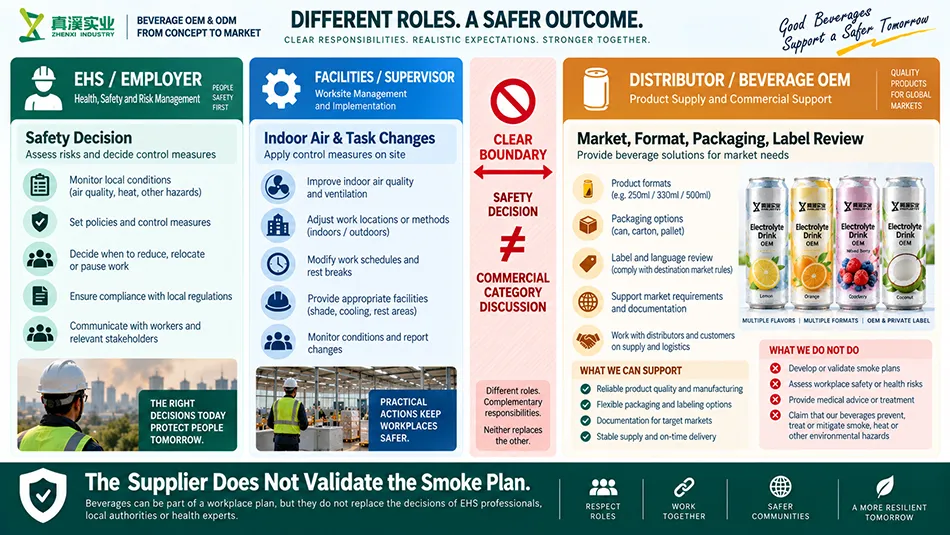
A distributor can make a useful contribution after the safety decision has a named owner: clarify the intended market, ordinary category, packaging route, label-review need and the wording that must not appear. The category conversation starts with what the buyer can verify—market, format, timeline and label-review route—not with what a drink is said to prevent. This keeps incident response in the safety lane and commercial inputs in the purchasing lane.
Before a supplier page is opened, the buyer should be able to state which current local source informed the work plan, who owns any change to the task, and which words are prohibited from the product brief. That record also makes timing clearer. A normal sourcing discussion can continue while a workplace review remains active, but the two documents should never be used to approve each other. The supplier does not validate the smoke plan, and the smoke plan does not validate a formula, label or market claim.
At ZHENXI, a buyer may then compare ZHENXI Energy Drink OEM pathways as a market-specific category discussion. It is not a basis for a smoke-protection promise, an emergency-treatment claim, or an assumption about formula performance. If a requested claim refers to preventing smoke effects, treating dehydration or making a shift safe, remove it and route the question back to the appropriate health, safety or regulatory reviewer.
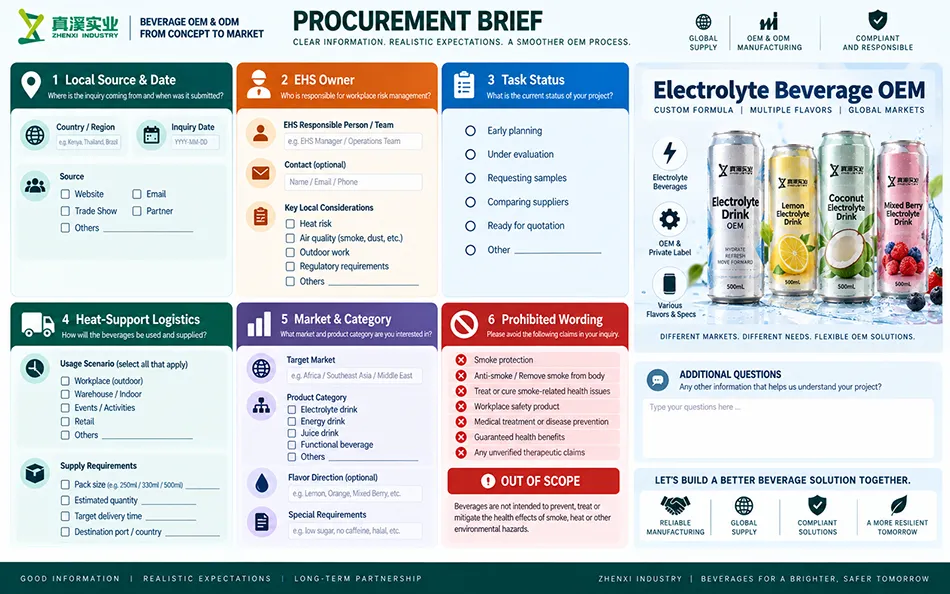
Use a workplace-safe category brief: a commercial request that records safety ownership and prohibited health wording before a buyer asks about a beverage category. This is not a safety plan or a substitute for local guidance. It is a handoff record that stops the commercial request from silently carrying claims that belong to a workplace safety team, emergency authority or health professional.
Once those five fields are complete, the buyer can ask ZHENXI to request a workplace-safe category brief.
An electrolyte drink does not filter smoke, improve local air quality or replace the controls used to reduce smoke exposure. It may be part of ordinary fluid logistics inside a heat plan, but that does not make it a wildfire response product. If a product description implies protection from smoke, respiratory effects, heat illness or workplace safety outcomes, remove the claim and return the decision to the appropriate safety, public-health or regulatory owner.
Workers with outdoor, high-exertion, heat-retaining or limited-clean-air tasks need a separate local review before the shift begins. The purpose is not to diagnose anyone. It is to identify whether task location, duration, timing, clothing, travel route, break access or communication arrangements create a different exposure situation. Use applicable local guidance and the employer’s workplace process to decide what changes are needed.
A single local AQI number should not be the only work-stop trigger because the work setting changes the exposure picture. Use the locally applicable air-quality guidance together with heat, task, shelter and worker-protection conditions. A number can be important, but it cannot show whether the work is high exertion, whether conditions are changing, whether a cleaner-air space is available or what the local authority requires. The four-level map is a coordination prompt, not a replacement for the official direction that applies locally.
Send a category brief that names the market, local guidance date, assigned safety lead, intended format and prohibited health wording. It should also state that smoke protection, treatment and workplace-safety claims are out of scope. That gives the workplace safety team a clear chance to protect the work decision, while the distributor receives a commercial request that can be reviewed for ordinary category, label and market inputs without implying a health outcome.


