An electrolyte descriptor does not decide what a product is allowed to be. A commercial beverage, a sport-positioned drink and an oral rehydration solution (ORS) used in a clinical diarrhoeal-dehydration context can all use electrolyte language, yet their evidence burden and market route may be different. For brand owners, distributors and compliance reviewers, the practical first move is to write the proposed purpose in one sentence and then test whether the product record and destination-market route support that sentence. If they do not, hold the wording rather than asking a formula or sample to settle a category decision.
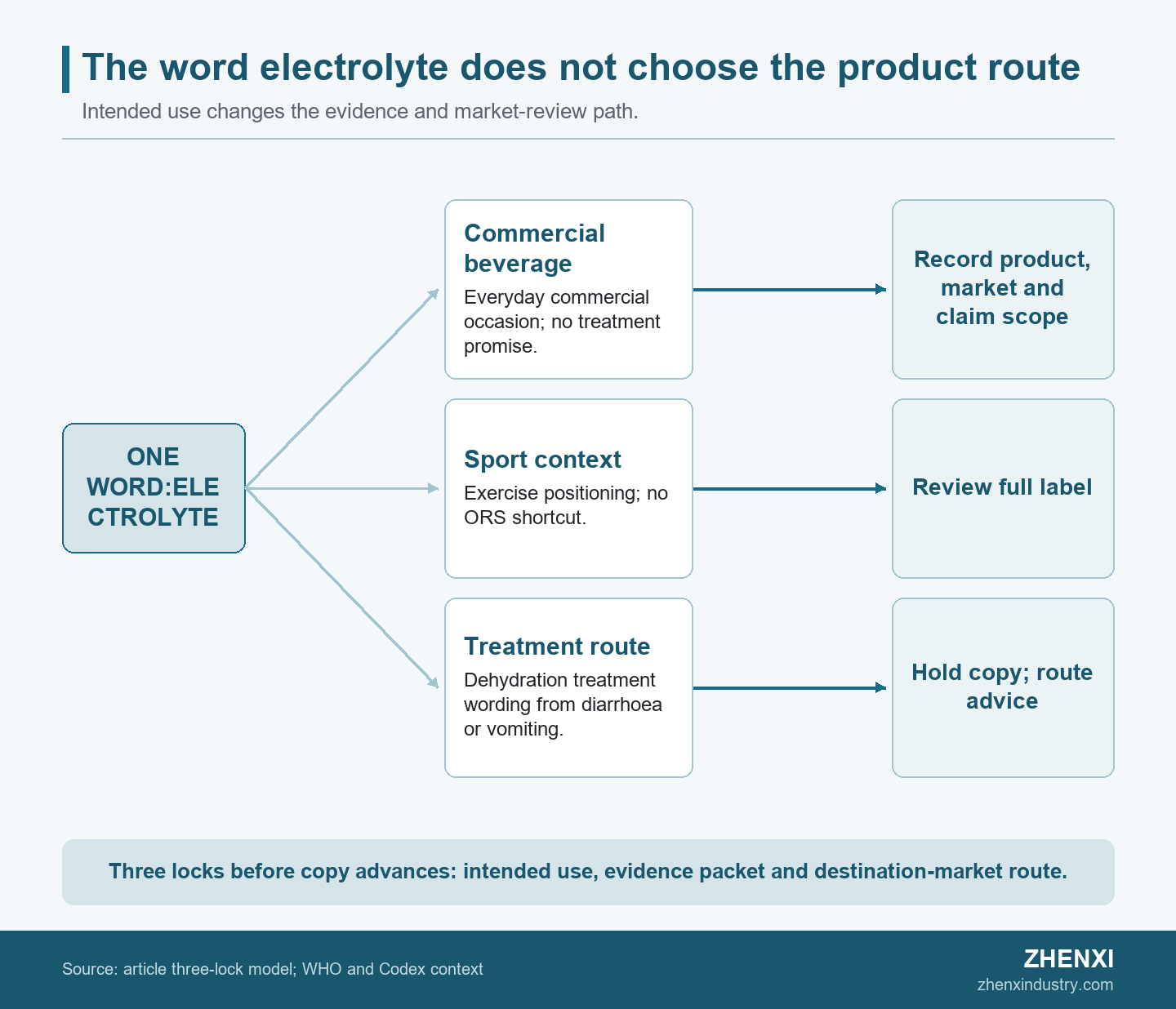
A category name is ready for working copy only when intended use, evidence packet and destination-market route point to the same decision. Here, intended use means the purpose a product is presented and marketed to serve. That framing stops a familiar error: treating an ingredient word as if it proves a clinical purpose, a sport claim or a legal category.
When any lock is open, the right status is “hold for review,” not “close enough.” That is a buyer control: it preserves a commercial concept while preventing unreviewed treatment language from travelling into packaging, sales copy or a supplier inquiry.
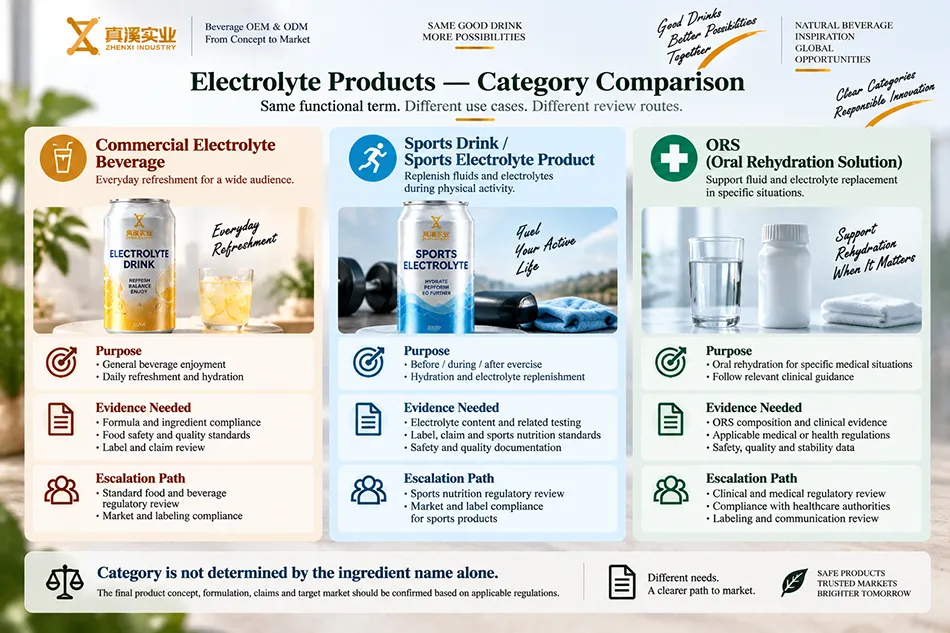
For a buyer, the useful comparison is purpose, evidence and escalation path rather than an ingredient-score ranking. Ingredients can appear in more than one product type; the decision changes when the product is presented for a different purpose or when its label begins to make a stronger representation. For route questions that continue after this comparison, you can browse ZHENXI beverage resources.
That clinical ORS context does not classify a commercial product; it makes clear why a clinical purpose must be separated from ordinary beverage positioning.
| Working category | What starts the route | What the buyer needs before copy advances | When to stop and escalate |
|---|---|---|---|
| Commercial electrolyte beverage | A commercial drinking occasion and a non-treatment product concept. | Destination, versioned product record, pack direction and proposed claim wording. | When the wording implies treatment, disease management or an unverified regulated status. |
| Sports drink or sports electrolyte product | A sport or exercise context that still requires product and market review. | Use context, product evidence and the full presentation of the label or advertisement. | When sport wording is used to imply ORS status or a clinical result. |
| ORS | A clinical rehydration purpose, not a flavour, ingredient or lifestyle descriptor. | The applicable clinical or regulated-product review path for the destination market. | Before a commercial beverage brief uses ORS equivalence or treatment language. |
The table is not a formula specification or a global legal classification. It is a way to prevent a team from comparing three different decisions as though they were interchangeable product names.
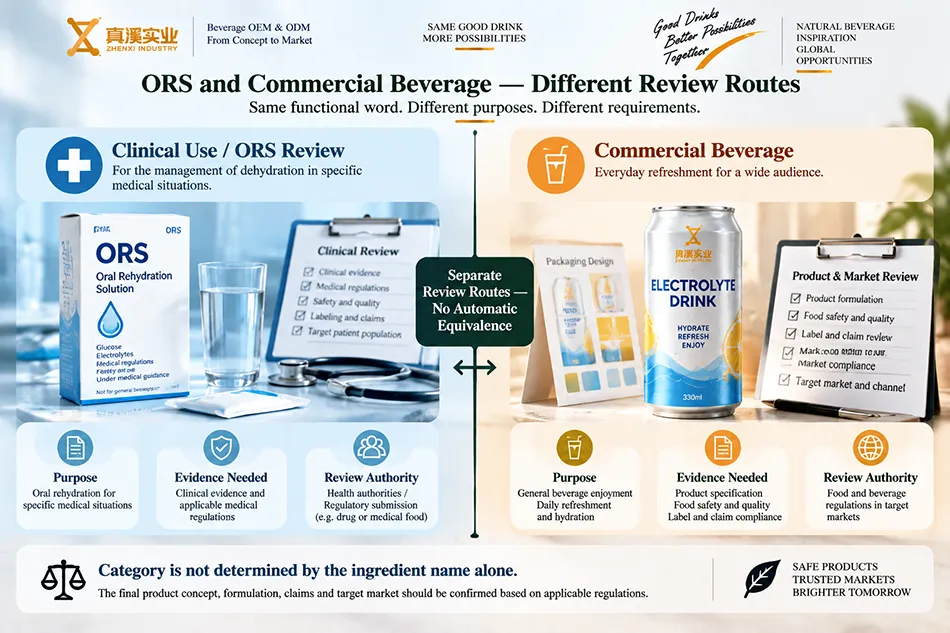
Write the intended use before choosing a category label because clinical treatment, sport context and commercial beverage occasions start different review paths. A brief that says only “electrolyte drink” leaves the key question unanswered: what is the product being presented to do, for whom and in which market?
For a commercial beverage inquiry, that statement can remain narrow: intended occasion, destination market, pack direction and draft wording. Once those are recorded, a buyer can review ZHENXI Energy Drink OEM options as a public category route without suggesting that the route is an ORS product, a finished formula or a market approval.
WHO places oral rehydration salts in the treatment context for dehydration caused by diarrhoea. Its ORS guidance concerns a clinical purpose and production context; it is not a claim template for a commercial drink. The buyer implication is simple: do not use “ORS,” “oral rehydration,” or treatment wording as a loose synonym for a beverage that contains electrolytes.
That boundary does not prevent a company from exploring a commercial hydration concept. It separates that commercial work from a separate clinical-use question. If the proposed copy says it treats dehydration from diarrhoea or vomiting, pause the commercial brief, retain the wording as an open issue and obtain advice through the applicable destination-market route. A sample can inform sensory or pack choices; it cannot establish a treatment purpose.
Sport wording can set a commercial context, but it cannot establish ORS status or a clinical purpose. “For sport” may explain an intended occasion, yet it does not turn a commercial beverage into a treatment product or remove the need to review the final presentation in the destination market.
For a sports drink concept, the responsible question is not “does sport wording make the product medical?” It is “what does this market permit this specific product and presentation to say?” Review the intended sport context, the product version, the label and the accompanying images together. If the team wants a medical implication, it has crossed out of the ordinary commercial-copy discussion and needs a named escalation path.
CFIA explains that the overall impression of a food label or advertisement can create a health claim. The Canadian guidance on health claims is a reminder to review the headline, image, product name and supporting copy as one presentation. Do not let a cautious sentence in small print carry the entire compliance burden while the prominent elements imply something stronger.
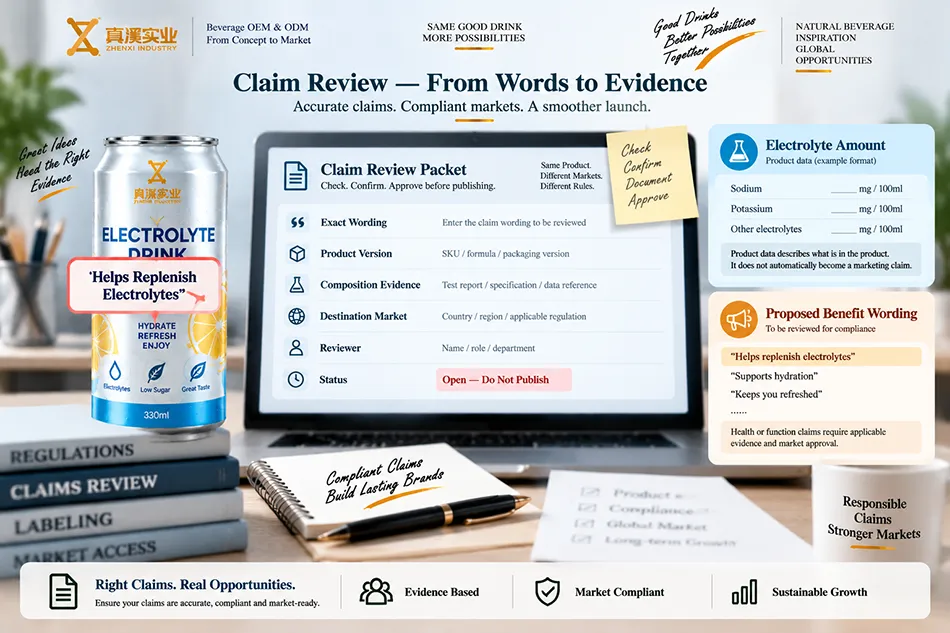
A workable review packet therefore ties each proposed phrase to one controlled product version and one market question. It should show what is known, what is still being tested or confirmed, and who owns the decision to approve, replace or hold the phrase. That is more useful than a general request for “hydration claims.”
Codex nutrition-labelling guidance pairs a nutrition claim with nutrient-declaration conditions. In this context, a nutrition claim is a representation about the nutritional properties of a food, so it needs a more deliberate evidence conversation than merely naming an ingredient in an internal concept note. The Codex nutrition-labelling guidance provides an international reference; destination-market rules still control the final label.
Before a phrase moves to artwork, match it to the final product version, the available composition evidence, the required label information and the market where it will appear. If any of those items is not yet fixed, write “open—do not publish” beside the phrase. This does not decide whether a claim is acceptable; it prevents the team from treating a draft phrase as if it had already been approved.
Codex says food claims should be justified and remain subject to national legislation. Its General Guidelines on Claims establish the useful international boundary: a persuasive phrase is not self-validating, and national rules set the detailed conditions.
FDA describes a health claim as a relationship between a food substance and a disease or health-related condition in its food-labelling Q&A. That U.S. example is not a conclusion for another market. It does show why disease, treatment or recovery language should trigger a distinct review rather than a copy edit. Hold the phrase, identify the market and responsible reviewer, then determine whether the concept belongs on a commercial food route or needs a different path.
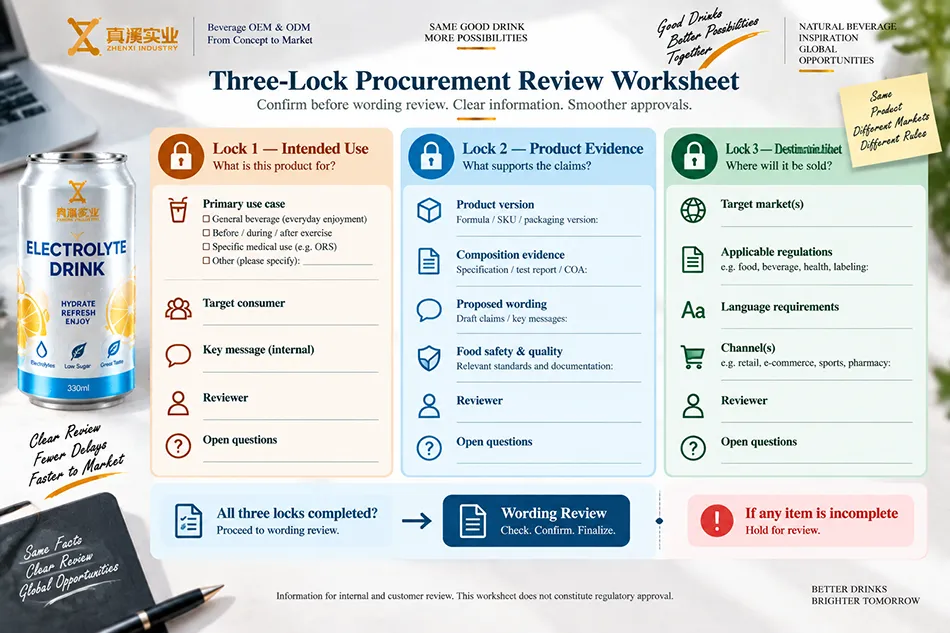
The three-lock worksheet turns an open category request into a record of use, evidence, market route and named owner. It is not a legal test; it is a short handoff document that exposes the one unanswered question most likely to create a misleading label.
Then apply one decision rule: an open lock keeps the relevant wording out of released commercial copy. The rest of the beverage project can continue only within the scope that is actually documented. This is especially helpful when commercial teams, distributors and external suppliers are working from different versions of a brief.
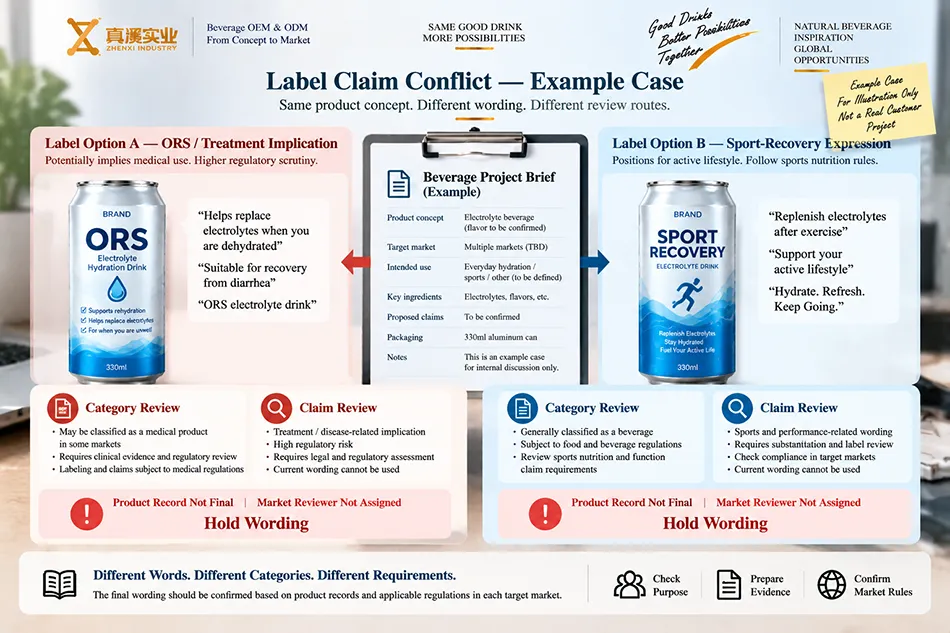
This composite example illustrates a category-copy conflict and does not describe a ZHENXI customer project or product result.
An illustrative distributor has 1 proposed retail launch and 1 canned beverage concept. The brief contains 2 draft front-label phrases, 1 provisional destination market and 1 unapproved commercial product record; there is no approved classification memo or final composition record. One phrase uses an ORS reference while the other uses sport-recovery wording.
One front-label phrase suggests treatment of dehydration while another uses sport context. The conflict is not resolved by choosing the stronger phrase. The team cannot link either phrase to a final product version, a settled category or an accountable market reviewer. A supplier sample may answer a taste or pack question, but it cannot prove the clinical use, claim permission or market classification assumed by the copy.
The decision is to hold the treatment-oriented phrase, preserve the commercial concept as an open route and split the two decisions between category and claim owners. The corrected packet records intended use, removes unreviewed ORS wording, requests the product evidence and sends the named market question for review. Only when intended use, product record and destination-market label review agree can the commercial wording move forward. No formula quantity, certificate, supplier commitment or medical recommendation is implied by this example.
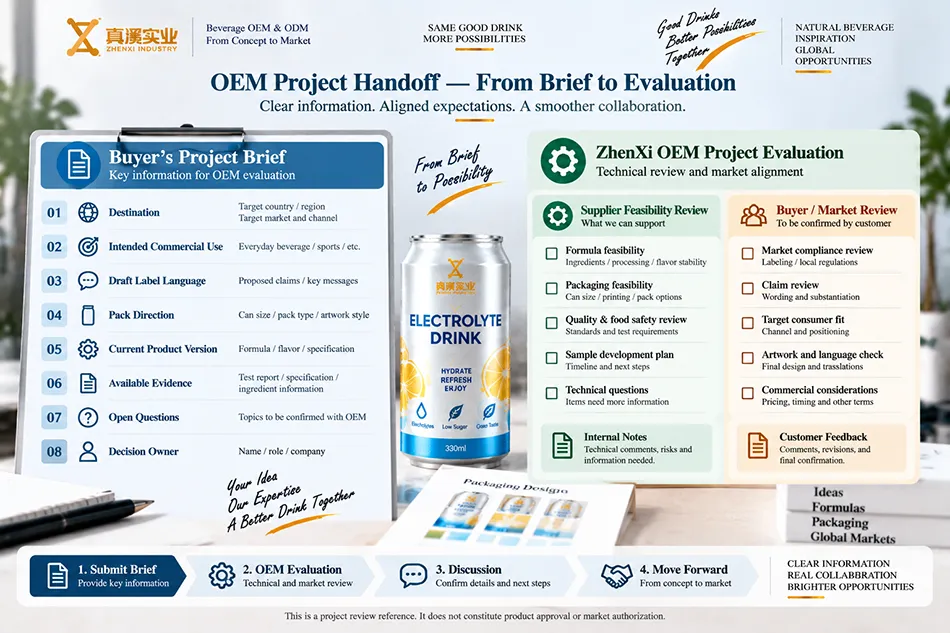
A complete commercial brief lets a buyer ask an OEM to assess project-specific feasibility while category, claim and market decisions stay visible for review. The supplier should receive the destination, intended commercial use, draft label language, pack direction, current product version and a clear list of open evidence questions—not a request to make an unreviewed medical promise workable.
That separation gives a supplier a practical brief while leaving the right decisions with the right owners. A buyer can review ZHENXI's public beverage OEM scope before requesting project-specific confirmation. The public route is a starting point, not evidence of a finished formula, a classification decision or a market approval.
Before sending the brief, put the current product version beside the proposed label language. Mark each phrase as supported, open or held. List the evidence that is available, the evidence that is still requested and the person who owns the next decision. This makes it possible to discuss a commercial concept without silently moving a medical implication into the supplier’s scope.
Also separate the questions a supplier can assess from the questions that need another decision maker. An OEM may be asked to confirm project-specific feasibility and available documentation. The buyer and relevant reviewers still need to decide the destination-market category, claim route and internal approval. No request should imply a formula, certification, MOQ, lead time, testing result or approval outcome that has not been confirmed.
For public process information, buyers can check ZHENXI's Beverage OEM FAQs while maintaining that separation. The most useful inquiry names what is settled, what is held and which question requires an answer before artwork, sales copy or a supplier sample proceeds.
A concise handoff also records the commercial objective, the intended sales channel, pack direction and the scope of each draft representation. It identifies whether the next action is evidence collection, market review, product development or a supplier feasibility discussion. That prevents a team from using a generic “electrolyte” request to conceal several unrelated approval questions.
Keep a dated version of the brief so every reviewer sees the same product and wording. If a phrase changes, reopen the relevant lock rather than carrying forward approval logic from an earlier version. This is a small administrative discipline with a practical payoff: it makes the next conversation about an identified item, not an assumption.
When those items are visible, submit a category-selection brief for review with the destination, intended commercial use, draft language, pack direction and open evidence questions included.
No—not unless the product is lawfully classified and supported for that use in the destination market, rather than merely containing electrolytes. ORS belongs to a clinical-use context, so a commercial beverage brief should hold that wording until the applicable route and evidence have been confirmed. The label, accompanying images and sales language all need to follow the same decision. A supplier sample or ingredient list may be useful for development, but it does not replace category review or establish a treatment purpose. If uncertainty remains, remove the unreviewed medical wording before the brief is shared.
No. The terms can overlap in commercial use, but sport wording does not settle category identity, evidence requirements or claim limits. Start with the proposed sport context, then review the final product version and the destination market’s rules for the complete label and advertising presentation. A team should also check whether the wording changes the overall impression of the product. If the concept moves toward disease, treatment or clinical recovery language, hold that phrase and assign the appropriate reviewer before it appears in a commercial brief. Document that decision before campaign images or distributor materials are released.
Review the destination market, final product version, composition data, proposed wording, nutrition declaration needs and the reviewer responsible for approval. FAO lists nutrition declarations, nutrition claims and health claims as distinct food-labelling topics in its food-labelling overview. Keep those questions separate in the brief, then connect them only after the right product and market records are available. If an item remains open, record who owns it and prevent the unreviewed phrase from moving to consumer-facing copy. Show the date and version so later changes trigger a new check.
Send the destination, intended use, draft label language, pack direction and the evidence questions that still require project-specific confirmation. Also state which wording is on hold and who owns the next category or claim decision. Add the current product version and a concise statement of the commercial purpose so the supplier is not required to infer it. That lets an OEM discuss the commercial scope without being asked to infer a clinical position, approve an unsupported representation or resolve an unnamed market question. It also makes the response easier to compare with the actual question in the brief.


