An electrolyte beverage label is not ready for multi-market launch because its English master artwork looks complete. It is ready when the product facts behind each destination file are current, traceable, and reviewed in the context of that market. Start with one controlled label source file, then create separate artwork decisions for each destination. This approach gives a brand owner, importer, or QA reviewer a practical way to spot a missing formula update, claim decision, language version, or allergen input before print approval. It is procurement guidance, not legal advice or a compliance guarantee.
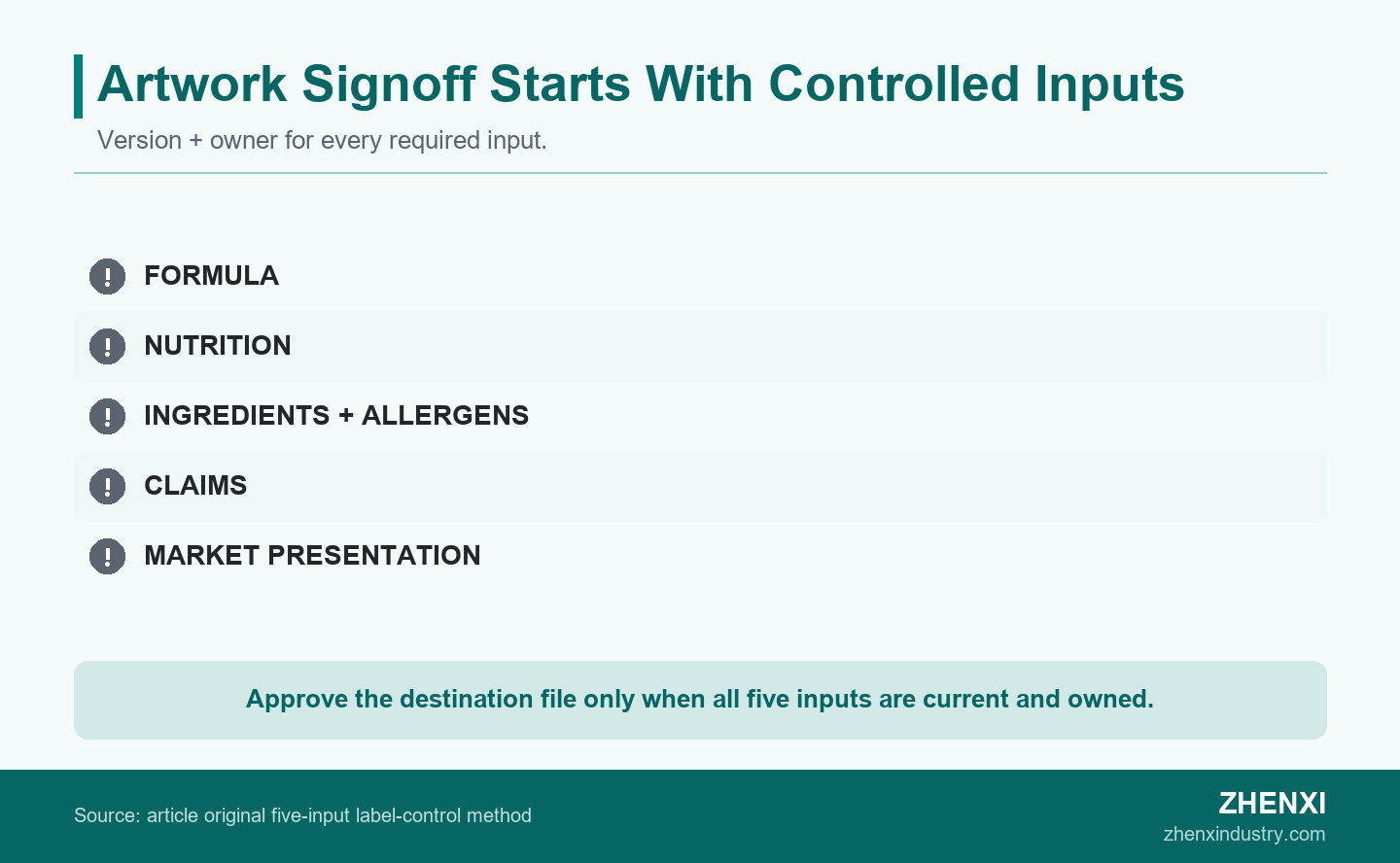
Use one controlled label source file for formula, nutrition, ingredients and allergens, claims, and market presentation. Put the current formula reference at the top, then give each of the five inputs a version and a named owner. That creates ten basic checks before a destination file is treated as ready: five inputs, each with a current version and an accountable person. This is an illustrative buying control, not a regulatory checklist. Its job is to stop a design file, translation sheet, and formulation summary from quietly becoming three conflicting sources of truth.
For a ZHENXI project, think of the source file as the project’s factual spine. The master design can still be useful, but it should point back to that controlled record rather than replace it. A claim ledger is the list of proposed claims, their exact wording, destination, evidence basis, and reviewer. When a formula, source material, serving convention, proposed benefit statement, or destination changes, the buyer can identify the affected line first. That is much safer than reopening all artwork without knowing what actually changed—or approving everything because the can image and brand layout have not changed.
| Controlled input | What to record | What it cannot decide alone | Typical owner |
|---|---|---|---|
| Formula | Revision, ingredient sources, target pack | Destination claim wording | Product development or technical team |
| Nutrition | Calculation basis and market presentation basis | Whether a benefit statement is permitted | Technical or regulatory reviewer |
| Ingredients and allergens | Current declaration input and source review | Translation quality for every market | Formula owner and destination reviewer |
| Claims | Exact phrase, destination, evidence, reviewer | Formula or nutrition calculation | Regulatory or label reviewer |
| Market presentation | Language, artwork version, destination, signoff state | Proof that a different market file is current | Importer and artwork owner |
The comparison matters because every row answers a different question. A formula sheet can be current while a translated claim is not. A nutrition calculation can be sound while the selected market presentation is incomplete. A complete review requires the rows to agree on the same product version and destination before artwork signoff moves forward.
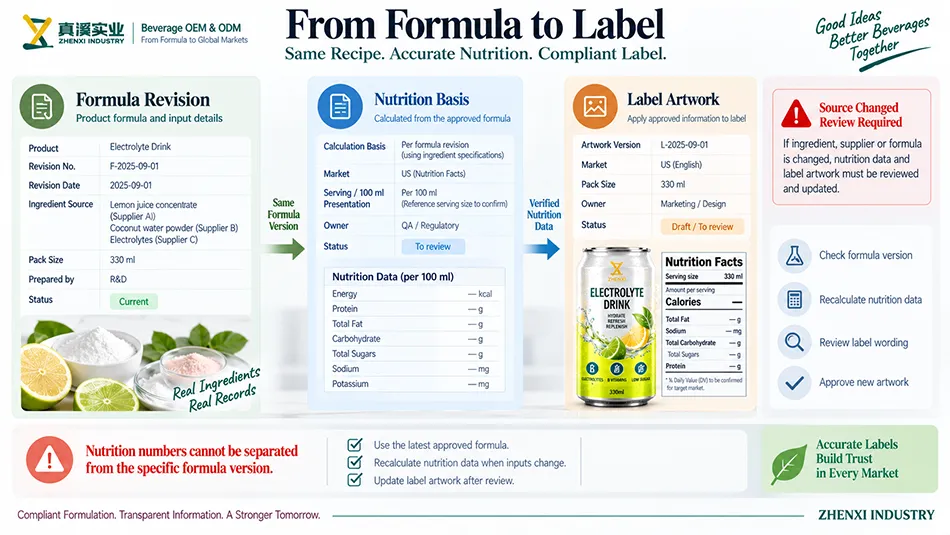
FDA explains that the Nutrition Facts label presents product-specific serving size, calories, and nutrient information. Use the FDA’s Nutrition Facts overview as a limited U.S. example of why the nutrition record needs a stated basis. A number in a formula workbook is not yet a label instruction. The file should say which formula revision supplied the data, which presentation basis was used, which destination it serves, and who can confirm a later change.
The European Commission describes a defined nutrition declaration and per-100 g or per-100 ml presentation basis for most EU prepacked foods. Its nutrition-labelling page shows why an EU-facing file needs its own presentation review. Here, a nutrition basis means the calculation and presentation basis used for the nutrition information in a named market. This is not a rule to copy into every country. It is a reminder that a serving-based master sheet, a per-100 ml declaration, and a pack panel can be related without being interchangeable. Keep the actual market basis beside the formula version, not in a designer’s comment thread.
For category context during a new project, buyers can review electrolyte energy-drink OEM project options. That page can help frame a commercial conversation, while formula, packaging, quantities, nutrition values, label wording, and destination fit remain subject to confirmation.
Keep the formula version and nutrition basis together before the data is used in a destination artwork file. In practice, give the nutrition line a formula revision, calculation source or date, intended market, presentation basis, and owner. If the electrolyte source, sweetener, serving concept, or pack size changes, do not assume the existing panel follows automatically. Open the affected market row, confirm whether the source data still applies, and record the result. This does not prescribe a calculation method; it preserves the trace between a product decision and the artwork that expresses it.
Treat an electrolyte amount as product data until a destination-specific review decides whether and how it can appear as claim copy. An amount can belong in a technical record while words such as “source of,” “high,” “replenishes,” or a similar benefit phrase create a separate marketing question. Keep the number and proposed copy on different lines. Add the intended panel or campaign location as well, because the same phrase can travel from front panel to side panel or digital asset without carrying its decision history. That separation prevents the design process from turning a useful formulation fact into a headline before the destination, exact wording, evidence basis, and reviewer are known.
Keep a current ingredient record linked to the formula before translation or artwork work begins. The record should use the formula revision, ingredient names and sources supplied for review, known allergen-related inputs, and the destination files that depend on it. Do not ask a translator or designer to decide whether an old ingredient panel still matches a revised formula. Their work becomes reliable only after the factual input is current, named, and owned.
FDA states that U.S. food labels must identify the food source of major food allergens. The FDA’s allergen-labelling guidance provides that U.S.-specific illustration. It does not decide allergen treatment for every destination. It does show why an allergen question should not be buried inside an unversioned translation request. Keep a dedicated field for the formula source, proposed declaration input, affected market, reviewer, and unresolved point. If a supplier declaration or ingredient source changes, reopen the market rows that use it.
A translation-ready file is not merely a list of words. It tells the reviewer which names must stay aligned with the current formula, which pieces require destination review, and which approved artwork versions are based on the same record. That distinction protects both speed and traceability when a launch adds a language after the first master artwork has already been prepared.
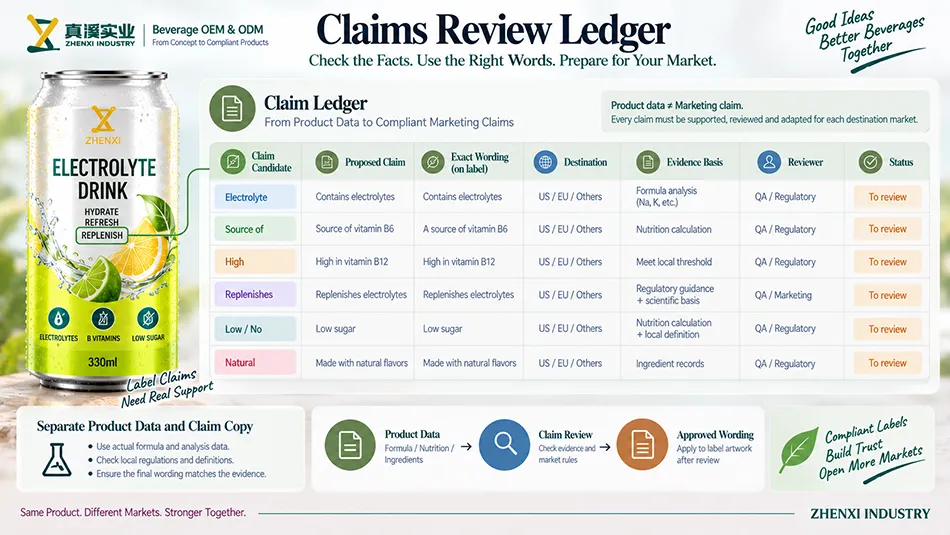
Use the claim ledger to record front-of-pack lines, icons, comparative statements, social-media copy proposed for the label, and translated phrases. It does not tell the buyer that a claim is allowed. It gives the team one place to identify what must be reviewed before copy reaches an artwork file.
FDA explains that nutrient-content claim terms, including high and low, are subject to defined criteria. Review the FDA’s label-claims guidance when the U.S. is relevant. For an EU-facing project, the European Commission describes a regulated EU framework and public register for nutrition and health claims. Its claims overview and register route provide a separate destination-specific starting point.
The practical rule is simple: do not treat “electrolyte,” “low sugar,” “source of,” or a proposed performance phrase as default copy. Flag it as a claim candidate, preserve the exact words, and attach the destination. Then write the outcome clearly: approved wording, wording to revise, further evidence or market review needed, or not for this artwork version. That record can travel with design comments without allowing a vague “reviewed” status to become a blanket approval.
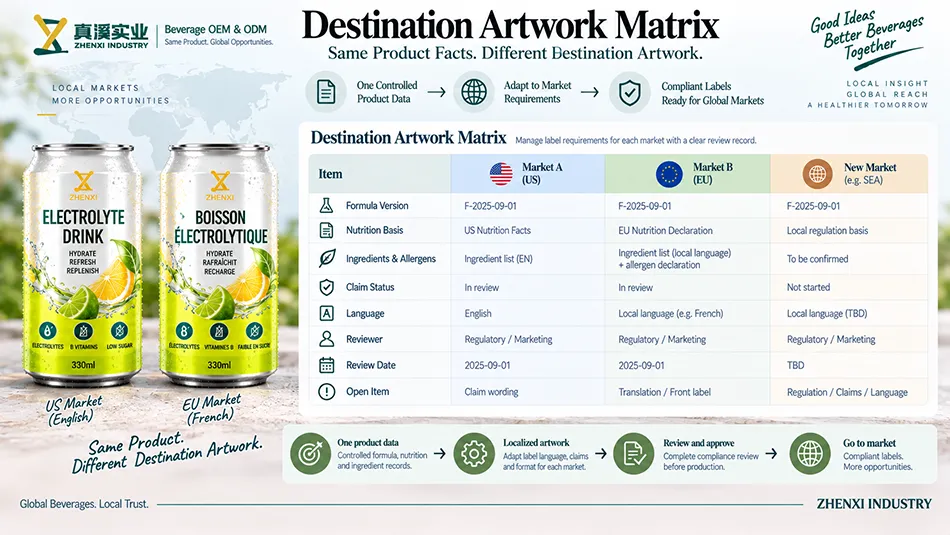
The European Commission says mandatory food information must be in a language easily understood by consumers in the Member State where the food is marketed. Its language and presentation guidance is a useful EU-specific boundary. It does not create a global language rule. It does make the core operational point: an English master file is a source document, not automatic approval for every destination artwork.
Build one row per destination and give it a unique artwork version. The matrix should show the formula revision, nutrition basis, ingredient and allergen input, claim ledger status, required language or languages, label reviewer, date of review, and open item. Add a clear state such as “data collection,” “awaiting destination review,” “copy revised,” or “ready for print confirmation.” Avoid a single green “approved” column that covers several countries and several versions at once.
| Artwork row | Data that must match | Decision still needed | Release condition |
|---|---|---|---|
| Destination A / version A | Formula revision, nutrition basis, ingredient input | Claim wording and local language review | All fields trace to one current source file |
| Destination B / version B | Formula revision, nutrition basis, ingredient input | Destination language and claim decision | Its own artwork file is reviewed and recorded |
| New market added later | Current source file plus any changed package facts | New market review and language scope | New row; no inherited signoff |
Use the matrix as a decision board, not as a translation tracker. If only one destination has changed claim language, hold that row instead of treating both market versions as uncertain. For broad category orientation while building the matrix, buyers can browse beverage product categories for label scope. Catalogue pages describe options; they do not confirm the formula, label, claim, or destination approval for a proposed launch.
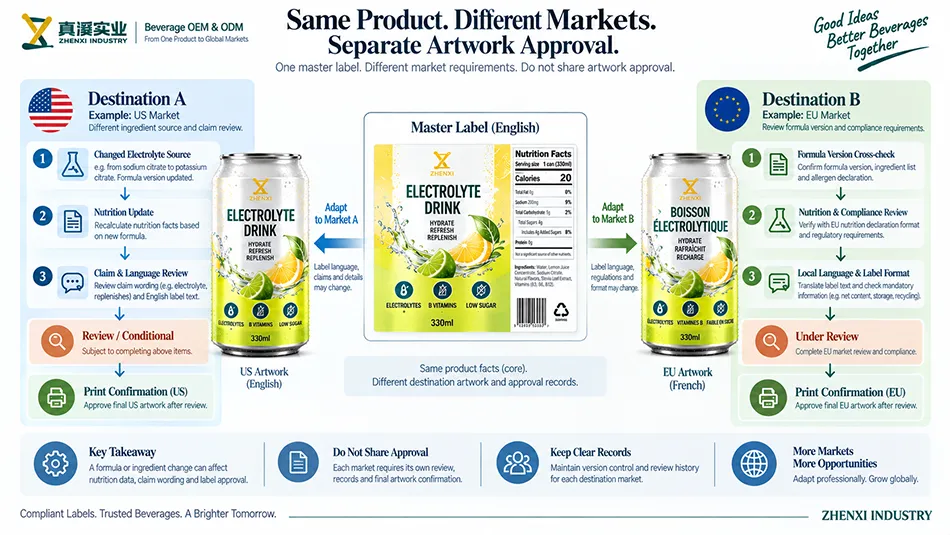
The following composite example shows why a late formula change should be traced into every market artwork version. It is illustrative, not a customer case and not evidence of a product result.
Hold the affected market artwork and isolate the changed copy chain before giving either version final approval. An importer is preparing one electrolyte beverage formula for two destination-market launches. A 36,000-can first order is planned across two market-specific artwork versions, with print files due after commercial approval. Both design files use the same English source text, but their claim and language fields are at different stages of destination review.
Three observations interrupt a shared approval. The electrolyte source changes after the nutrition basis is prepared. One destination version carries a translated benefit statement that has not been reconciled to the new claim ledger. The other destination version has no affected claim copy but still needs the changed formula version recorded. The 2 market-specific artwork versions now have different review paths: 1 version has an affected claim-and-language chain, while the other needs a formula-version cross-check. Neither difference is visible from the can image alone.
The label source file has split into a changed subset and an unaffected subset, so one master-artwork approval would hide which facts and copy actually remain current. The buyer does not need to declare that either can is defective. The decision is narrower: hold the affected market artwork, preserve the other as conditional, and make the formula-version cross-check visible before either file becomes final. That prevents a late change from being treated as a styling issue when it actually affects the data-to-copy chain.
Approve each artwork only when its own formula version, nutrition basis, ingredient and allergen inputs, claim decision, language copy, and destination are traceable together. For the affected file, freeze the revised formula reference, rebuild the nutrition and ingredient inputs as needed, update the destination claim ledger, and send the affected language version for review. For the other file, confirm that no changed input alters its approved copy. The verification gate is record-based, not visual: each row must show the same current product basis and its own outstanding-change decision. Required review and acceptance criteria remain specific to the actual formula, package, claim, and destination. The example does not set a market rule, product threshold, or claim outcome.
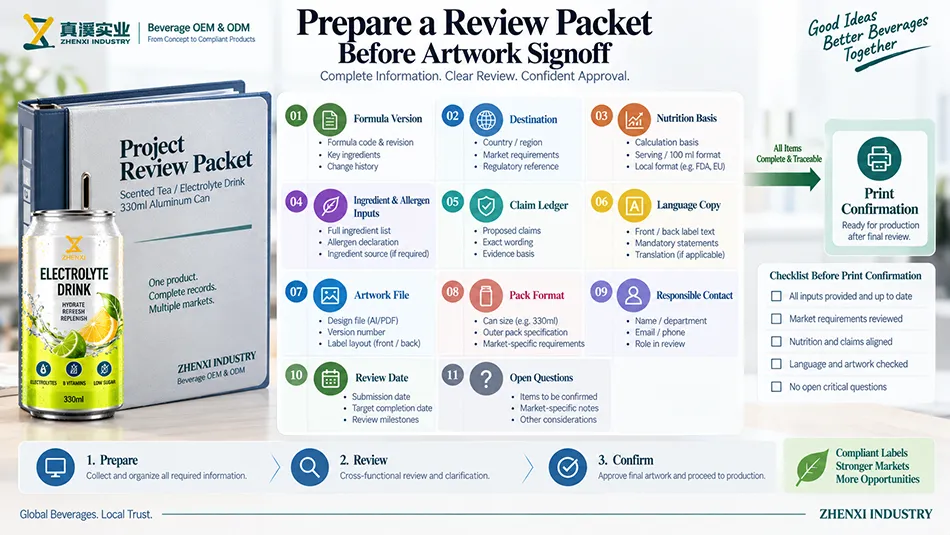
A complete review packet names the formula version, destination, nutrition basis, ingredient and allergen inputs, claim ledger, language copy, and current artwork file. Add the pack format, proposed front-of-pack phrases, responsible contacts, review dates, and a short list of what is still unknown. This avoids asking a manufacturer, translator, designer, or market reviewer to “check compliance” without knowing which question belongs to whom.
Once the packet is complete, ZHENXI can discuss the relevant OEM/private-label project context while formula, packaging, quantities, destination requirements, and final specifications remain subject to confirmation. Buyers ready to start that scoped conversation can submit formula-and-destination data for review.
For a first label review, provide the current formula version, destination, draft artwork, nutrition basis, ingredient and allergen inputs, and proposed claims. Include every language version, pack format, known change, and a contact who can answer formulation questions. If any item is still unknown, name it rather than leaving an old file to imply an answer. A clear list of open points lets the reviewer scope the work without confusing a preliminary check with final market approval.
Usually, an English master label can guide preparation but is not a final multi-country approval because language, mandatory information, and claims need destination review. Use the master as the controlled source, then create a separate row and artwork version for each market. That approach preserves shared product facts while making differences visible. It also prevents a translated file from inheriting an approval that belonged only to another destination, formula revision, or wording set.
No, an electrolyte amount should begin as product data because any claim expression depends on the destination, exact wording, and applicable review. Keep the amount in the nutrition or formulation record, then put the proposed label phrase in the claim ledger. This allows the team to compare the wording, supporting basis, and market before it reaches artwork. Do not use a generic “electrolyte” headline as a substitute for that destination-specific decision.
Repeat the review whenever a formula, nutrition basis, ingredient declaration, allergen input, claim, destination, language, package fact, or artwork version changes. The change does not always require a full restart, but it should identify the affected market rows and copy chain. Record the change, its owner, and the decision about whether earlier evidence still applies. That gives the buyer a controlled update path instead of relying on a verbal assurance that the label is “basically the same.”


