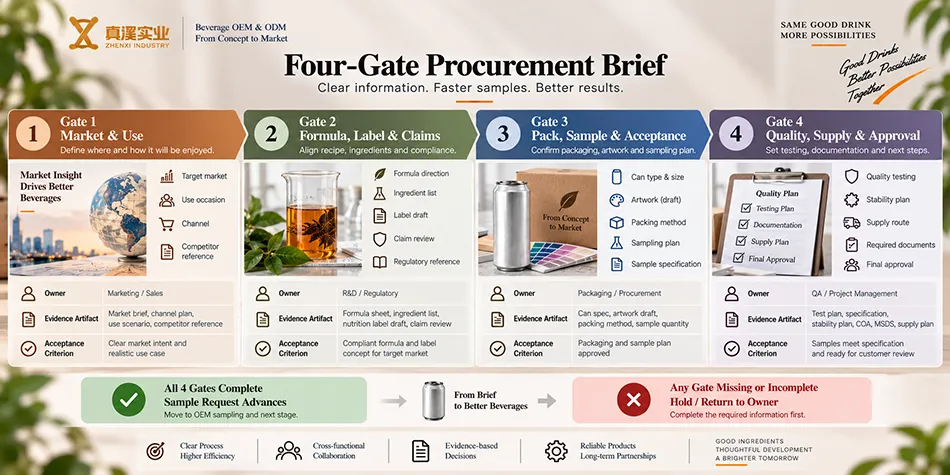
An electrolyte drink manufacturing brief fails when a sample is asked to resolve decisions that the buyer has not made. A category idea cannot stand in for a destination market, a controlled product record, or an approval owner. Before sampling, turn the inquiry into four gates that show what is known, what needs confirmation, and who can return an incomplete field.
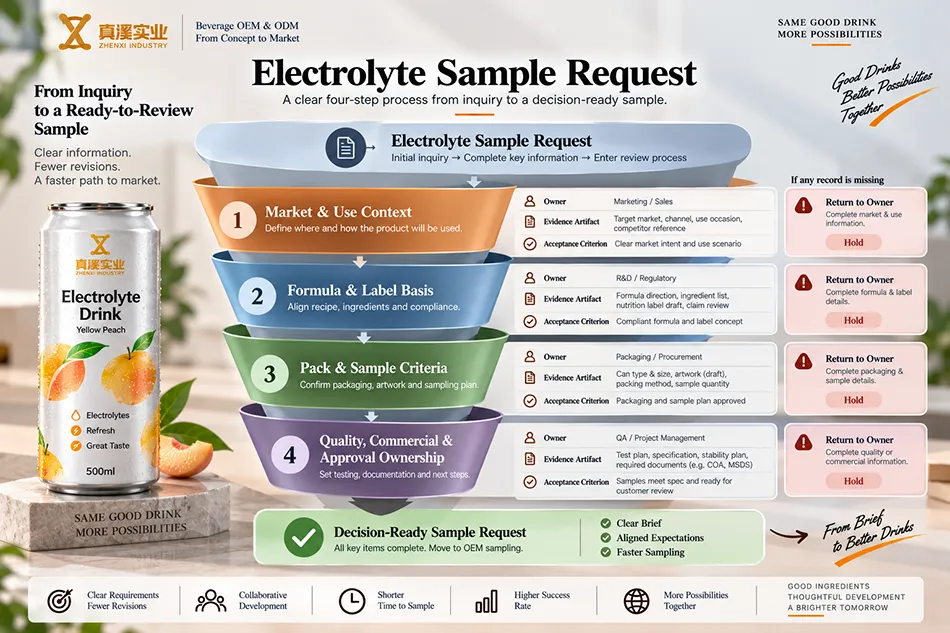
A sample request is ready only when the four gates each name an owner, an evidence artifact and an acceptance criterion. For this page, an OEM is a manufacturer producing to a buyer’s approved specification; an acceptance criterion is an agreed check a sample must meet before it advances; and a claim is a label or marketing representation about a food’s qualities. The gates are market and use context; formula, label and claim basis; pack and sample purpose; and quality, commercial and approval ownership. Their purpose is not to make the first inquiry burdensome. It is to prevent a good-tasting sample from being treated as evidence that a market, a label phrase, a test request, or a commercial condition has already been accepted.
Use a simple stop rule: if any gate lacks one of its three records—owner, evidence artifact, or acceptance criterion—return that field to the named team. A supplier can then respond to a bounded question instead of interpreting a broad request such as “make it suitable for hot weather.”
A hot-climate use context can inform a buyer brief, but it cannot move water, rest, shade or emergency responsibility into a beverage specification. The use context may matter to channel selection, storage questions, consumer occasion, or the evidence a team chooses to review. It does not make a beverage a workplace heat-control plan, a medical intervention, or a substitute for an employer’s procedures.
OSHA’s Water. Rest. Shade. guidance presents water, rest and shade together as workplace heat-prevention measures. That is a U.S. occupational-safety context, not a universal product rule, but it makes the allocation clear: site controls and emergency arrangements remain with the employer and its safety program. The beverage brief should only record the intended use context and the questions that product, QA and regulatory reviewers need to resolve.
Write the climate field in plain operational terms: intended market, consumer occasion, route to market, expected distribution conditions, and any packaging or storage questions to be confirmed. Do not write a treatment outcome, a hydration promise, or a claim that the product will control heat risk. Buyers who need related decision support can browse ZHENXI beverage resources while keeping local workplace, medical and legal decisions with the responsible professionals.
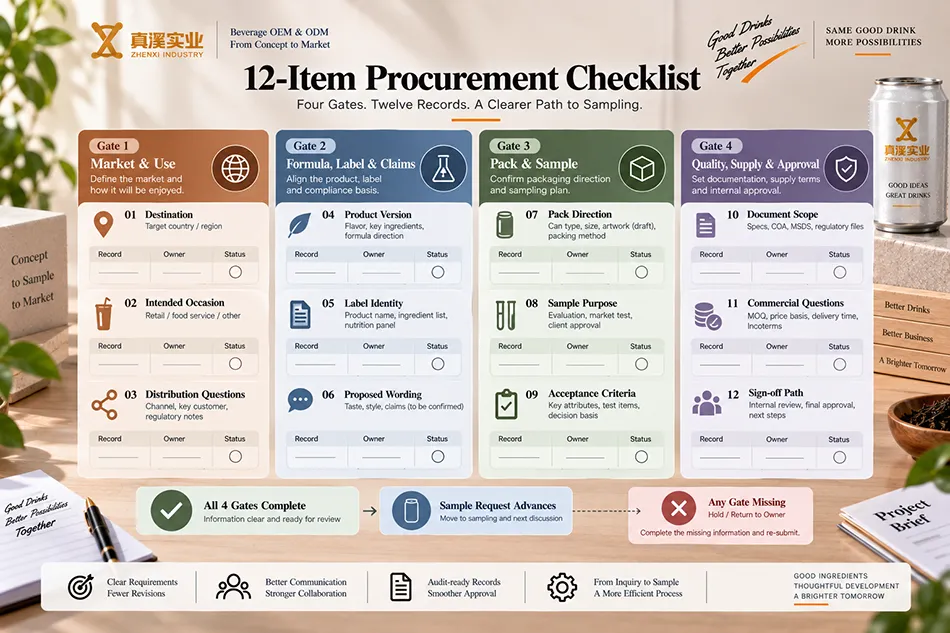
The 12 requirements turn four gates into a buyer-controlled record of destination, evidence, sample purpose and approval ownership. Each row is a field to complete or explicitly mark open; none is a statement that a supplier already offers a certain formula, package, test, certificate, minimum order quantity, lead time, or shelf life.
The table is deliberately arranged as a dependency chain. A market question comes before label review; a controlled product version comes before wording; and a sample question comes before a request for proof. That order keeps open decisions visible instead of burying them in email threads.
| Gate | Requirement | Record to bring | Acceptance condition |
|---|---|---|---|
| Market and use | 1. Destination market | Named country or market group | Regulatory owner confirms the review scope |
| Market and use | 2. Intended occasion | Consumer and use-context statement | Product team confirms the brief is specific |
| Market and use | 3. Distribution questions | Channel, storage and handling questions | Open logistics assumptions are visible |
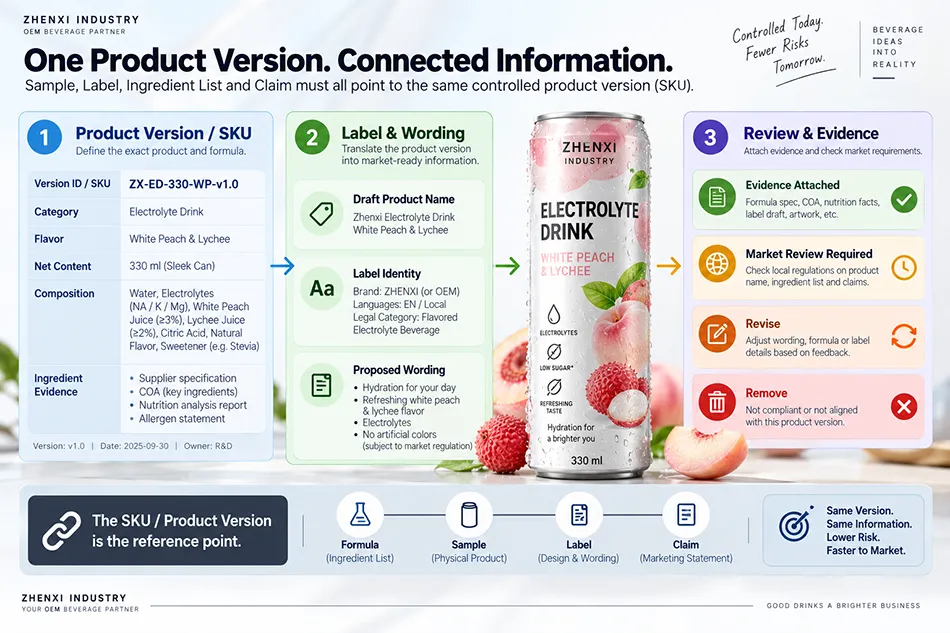
| Formula and label | 4. Product version | Version ID and composition request | One version is assigned for review |
| Formula and label | 5. Label identity | Draft product name and ingredient-record request | Label review attaches to that version |
| Formula and label | 6. Proposed wording | Exact label or marketing phrases | Each phrase is marked review, revise or remove |
| Pack and sample | 7. Pack direction | Provisional format and artwork questions | Unknown pack constraints are recorded |
| Pack and sample | 8. Sample purpose | One question the sample must answer | Out-of-scope approvals are listed separately |
| Pack and sample | 9. Acceptance criteria | Named checks and reviewer | Pass, revise or stop outcome is defined |
| Quality and approval | 10. Document scope | Requested specification, test and certificate list | QA names what needs project confirmation |
| Quality and approval | 11. Commercial questions | Quantity, timing and supply questions | Procurement records what the supplier must confirm |
| Quality and approval | 12. Sign-off path | Product, regulatory, QA and buyer owners | One owner can return every unresolved field |
The destination market, intended use and distribution questions must be named before later label and claim review can be scoped. This does not require the buyer to know every answer before a first conversation. It requires the buyer to distinguish a confirmed input from an open question, then assign the open question to a person who can close it.
FAO identifies nutrition declarations, nutrition claims and health claims as separate food-labelling areas. That separation is why “hot-climate market” is not enough context by itself. A named destination, the intended consumer occasion, and the route-to-market questions give regulatory and product reviewers a defined starting point; without them, a generic label request can make uncertainty look like approval.
For this gate, record the destination even if it is provisional, name the intended occasion without making a benefit promise, and list the storage or distribution questions that need confirmation. If the market is still undecided, the correct status is “open,” not “global.” That one word stops a supplier sample from being misread as clearance for several markets at once.
Ingredient evidence, label identity and claim wording should attach to the same controlled product version rather than an electrolyte category label. A SKU means one specific product version: it is the reference point that connects a proposed composition request, a draft product identity, and the wording under review. Without that reference point, a team can accidentally compare a sample, a label draft and an ingredient list that do not describe the same proposed product.
Codex labelling guidance says labels should not be false, misleading or deceptive. Its general claims guidance says claims should be justified and subject to national legislation, while the nutrition-claims guidance treats nutrition claims as statements about nutritional characteristics. These are international reference points, not an approval decision for a target market. Their practical implication is simple: place every proposed phrase beside the product version and the evidence or reviewer it needs.
Ask for a version identifier, a composition or ingredient-evidence request, a draft product name, and the exact wording the team wants considered. Then give each phrase one status: evidence attached, market review required, revise, or remove. Do not let the words “electrolyte” or “hydration” perform the work of a controlled record.
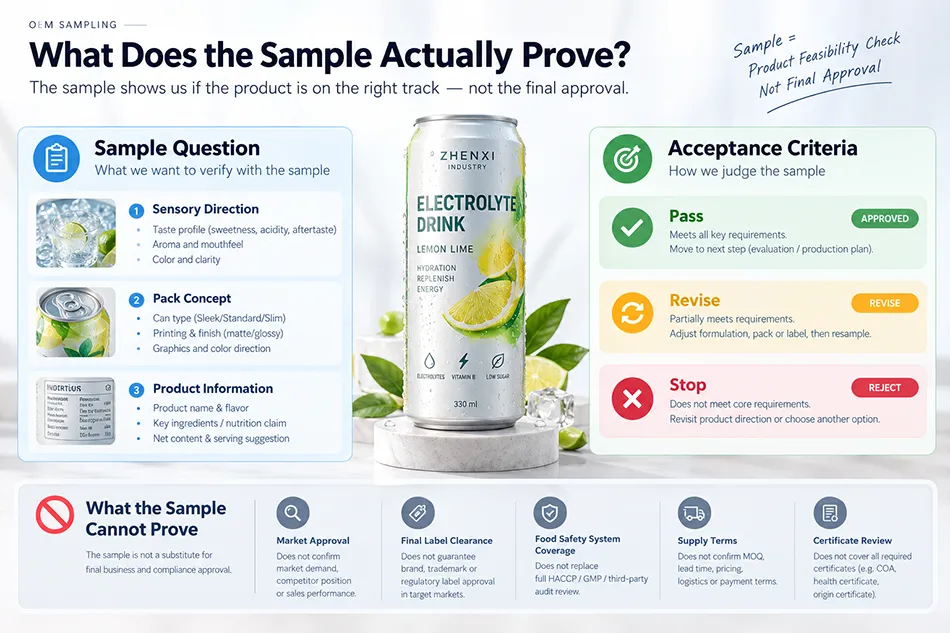
Pack direction, sample purpose and acceptance criteria should state the question the sample can answer and the question it cannot answer. They are not an informal preference list: each agreed check needs a reviewer and a result that can be recorded as pass, revise or stop.
Start with one sample question, such as whether the proposed sensory direction suits the buyer’s intended occasion, whether a provisional pack concept needs revision, or whether reviewers need more information before moving forward. Then list what the sample cannot prove: destination-market acceptance, final label clearance, food-safety-system coverage, supply terms, or a completed certificate review. That boundary makes a sample more useful because it tells every reviewer what outcome is actually possible.
Once those questions are visible, buyers can review ZHENXI Energy Drink OEM options as a relevant public category route and use the completed brief to ask which project-specific options, records and conditions can be confirmed. The route is not proof of a particular package, formula, sample, commercial term or certificate; those remain fields for the project discussion.
Quality documents, commercial conditions and approval ownership must be confirmed for the proposed project rather than presumed from a sample result. This gate asks the buyer to name the records needed for the selected product and market, the supply questions that procurement needs answered, and the people who can accept or return each field. It does not assume that a given document, term or certification applies.
As a jurisdiction-scoped example, the FDA preventive-controls rule overview describes a written food-safety plan with hazard analysis and preventive controls for covered facilities. That does not determine the requirements of another market or prove that any supplier has a particular system. It does show why a buyer should state the document scope and assigned reviewer instead of asking a sample to stand in for a food-safety record.
Keep commercial questions equally explicit. Quantity, timing, production feasibility, shelf-life expectations, test needs, and certification applicability should be marked “supplier to confirm for this project,” not copied from a category page or an earlier inquiry. The final sign-off path should name product, regulatory, QA, procurement and buyer stakeholders where they have a decision to make.
The following composite example is illustrative and does not report a ZHENXI customer project or supplier result. It uses a realistic document-product conflict to show how an incomplete brief can create a false sense of readiness without stating any formula, commercial, testing or certification result.
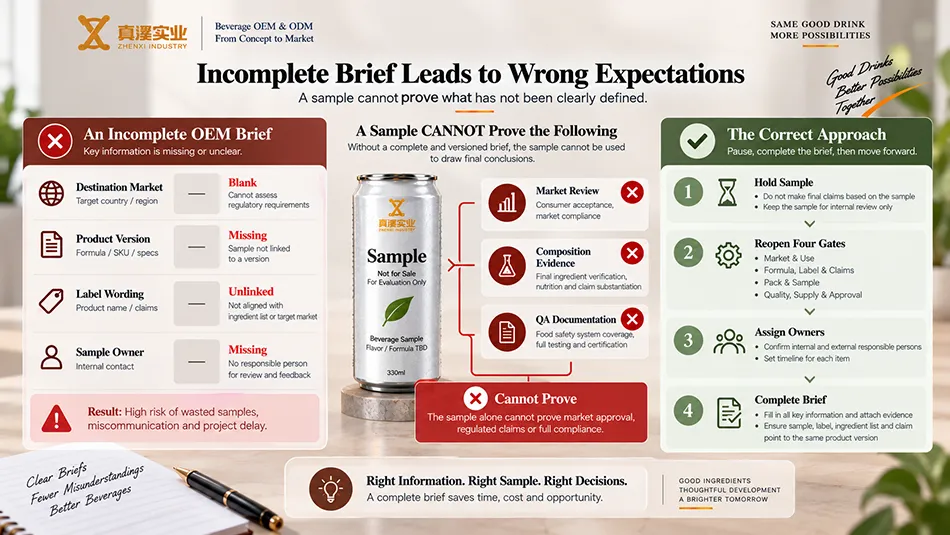
The sample may answer a sensory question, but it cannot establish an unspecified market, undefined claim basis, missing document list or absent acceptance owner. An illustrative regional beverage distributor is coordinating product, regulatory, QA and procurement reviewers for a hot-climate launch concept. The brief covers a 3-SKU concept intended for 2 retail channels, with 2 provisional pack directions and no confirmed destination market. The team has flavour preferences and a can concept, but no controlled product record, label wording, document list or sample-acceptance owner.
The creative brief uses electrolyte and hydration language while the destination market field is blank. The draft label, testing request and expected shelf-life field have no linked product version or named reviewer. Those are not small administrative gaps: they change what a sample can reasonably be asked to demonstrate.
The sample would be asked to stand in for market review, composition evidence and QA documentation, so a pleasant taste result could be misread as readiness. The correct decision is to hold the sample request and reopen the brief at the market, formula-label and quality-commercial gates. A hold is useful here because it makes the missing decisions visible before a supplier has to guess which version, market or evidence standard to work from.
Assign product to version the composition request, regulatory to name the destination and wording review, QA to list required records, and procurement to define the sample acceptance check. Advance only when the revised brief has four named owners, the 12 fields are version-controlled and each sample criterion states pass, revise or stop. This illustrative example contains no formula quantity, customer result, supplier capability, certification, MOQ or lead-time claim; it is a decision pattern for returning an incomplete brief to its owners.
A completed brief can ask an OEM to confirm project-specific feasibility and records, while destination approval, claim governance and buyer acceptance remain explicit shared decisions. This distinction avoids two unhelpful extremes: sending a vague request that forces the supplier to infer requirements, or assuming that a supplier response transfers every approval to the supplier.
An OEM discussion can reasonably ask which options are feasible for the documented product version; which records or test requests can be considered for the named scope; what packaging questions need clarification; and which supply, commercial or certificate questions require project-specific confirmation. The buyer still owns the commercial objective, destination selection, final wording decisions, and the acceptance criteria used to advance the project. Regulatory and QA reviewers retain their own review responsibilities.
That is the natural point to review ZHENXI's public beverage OEM scope. Treat public pages as orientation, then put the completed brief at the centre of a confirmation conversation. Where a field is open, keep it open in the packet. A clear unresolved item is more useful than a guessed capability, certificate, timeline, quantity or formula statement.
A versioned 12-field packet with named owners and open-item status gives the buyer and supplier a reviewable basis for the next project decision. Add a date, a version identifier, and one accountable person for each gate. Then mark every line as confirmed, awaiting supplier confirmation, under regulatory review, under QA review, or returned for revision.
The packet should travel with the supplier conversation, not disappear after the first sample. Buyers can check ZHENXI's Beverage OEM FAQs for public process context, then submit a complete electrolyte OEM brief for review when the market, product version, sample purpose and open approvals are visible. That request starts a project-specific discussion; it does not pre-approve product specifications or commercial conditions.
Yes—the intended destination market should be named before sampling because label language, claim review and document needs cannot be assumed globally. If a commercial team is still evaluating markets, record the alternatives and assign a reviewer rather than presenting the project as market-ready. The sample can still be discussed, but its purpose should remain limited until the destination is chosen and the review scope is clear.
Not automatically—any electrolyte or hydration wording needs a specific product record and destination-market review before it is treated as approved label language. A buyer can list the proposed phrase in the packet and ask what evidence or review it needs. The safe status is “proposed wording under review” until the relevant product version and market context have been confirmed.
Ask the supplier to state which specification, ingredient, label, test, shelf-life, production and certificate records are available for the proposed product and market. The buyer should name which of those records the project needs, who will review them, and what decision each one supports. Availability, applicability and timing should stay marked as project-specific confirmation fields.
No—a beverage brief does not replace the employer’s responsibility to manage heat through water, rest, shade, work practices and an emergency response plan. The brief can document the intended use context, but worksite heat controls and medical escalation remain outside the product specification. Local safety and medical professionals should set those procedures for the actual workplace and jurisdiction.


