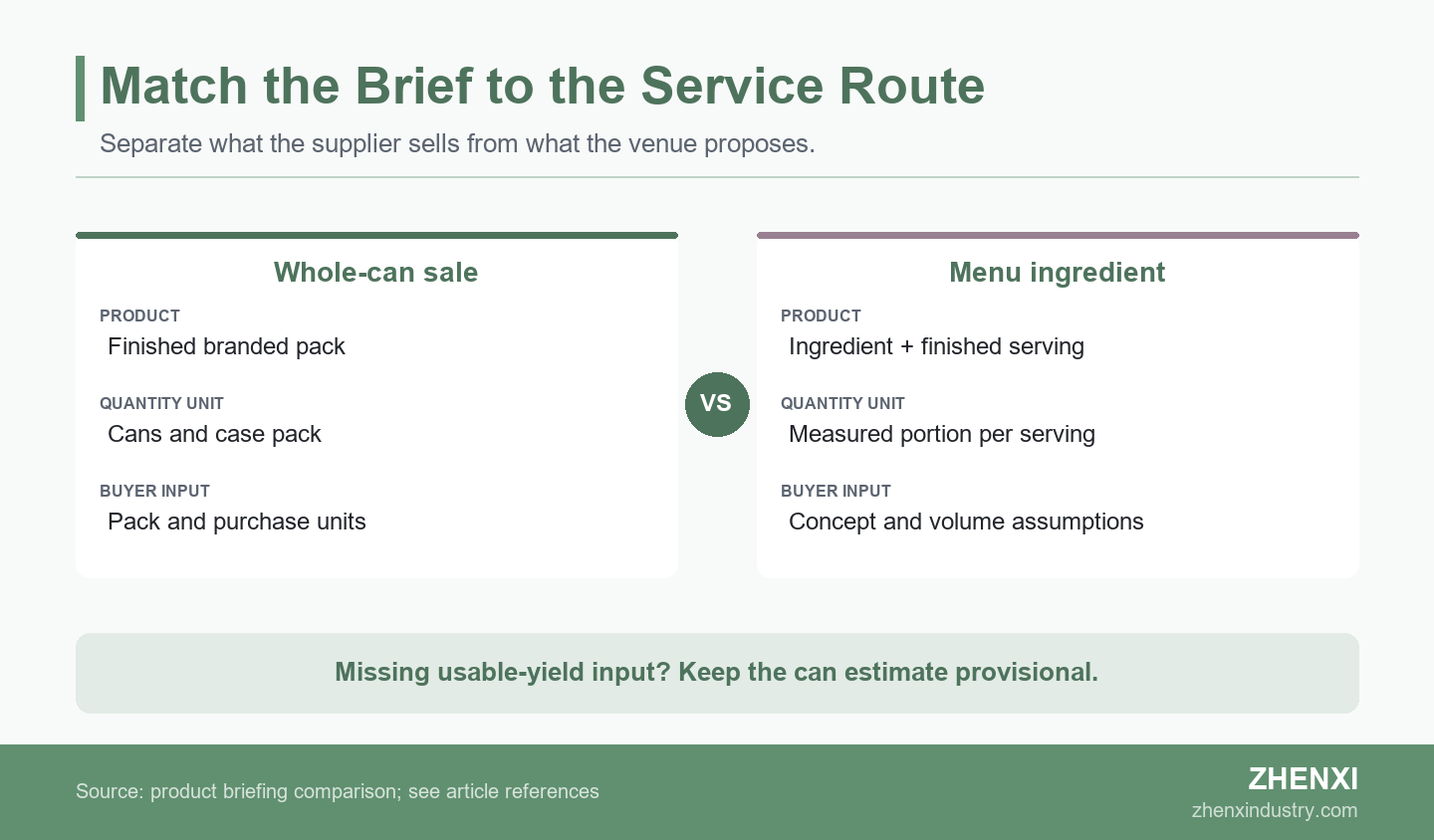
A foodservice energy drink brief should start with the destination country, the specific venue and how the product will be sold or used. A finished can offered to a customer needs a different brief from an ingredient measured into a menu drink. Once the local conditions for the proposed route are confirmed, specify the product, packaging, service format and information the operator needs. If permission remains unresolved, keep the route on hold while gathering product data.
A foodservice energy drink brief should start with the destination country, the specific venue and how the product will be sold or used. A finished can offered to a customer needs a different brief from an ingredient measured into a menu drink. Once the local conditions for the proposed route are confirmed, specify the product, packaging, service format and information the operator needs. If permission remains unresolved, keep the route on hold while gathering product data.
For a brand owner considering a Middle East café or restaurant project, this distinction makes the development conversation more useful. “We want an energy drink for our menu” does not yet explain whether the brand needs a packaged retail item, a product for preparation on site or both. The brief below helps your brand separate those requests before committing to a specification.
Choose the Service Route Before Writing the Formula
Choose whether the project is a finished can sold to the customer or an ingredient used by the venue before requesting a formula or quotation. The intended use changes what the original equipment manufacturer, or OEM, needs to evaluate and what the local operator needs to establish.
Whole-can sale:define the finished branded pack, product specification and venue handover.
Menu ingredient:also define the measured portion, finished serving and proposed preparation method, subject to local confirmation.
Both routes:keep separate use descriptions so a decision about one does not silently approve the other.
Unresolved country or venue conditions:gather the missing evidence before treating the route as ready for launch.
A café group may want customers to see its own brand on a sealed can. Another buyer may be exploring a drink prepared by staff. Those are different product-development objectives, even if both conversations begin with the same flavor idea. State the commercial objective in one sentence and name the person who will contribute the venue details.
Identify the Buyer, Venue and Open Questions
Name the destination country, city and actual venue in the purchasing brief. Put unresolved local questions in a separate field with the contact who will answer them; the supplier request should make clear which commercial proposal is being discussed.
An independent café, hotel outlet and restaurant chain may have different buyers, purchase units and display plans. Record the proposed adult audience, who buys the stock and who receives it. These are project inputs, not evidence that one route is approved for a location.
Dubai Municipality maintains afood-trader information pagewith resources for food traders and establishments. Keep relevant official references with the local questions; this purchasing sheet does not interpret those resources.
For an early inquiry, state what the venue wants to buy and list what it has not decided. A buyer can ask about a sealed own-brand can while a separate ingredient concept remains an open proposal. Keep the two budgets and quantities identifiable rather than silently combining them into one order.
Compare the Two Product Briefs
The whole-can brief describes the product handed to the customer. The ingredient brief must also describe what the venue does with that product and the resulting serving. This gives the supplier and operator a shared description while keeping their responsibilities visible.
Keep sales forecasts and purchase units distinct. Missing usable-yield data leaves an ingredient can estimate provisional.
Product-brief inputs after country and venue conditions are confirmed
Brief field
Whole-can sale
Conditional menu-ingredient use
Commercial product
Finished branded can offered to the customer
Supplied ingredient and the venue’s finished menu serving
Quantity description
Can volume, case pack and order quantities
Can volume plus measured ingredient portion per finished serving
Product information
Current product specification and pack reference
Supplier product reference plus venue-provided concept description
Questions supplied by the venue
Receiving and handover questions for the operator
Venue-provided concept and unresolved operational questions
Buyer feedback
Pack presentation and product as served
Desired product characteristics and concept reference
Changed project input
Formula, pack, artwork or destination change
Those changes plus a new portion, preparation or finished-serving version
Use the column that matches the proposed operation. If the project needs both, create separate service descriptions under one product reference. This avoids treating a satisfactory sealed-can sample as proof that a different preparation will work.
Specify the Whole-Can Product
For a whole-can project, the buyer brief centers on the finished branded pack, its approved specification and the way the venue receives and serves it. Begin with your brand positioning, flavor direction, sugar preference, carbonation preference and proposed can size.
Describe the customer experience in concrete terms. Will the venue hand over a sealed can, open it at the point of service or present it with separate serviceware? Record the intended arrangement rather than assuming that every whole-can project operates identically. The venue should confirm the arrangement within its local review.
For packaging, include case configuration, storage space, artwork status and the information that must remain available to staff and customers. Ask the supplier for the product-specific composition, label data and storage instructions needed to evaluate the request. Keep a desired specification separate from information already confirmed for a particular product version.
Then explain the brand objective: for example, a visible own-brand packaged drink alongside an existing food offer. That is a positioning proposal, not evidence of local demand or an approved health benefit. Use channel feedback to assess the concept rather than assigning a regional preference for sweetness, flavor or can size.
Once those inputs are clear,review ZHENXI energy drink optionsas a starting point for the product discussion. Ask which formula and packaging directions are feasible for your buyer-owned brand, quantities and destination.
Separate Ingredient Volume from Finished-Serving Volume
For a proposed menu-ingredient project, ask the venue to supply its intended ingredient portion and finished serving size as separate commercial inputs. A 110 mL ingredient portion is not a 110 mL finished drink if the concept includes other ingredients. Record the concept reference and the person who supplied the quantities; the brief does not provide a recipe.
A hypothetical 330 mL can divided into 110 mL portions gives three theoretical portions before losses. This is a purchasing calculation, not an instruction to prepare or retain an opened product.
In this hypothetical example, a forecast of 900 servings at the stated 110 mL portion corresponds to 99,000 mL of ingredient, or 300 cans at the purely theoretical three-portions-per-can ratio. That is a transparent starting calculation for the buyer. It is not an order quantity until the operator supplies the actual usable-yield assumption and the project confirms how it will buy the product. If that input is absent, leave the purchasing estimate provisional instead of inventing a waste allowance.
Collect Specific Product and Presentation Feedback
Tie product feedback to the sample reference and the commercial concept being evaluated. Ask what the buyer wants changed, what should remain and which observation led to that request. Confirm sample availability and the scope of any proposed evaluation before scheduling it.
For a sealed-can concept, record the proposed brand presentation, can size, case arrangement and flavor feedback. “Less sweet than sample A while retaining the citrus aroma” gives a clearer development request than “make it better.” It remains a preference from that buyer, not a finding about Middle East consumers.
For an ingredient concept, request the venue’s existing concept description and the product characteristics it wants from the supplier. Keep any operating, handling or consumer-information questions as unanswered requests for the responsible parties. Do not use the purchasing sheet to devise a preparation method or a technical assessment.
Compare one stated choice at a time. If a buyer prefers sample B, ask whether the preference concerns the supplied liquid, the finished concept or the pack presentation. Otherwise the supplier might change the formula when the unresolved issue was actually the intended format.
Use thebeverage OEM FAQsto prepare questions about samples, artwork and ordering, then retain project-specific answers beside the brief. A sample reference, a buyer preference and an accepted manufacturing specification are different records.
Copy the Foodservice Product Brief
Keep the supplier product data, the venue concept and open destination questions in separate fields of one shared brief. The fillable foodservice product brief below lets a brand request development input while making unresolved conditions visible.
Copy the table into your project file and fill the blank column. Choose one service route per sheet. For a second route, attach another sheet with its own use description, portion and review status. Supporting packaging and project-planning reading is available in thebeverage buyer resources.
Foodservice energy drink brief — buyer input sheet
Field
Your input
Information to provide
Buyer-owned brand and project owner
________________
Brand, contact and commercial objective
Destination and venue
________________
Country, city, venue type, operator and intended adult audience
Service route and local status
________________
Whole-can or ingredient; confirmation source/date; any restrictions or open questions
Product direction
________________
Formula/flavor target, sugar direction and carbonation preference
Packaging and artwork
________________
Can size, case pack, branding, label version and design status
Ingredient-use details, if applicable
________________
Measured portion, finished serving, other ingredients and preparation version
Supplier information requested
________________
Approved composition and label data; storage and post-opening instructions; evidence gaps
Operator service method
________________
Receiving, storage, opening, measuring and disposal; responsible reviewer
Menu information
________________
Finished-serving data required, person checking it and menu channels used
Trial reference and result
________________
Sample/product version, service conditions, observations and outstanding actions
Commercial request
________________
Total single-order and per-flavor quantities, target launch and quotation assumptions
If the buyer selects ingredient use but has no usable-yield estimate from the operator, the brief can still identify the proposed portion and sales forecast. Keep the can requirement provisional and assign the missing input. If the buyer instead selects sealed-can sale, use cans and cases as the purchase units and update the route sheet rather than carrying over the ingredient calculation.
To discuss development feasibility,send your foodservice energy drink briefto ZHENXI with your buyer-owned brand and channel, destination country, service route, formula and flavor targets, sugar direction, size and packaging, artwork status, total single-order and per-flavor quantities, and target launch date. Ask the team to confirm the product options and quotation conditions for the project. Price, MOQ, certification, sample availability and delivery require project-specific confirmation.
Foodservice Brief Questions from Energy Drink Buyers
Can the same energy drink serve both whole-can and menu-ingredient projects?
Only if the supplier and local operator separately confirm the product and service conditions for both uses. Maintain a common product reference but describe each route independently. A whole-can evaluation does not answer questions about measured portions, preparation or opened-product handling. If the ingredient route needs a different specification, record that as a separate version and check its effect on the quotation and artwork. Do not assume that a shared flavor name makes the two briefs interchangeable.
What if the venue cannot yet estimate usable yield?
Leave the final can requirement provisional and ask the operator for its purchasing assumption. The three-portions calculation is a theoretical conversion only. Record the ingredient portion, forecast servings and missing yield input so a later answer can update the order without changing the original demand forecast.
Separate forecast servings from the quantity you are ready to purchase. If usable yield is unknown, show that input as missing; do not turn the theoretical portion count into a confirmed buying quantity.
Should a menu serving forecast and a can order use the same unit?
No. Record serving demand and purchased cans separately, with the stated conversion between them. A serving forecast describes what the venue expects to sell; the can order describes what the buyer asks the supplier to quote. If the portion or usable-yield input changes, update the purchasing estimate and retain the original sales assumption so the team can explain the difference.
Can I request a quotation before the country and venue are confirmed?
You can request a preliminary feasibility discussion, but identify the unresolved country and service-route conditions clearly. Share the product direction, proposed packaging, quantities and intended use so the supplier can explain what it still needs. Distinguish an indicative discussion from a confirmed specification or launch commitment. When the local review changes the route, artwork or formula requirements, send the revised brief and ask which commercial assumptions need to be updated before the order proceeds.