The first Middle East market for your energy drink should be a country-specific project that can support the next real commitment. Start by checking the local partner, channel plan, product review, packaging version and supply assumptions. Then compare the commercial opportunity among the options that are ready. A country with an attractive sales forecast may belong in a later wave if its importer, product information or artwork remains unresolved.
The first Middle East market for your energy drink should be a country-specific project that can support the next real commitment. Start by checking the local partner, channel plan, product review, packaging version and supply assumptions. Then compare the commercial opportunity among the options that are ready. A country with an attractive sales forecast may belong in a later wave if its importer, product information or artwork remains unresolved.
For a buyer-owned brand planning several countries, this approach turns a regional ambition into separate projects that can be managed. The objective is to choose what moves now, what needs another action and which version the manufacturer should evaluate. It does not require declaring one country the best market for every energy drink brand.
Choose the First Market by Release Readiness
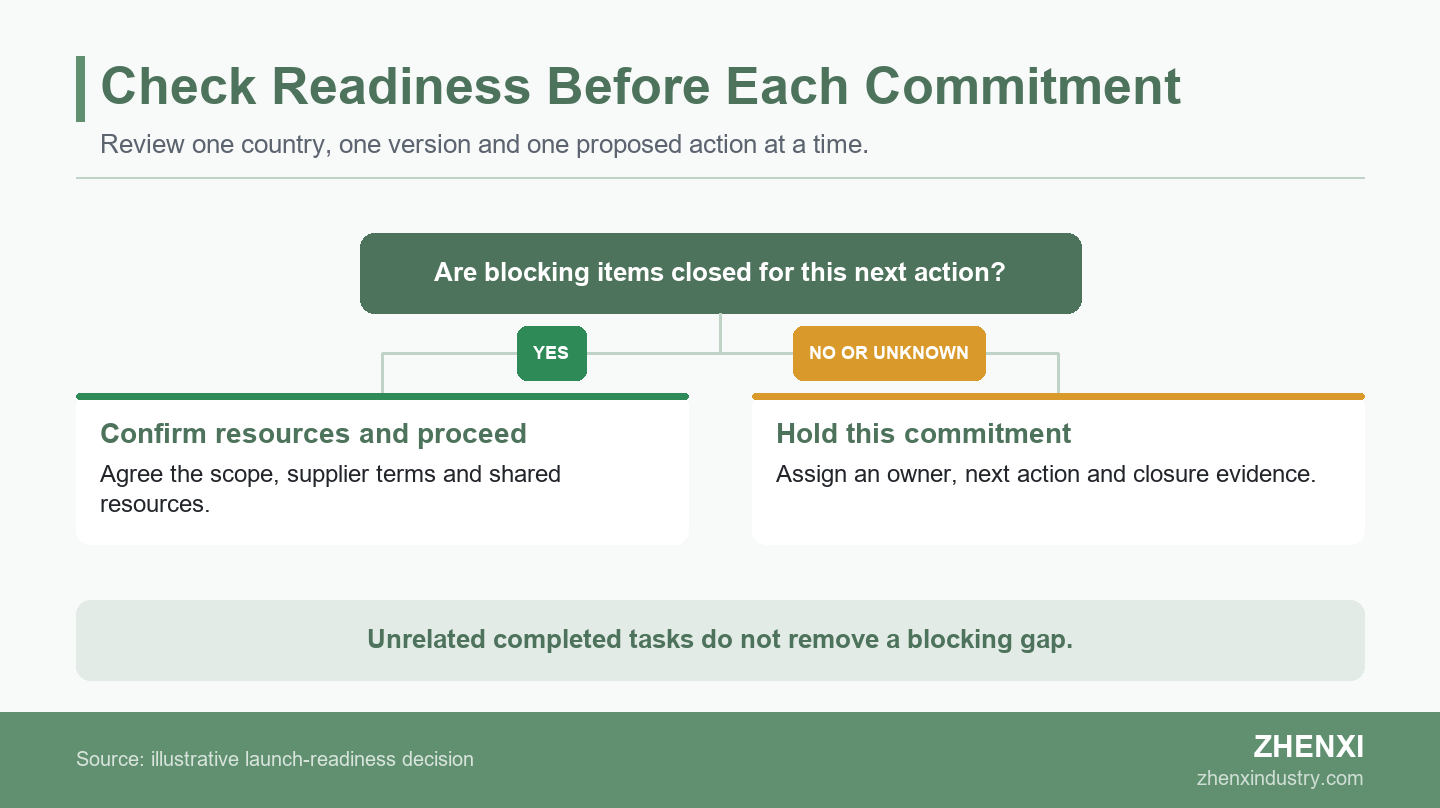
Choose the first market from the versions that can support the next commitment, then compare confirmed channel opportunity and available resources among those eligible options. Readiness qualifies an option; it does not prove that the option is commercially worthwhile.
Define the next commitment: development work, dedicated packaging, production scheduling or shipment.
Keep a separate readiness row for each destination and product version.
Treat a blocking gap as unresolved even when other tasks are complete.
Compare channel commitments, costs and resource needs among the options that can proceed.
A blocking item is something that prevents the particular commitment under review. Missing final artwork may stop dedicated printing while allowing some development discussions to continue. An unconfirmed importer may stop a shipment plan even if the product sample is satisfactory. Name the commitment before deciding whether a row is ready.
If no commercially viable version is eligible, use the matrix to assign the missing work. Launching the least incomplete option would not solve its outstanding dependencies.
Separate Target Countries from Active Launch Projects
A target country becomes an active launch project when the brand can identify a local partner, a defined channel and the people responsible for the unresolved product and market questions. A distributor conversation is an opportunity to investigate; it is not yet a completed launch plan.
Ask what the partner can substantiate: the intended adult channel, receiving arrangements, product expectations and the purchasing decision it is prepared to discuss. Keep an expansion wish list separate from countries with an actual project owner and an agreed next step.
SFDA’sFood Products Registration Guideincludes an energy-drink application review covering the product label and submitted data.
These are scoped official examples, not a comparison of which destination is easier. They show why a general “Middle East ready” status is insufficient for a project decision. Have the responsible local party identify the current checks for the actual destination, product and channel. Keep the result and supporting references in that country’s row rather than carrying a completed status across the region.
The local reviewer determines the requirements and their application; the launch team uses the resulting status to decide what it can commit to next.
Build One Readiness Row for Each Market and Version
Keep the country, partner, product reference, local review status, packaging version and responsible owner visible in the same readiness row; unknown is not complete. Each status should point to the evidence or decision on which it depends.
Copy this fillable market-readiness matrix into your project file. Add a row when the destination or reviewed product version differs. Use the same product references as the supplier so the team can tell which formula, can size and artwork are being discussed.
Market-readiness matrix — complete one row per country and version
Choose status words the team can apply consistently. “Not started,” “awaiting a named input,” “under review” and “confirmed for this version” describe different situations. Record the reference and date behind a confirmed status. “Submitted” should remain under review until the required outcome is known.
Alongside the matrix, keep the commercial assumptions for each row: order quantity and flavor split, budget, receiving location and desired launch window. A product version can be technically settled while its proposed order remains commercially unworkable. Ask the supplier to confirm the minimums and supply conditions that apply rather than importing assumptions from another version.
Related packaging and product-planning background is available in thebeverage buyer resources. Use that background to prepare questions; use project-specific evidence to close the matrix fields.
Use the Matrix to Choose the Next Commitment
In this hypothetical example, Market A can move to scheduling, Market B waits for its artwork review, and Market C remains in partner development.
Apply the decision to each country and version separately. Closing one row does not release the other markets.
Assume one brand is considering all three markets. For Market A, the partner and channel commitment are confirmed, the product and relevant local reviews are complete for the specified version, and the budget and supplier feasibility have been checked. Market B has a confirmed partner and product direction, but its destination artwork is still under review. Market C has generated interest without a confirmed importing partner.
Hypothetical market rows and their different next actions
Market
Present evidence
Unresolved dependency
Next action
Commitment now
A
Partner, channel, product/local review and artwork confirmed; commercial basis checked
Final supply-slot confirmation
Procurement confirms the schedule for the frozen version with the supplier
Advance to scheduling; authorize production only after the final schedule and terms are agreed
B
Partner and product direction confirmed
Destination artwork review
Brand project owner obtains the reviewer’s result against the identified artwork
Hold dedicated printing; reassess when the review closes
C
Initial channel interest
No confirmed importing partner
Country project lead establishes the partner and channel basis
Continue partner development; do not treat shipment as scheduled
The rows answer different commitment questions. A has enough evidence to enter scheduling, but the unconfirmed slot still prevents a final production commitment. B may continue appropriate development discussions while dedicated printing waits. C needs a partner decision before the team can build a credible import and receiving plan.
Counting completed cells would blur these differences. B could have many finished administrative tasks and still lack the artwork outcome required for printing. Keep the blocking condition visible instead of converting unknowns into a readiness percentage.
Now consider a change: B’s artwork review closes. Update its evidence and compare A and B on confirmed purchase opportunity, total project cost and the team’s ability to support each launch. A still does not win automatically. If its commercial basis weakens, waiting for B may be the better business decision. Record that reason rather than disguising a commercial choice as a technical status.
If B’s review instead requires a product change, identify the affected formula, artwork and commercial assumptions before returning it to the sequence. A proposed correction is another action to complete, not evidence that the reviewed version is already settled.
Give Every Open Item an Owner and a Closure Test
An open item needs a named owner, a specific next action, a target date and an observable closure condition. “The importer is handling it” does not tell the launch team what response to expect or what the response must address.
Assign a person to coordinate each unresolved item, then identify the party whose answer is needed. The brand product manager may obtain a formula clarification from the manufacturer; the country project lead may obtain the local reviewer’s response; procurement may confirm the commercial effect. Coordination responsibility does not give that person authority to approve another party’s work.
Write the closure condition as an outcome that can be checked. For artwork review, it might be a recorded decision against the exact file reference, including any conditions to resolve. For supplier feasibility, it might be confirmation of the proposed formula, pack and quantity combination. A forwarded email saying “looks fine” without identifying the version leaves room for disagreement.
Keep a compact action line with each gap:open question — owner — next action — due date — close when — evidence reference.Complete the blanks with actual project details. If the due date passes, update the dependency and its effect on the next commitment rather than silently retaining the old launch date.
Thebeverage OEM FAQscan help prepare supplier questions about artwork, quotations or ordering. The answer that closes your item should still refer to the current project. General website guidance does not confirm a production slot or approve a specific country version.
Freeze a Market Version Before Booking Supply
Freeze the reviewed product and artwork references for each market before booking against them, and reopen the affected decision when a relevant version changes. A freeze means the team agrees which files and specification are being committed; it does not prevent controlled changes.
The record should connect the destination, flavor/formula reference, sugar direction, can size, case pack, artwork file and local review evidence. Include the current quantity and the supplier confirmation used for scheduling. This lets the brand, importer and manufacturer check that they are discussing the same product.
GS1 says the brand owner normally allocates theGlobal Trade Item Number, regardless of where or by whom the item is manufactured. This identifier is commonly abbreviated as GTIN.
Identify who manages the product-reference and identifier decision in your project. A country row or artwork revision does not, by itself, establish whether a new identifier is needed; have the responsible party check the applicable rules for the actual change. The sequencing record should retain the result so the commercial and packaging teams use consistent references.
If flavor, composition, size, supplier arrangement or artwork changes, ask which prior reviews and costs are affected. Keep the earlier version in the history, identify its replacement and prevent the obsolete file from reaching production. Reuse unaffected work where the responsible parties confirm that it still applies.
To clarify the product side of a proposed version,review ZHENXI energy drink optionsalongside your formula, packaging and quantity brief. Ask for project-specific feasibility and available alternatives before treating the version as settled.
Run Markets in Parallel Only When Each Row Can Proceed
Parallel launches are a workable option only when each market version has closed its own blocking items and the shared production, budget and review resources can support both. Similar packaging does not establish a shared release date.
Check the common dependencies explicitly: development time, printed packaging, production arrangements, funding and the people needed to review changes. A delay in one destination should have an identified effect on the other. Decide whether the ready version can proceed independently or whether the economics require a combined commitment.
For a staged launch, record the condition for the later market to re-enter scheduling. That might be a completed review or a confirmed partner, not simply “after the first launch.” Early preparation can continue where appropriate, but any spend exposed to an unresolved version should be a deliberate budget decision.
To discuss the supply implications,send your market-launch briefto ZHENXI. Include your buyer-owned brand and channels, destination list and proposed first market, formula and flavors, sugar direction, can size and packaging, design status, total single-order and per-flavor quantities, and target launch dates. Attach the current version references and unresolved actions. Ask which product options, minimum-order conditions and scheduling assumptions need confirmation; price, MOQ, certification, sample availability and delivery remain project-specific.
Market-Sequence Questions from Energy Drink Buyers
Should the largest market always be the first launch?
No. Compare commercial opportunity among versions that can support the next commitment, rather than treating market size as a substitute for readiness. A large addressable audience does not establish a confirmed importing partner, viable order or completed product review. Among eligible options, consider the strength of the channel commitment, total costs and resources needed. If a ready market lacks a worthwhile commercial basis, record the decision to wait rather than forcing it into the first wave.
Can one formula and pack serve several countries?
Possibly, but confirm the exact shared version against each destination instead of assuming that one market’s review covers the others. Keep separate country statuses even when the underlying specification is shared. If a later review requires a change, establish whether the change affects only that destination or the common version. Update the relevant product, artwork and commercial references before making another commitment. Similarity can reduce repeated work where confirmed; it does not replace destination-specific verification.
What if two markets become ready at the same time?
Consider a parallel launch only after confirming that both market versions and the resources they share can proceed. Check whether the supplier arrangements, budget and review team can support the combined workload. If a common dependency remains open, keep the proposed timing conditional and assign an owner to resolve it. You can also sequence two ready markets when that better matches confirmed orders or available resources. Readiness creates an option; it does not oblige the brand to launch simultaneously.
Should a distributor’s proposed date set the production schedule?
Use the proposed date as an input, then work back through the unresolved dependencies before confirming a production commitment.
A proposed launch date is a planning target until the dependencies and the supplier schedule have been confirmed. Record which product version and quantity the date assumes, and what still needs to happen. If a dependency changes, revise the affected schedule with the parties involved instead of keeping an unsupported date in the readiness matrix.