Non-alcoholic beer looks simple on the shelf, but it is not a simple product to build. A private label brand must decide how the drink should taste, how much alcohol it may contain, which format fits the channel, and how the supplier will control stability before mass production. For a non alcoholic beer OEM project, these decisions affect both consumer acceptance and production cost.
This guide is written for beverage brands, importers, distributors, and retail buyers preparing a private label non alcoholic beer line. It focuses on practical checks before production, from product positioning to sample approval, packaging, MOQ, and supplier capability. The aim is to reduce avoidable mistakes before the first commercial batch.
The first decision is the alcohol level. Many buyers use terms such as alcohol-free, non-alcoholic, low-alcohol, and 0.0% beer as if they are the same, but they can create different expectations in retail and export markets. A product with an alcohol content of ≤0.5%VOL should not be presented as 0.0% beer unless the formula and testing support that claim. This matters for packaging text, customs documents, buyer communication, and consumer trust. In an ODM project, the buyer and manufacturer should confirm the target market definition before artwork approval. For a private label non alcoholic beer, clear positioning also helps decide whether the product should sit closer to beer, soft drinks, adult social beverages, or wellness-oriented alternatives.
After the alcohol level is clear, the next question is flavor direction. Some brands want a beer-like profile with malt aroma, light bitterness, and familiar carbonation. Others prefer fruit-led non-alcoholic beer drinks for casual drinking, party packs, or younger retail shelves. The two directions need different sample standards. A classic craft non alcoholic beer should not taste like a sweet soda, while a fruit beer concept should not carry harsh bitterness that conflicts with the fruit profile. Zhenxi’s non-alcohol beer range includes 250ml fruit-flavored options and a 500ml alcohol-free beer in a standard can, so buyers can plan either a light flavor series or a more traditional beer-style product.
A common weakness in alcohol-free beer is a thin body. When alcohol is reduced, the drink can lose body, texture, and finish. Before approving a sample, buyers should check whether the malt base has enough presence, whether the sweetness feels balanced, and whether the bitterness suits the audience. For a craft non alcoholic beer aimed at adult social drinking, a clean finish is usually more useful than a heavy bitter note. Carbonation also needs careful testing. Too little carbonation can make the product seem flat; too much can push it toward soda. Buyers should test the sample chilled and at moderate room temperature, because export products may face different storage conditions before sale.
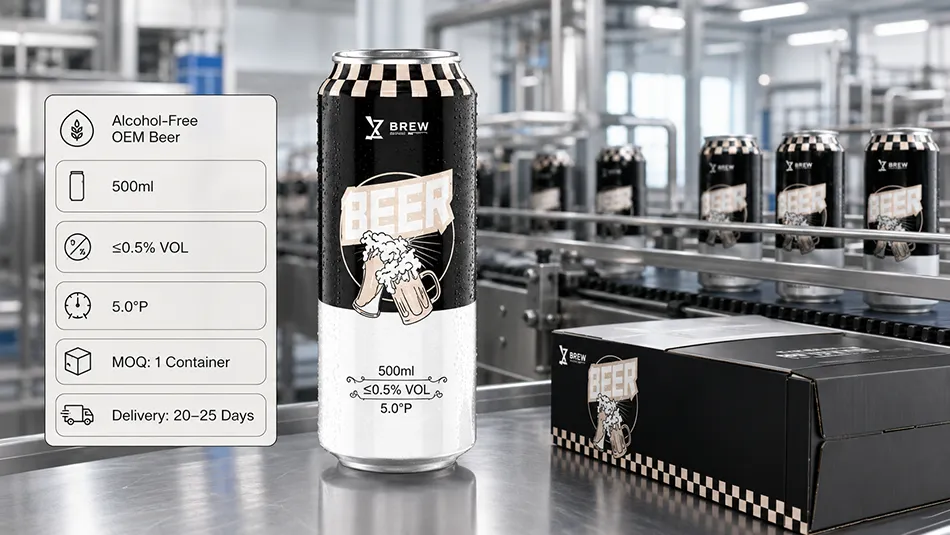
The 500ml Craft Brewing Alcohol-Free Beer uses water, malt, rice, hops and products, with 5.0°P wort concentration and ≤0.5%VOL alcohol content. These confirmed parameters make it suitable as a practical reference when buyers compare beer-style positioning, can size, and production requirements.
|
Production item |
Confirmed specification |
|
Net content |
500ml |
|
Alcohol content |
≤0.5%VOL |
|
Wort concentration |
5.0°P |
|
Shelf life |
365 days |
|
MOQ |
1 container |
|
Delivery time |
20–25 days |
Aluminum cans are practical for canned non alcoholic beer because they are light, stackable, opaque, and suitable for printed branding. A 500ml standard aluminum can gives a familiar beer feel, while 250ml fruit beer options may work better for sampling, smaller portions, or multi-flavor shelf displays. Packaging should follow the brand’s actual channel. Foodservice buyers may prefer familiar serving sizes. Convenience stores may favor easy storage and clear shelf identity. Online sellers may care more about carton protection and weight. This is where packaging and formula should be discussed together, not as separate tasks.
A good liquid can still fail if the can design is unclear, non-compliant, or difficult to reproduce on metal. Before production, buyers should prepare brand authorization, trademark documents, business license information, and editable artwork files when custom printing is required. For a non alcoholic beer ODM project, design work should start early because flavor positioning affects visual style and label wording.
Choosing an alcohol-free beer manufacturer should involve more than a sample tasting. The factory must be able to repeat the approved result across production batches. ZhenXi Industrial has a 20-year factory history, 12 production and manufacturing bases, 55 production lines, and 96 sets of inspection and testing equipment. These figures matter because non-alcoholic beer production involves liquid preparation, filling, coding, packaging, storage, and export coordination. The product must also remain stable after transport and warehousing.
Buyers should ask how the manufacturer checks raw materials, manages filling hygiene, confirms alcohol level, handles packaging inspection, and records finished product quality. Strong process control cannot guarantee a market hit, but it reduces production risk before launch. For a private label beer launch, this control is especially important because the buyer’s brand is attached to every batch.
The difference between OEM and ODM is not only a wording issue. In a non alcoholic beer OEM project, the buyer usually brings a clearer product reference, formula direction, target can size, or brand concept. The manufacturer focuses on production execution, filling, packaging, and delivery. In a non alcoholic beer ODM project, the buyer may need more help with flavor direction, sweetness, beer body, packaging concept, and product structure. Zhenxi’s OEM beverage service covers requirement discussion, R&D formulation, can size confirmation, sample testing, mass production, can filling, and export shipping. This workflow is useful when a buyer has a market idea but still needs a manufacturable product plan.
For a craft non alcoholic beer line, ODM support may be helpful at the early stage because small changes in sweetness, bitterness, carbonation, and aroma can change the drinking experience. OEM can be more efficient when the buyer already has a fixed benchmark and wants stable execution.
A vague inquiry often slows down sampling and quotation. Before contacting a supplier, the buyer should prepare a clear brief. It can be simple, but it should include enough commercial and technical details for the factory to respond accurately.
This is a practical way to compare suppliers more fairly. If one brand requests a 500ml classic alcohol-free craft beer for retail, and another requests a 250ml fruit beer variety pack, the formula, packaging, cost, and MOQ may be very different. A clear brief helps both sides avoid repeated revisions and unclear price discussions. For additional context on flavor-led product ideas, buyers can read our blog on non alcoholic flavoured beer in craftsmanship before finalizing a fruit beer or classic malt direction.
A non-alcoholic beer brand needs a story, but the story should come after the product is stable. Buyers should first confirm alcohol level, mouthfeel, carbonation, packaging, sample performance, and order planning. Zhenxi can fit projects that need canned production, private label support, formula discussion, and export-ready communication without turning the cooperation into a complex multi-supplier process. We can support buyers who already have a clear beer concept and buyers who need more early-stage product direction.
When the product brief is ready, send the target market, alcohol level, flavor direction, can size, and expected order plan to our team. Share your non-alcoholic beer production plan with Zhenxi, and we can help check whether the project is better suited to OEM production, ODM development, or a staged sampling process.
Q: What should buyers confirm before starting a non alcoholic beer OEM project?
A: Buyers should confirm alcohol level, target market, flavor direction, can size, artwork status, MOQ, delivery expectations, required documents, and sample testing standards. These points affect formula work, packaging preparation, cost calculation, and export planning.
Q: Is private label non alcoholic beer suitable for fruit flavors?
A: Yes, if the target channel supports lighter and more approachable drinking scenes. Fruit-led products can work for variety packs, casual retail, and younger beverage shelves, while classic malt styles may suit beer replacement and social drinking occasions better.
Q: How is non alcoholic beer ODM different from OEM production?
A: ODM usually includes more early product development support, such as flavor adjustment, formula direction, packaging concept, and sample refinement. OEM is more suitable when the buyer already has a clear product reference or finished brand concept.


