Heat alone does not make an electrolyte drink appropriate: the decisive question is whether a documented work pattern creates sustained sweat loss after water access, cooling and recovery controls are already in place.
That order matters. A drink can be part of a narrowly defined supply decision; it cannot cool a work area, shorten an unsafe task, restore a missed break, or determine whether a worker needs medical attention. For workplace safety and procurement teams, the useful question is therefore not “Which drink should we buy?” but “Which work conditions have changed enough to justify a category review?”
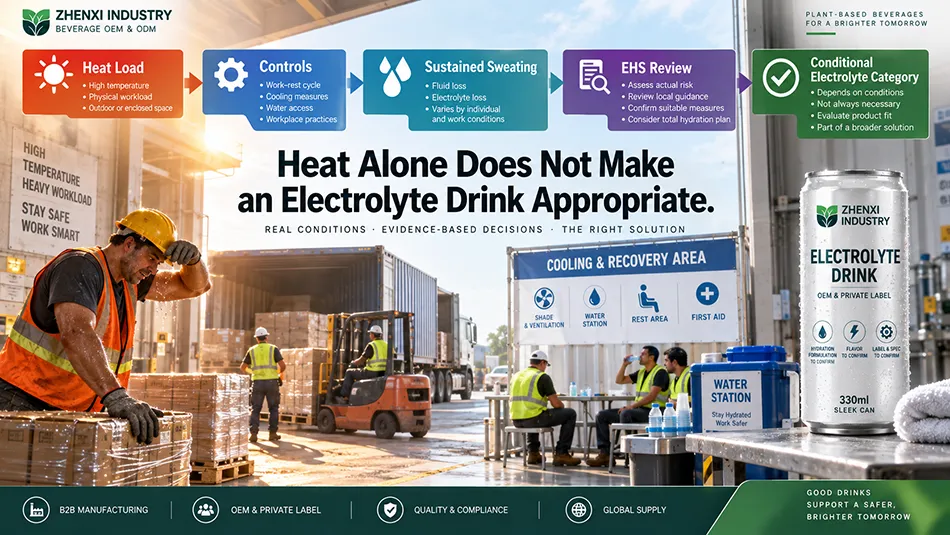
A workplace may consider an electrolyte-drink category after it has documented sustained sweating, confirmed that heat controls are working, and assigned EHS and local-rule ownership. A hot shift by itself is not that decision.
This is a decision guide, not an individual hydration prescription or a legal standard. It keeps three boundaries visible: temperature is only one part of heat stress; product selection comes after controls; and any possible heat-related illness exits the procurement path. Those boundaries make the article useful for a purchasing conversation without asking a beverage supplier to make a safety or treatment claim.
A worksite heat assessment must consider specific job conditions before controls are selected. CCOHS heat-control guidance frames heat exposure as more than air temperature: radiant sources, humidity, workload, clothing, air movement and the work-rest pattern can all change the heat burden. Here, EHS means the environment, health and safety function that owns the site’s heat measures. That is why a product label cannot answer the suitability question by itself.
Use the following distinctions before anyone writes a category brief:
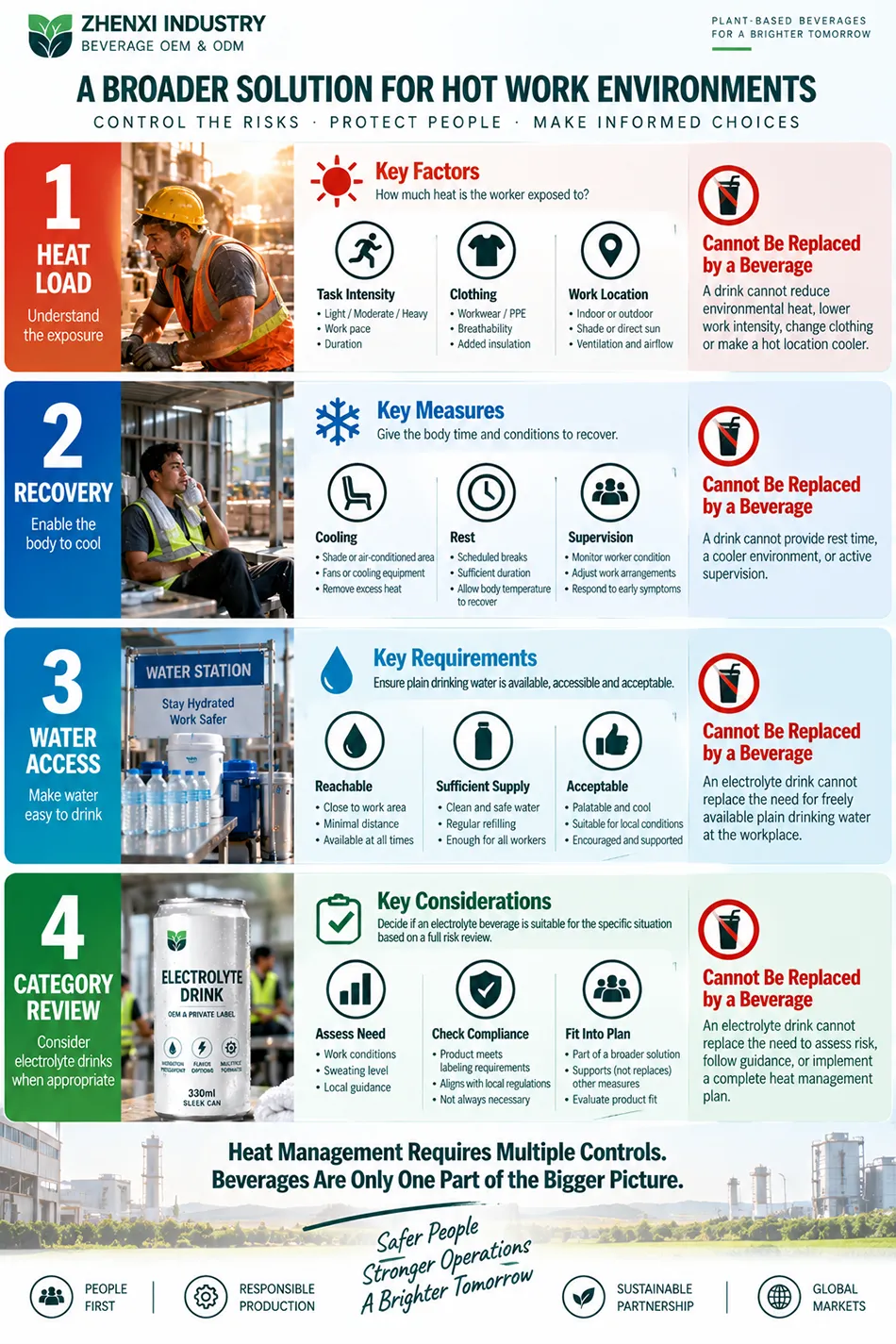
The distinction prevents a common handoff failure: calling a beverage purchase “heat control” because the workplace is hot. A category may support a plan once a qualified work pattern has been assessed. It cannot stand in for the assessment.
A useful record also separates observations from conclusions. Record the work zone, task pace, clothing or PPE, access constraints and recovery arrangement first; then let EHS decide whether those observations create a category question. This avoids turning a manager’s concern or a buyer’s preference into an untested claim about every worker on the shift.
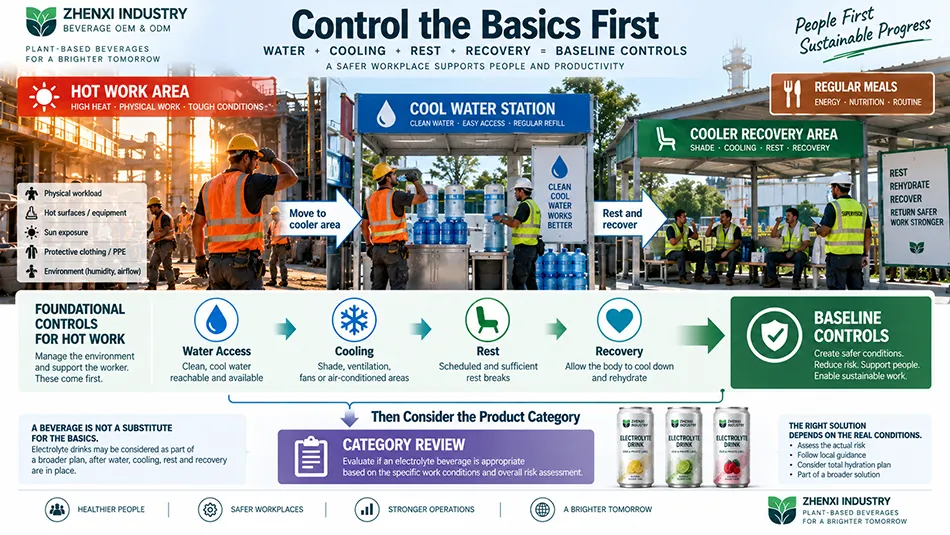
For acclimatized workers, a normal diet is usually sufficient to maintain electrolyte balance in body fluids. In its Heat Stress Guide, OSHA notes that commercial replacement drinks containing salt are not necessary for acclimatized people when normal summer diets provide enough salt. This is U.S. occupational guidance with a defined scope, not a universal rule for every worker, region or medical circumstance.
Acclimatization means gradual adaptation to hotter work conditions. It is relevant because a new or returning worker, a different workload, or heat-retaining protective clothing may change the site’s assessment. Regular meals are similarly part of the worker’s normal context, not a product claim. The practical baseline is a work arrangement in which people can obtain cool water, take planned recovery breaks and maintain their usual food access.
Frequent cool-water access should be planned rather than triggered only by thirst. The UK HSE dehydration guidance emphasizes cool water, notes that thirst is not the only useful signal, and explains that substantially greater sweating can create a salt-replacement question. For an EHS manager, that makes location and access part of the baseline: water that is hard to reach during a task is not the same as water that workers can use when they need it.
Before evaluating any alternative category, verify where water is located, when workers can leave the task, whether breaks actually provide recovery, and whether ordinary meal access is disrupted. Readers who are mapping the wider beverage side of that conversation can browse ZHENXI beverage resources; that resource path does not replace the site assessment.
For multi-zone sites, make the baseline check specific to each task rather than attaching a single label to the whole facility. An indoor packing area, a loading dock and a hot process line can share the same day while presenting different work demands, clothing constraints and recovery opportunities. The record should preserve those differences before it reaches a sourcing team.
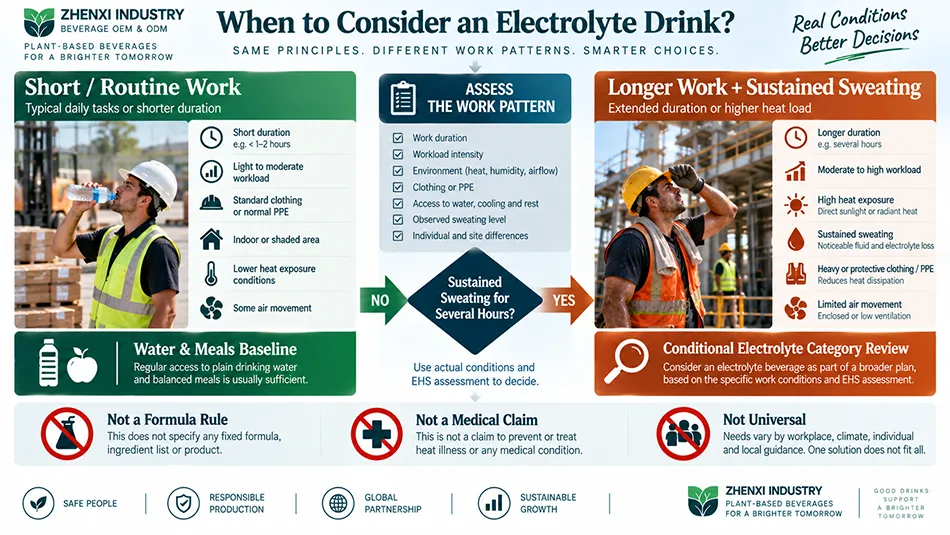
OSHA distinguishes short jobs from longer work with sweating lasting several hours when discussing electrolyte-containing beverages. Its Water, Rest, Shade guidance treats cool potable water as sufficient for short jobs and discusses electrolyte-containing beverages for longer work with ongoing sweating. That is a useful conditional trigger, not a global formula rule or a substitute for local occupational requirements.
The change in question is therefore specific: can the site show a recurring pattern of sustained sweating after it has accounted for task intensity, clothing, recovery and water access? A single hot forecast, a job title, or a worker preference does not establish that record. Conversely, a known long-duration task with heavy physical demand and heat-retaining PPE may deserve EHS review even when the air temperature looks similar to another work area.
This approach also keeps “balanced electrolytes” in the right place. It names a category that local EHS and market review may assess; it does not establish what formula, concentration, flavour, packaging or health outcome would be suitable. Those are separate product and regulatory questions.
The documentation need not imitate a clinical assessment. It can be a practical EHS record that states what work occurs, how long the repeated sweat pattern lasts, which controls operate, where the local rule review sits and what question procurement is permitted to ask. A clear record is more useful than a broad instruction to buy a “heat drink.”
Engineering and administrative controls, rest, shade and fluids are parts of the same heat-prevention system. OSHA’s prevention guidance calls for heat-hazard recognition, engineering and administrative controls, plus sufficient rest, shade and fluids. The order is important: if recovery is unavailable or the task can be changed to reduce heat stress, repair that worksite gap before discussing a beverage category.
In practical terms, confirm that the cooling or recovery location is usable, the break plan fits the actual task, water is accessible near the work, and supervisors can adjust work when the heat burden rises. A beverage brief cannot compensate for missing air movement, a poor work-rest arrangement, or protective clothing that has not been considered in the site plan.
Sustained sweating, confirmed controls and EHS/local review are three separate conditions for a category brief. This is an editorial handoff model, not a medical screen or legal threshold. Its value is that it prevents a team from treating one observation—“the work is hot”—as evidence that every other condition has been met.
Record the task and work zone, the pattern and duration of physical effort, clothing or PPE constraints, access to water and meal breaks, and the control measures already in operation. EHS can then decide whether the pattern creates a conditional category question. Procurement receives a narrower output: the destination market, permitted category language, package and label requirements, and the explicit instruction not to convert the discussion into a safety promise.
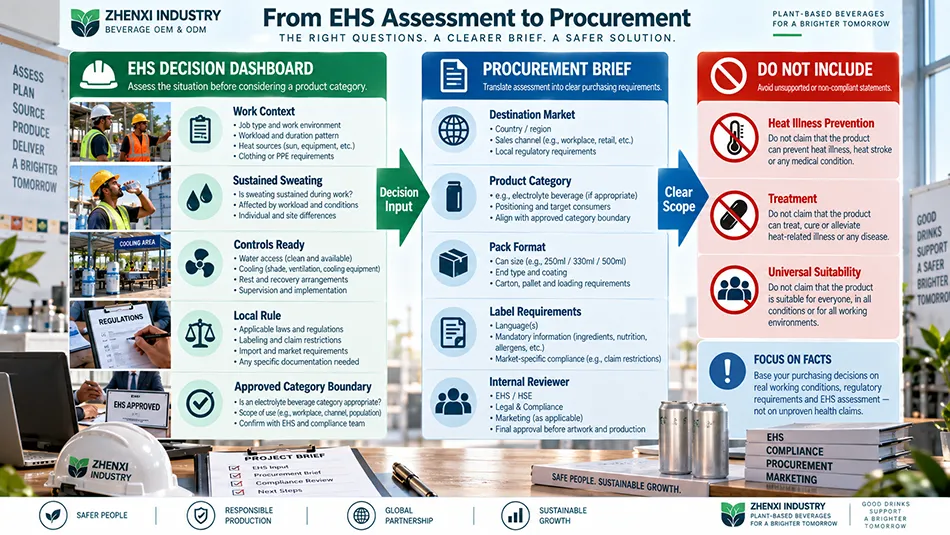
Procurement should translate an EHS decision into a market-scoped category brief rather than a safety or treatment claim. A supplier should receive the category boundary that EHS has approved, not an instruction to solve workplace heat exposure through a product. This keeps safety ownership with the site and avoids unsupported claims about hydration, prevention or individual suitability.
| EHS confirms | Procurement carries forward | Keep out of the supplier request |
|---|---|---|
| The defined work context and the reason it differs from the routine water-and-meals baseline. | Destination market, intended product category, pack format and reviewed label requirements. | Claims that a drink prevents heat illness, replaces controls or suits every worker. |
| That water access, cooling, rest and recovery controls are operating. | Which internal owner will review product and market information before approval. | Assumed formula, certification, lead time, minimum order or performance facts not supplied by verified documentation. |
Based on this comparison, the supplier conversation starts with scope and market facts, not a physiological claim. It does not establish that any listed item is appropriate for a particular worksite or worker. If the resulting brief is a legitimate category inquiry, procurement can review the ZHENXI Energy Drink category as a category-level reference.
Before moving on, record the internal approval owner, the intended market, the required package and label information, and the exact wording that must not appear in product communication. That record prevents an ordinary sourcing exchange from gradually becoming a safety assurance. For general production-process questions after the EHS boundary is settled, buyers can check Beverage OEM FAQs.
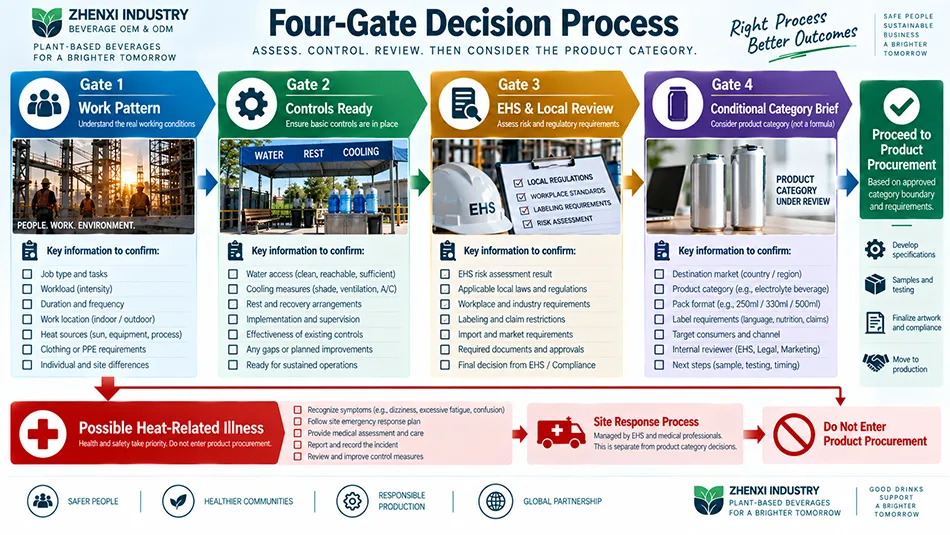
When possible heat-related illness is present, the product conversation ends and the site response process begins. OSHA’s first-aid guidance cautions against trying to diagnose which heat illness is occurring because symptoms can overlap, and it directs prompt first aid and emergency action. The product brief should never delay that response.
For the same reason, this page does not tell an individual what or how much to drink. Workers may have personal health factors, medication effects or employer procedures that change the correct response. EHS should use the governing site process, appropriate professional input and local occupational rules. Procurement should pause its category work when those questions are unresolved.
Local requirements can also vary by jurisdiction, sector and work setting. U.S., UK and Canadian occupational references clarify how agencies frame these decisions, but each employer must follow the rule set that governs its own site. The local review condition exists because category availability, labelling and workplace duties are not interchangeable.
Three recorded conditions determine whether procurement can proceed, must repair controls, or should exit to the site response process. The model is deliberately simple: it turns a safety-sensitive topic into a shared handoff without pretending to rank formulas or diagnose workers.
An illustrative handoff has three recorded conditions and three possible routes: proceed to a bounded category brief, repair a control gap, or stop for the response process. The count is a workflow aid, not a health threshold. It gives EHS and procurement a common record while preserving the limits of each role.
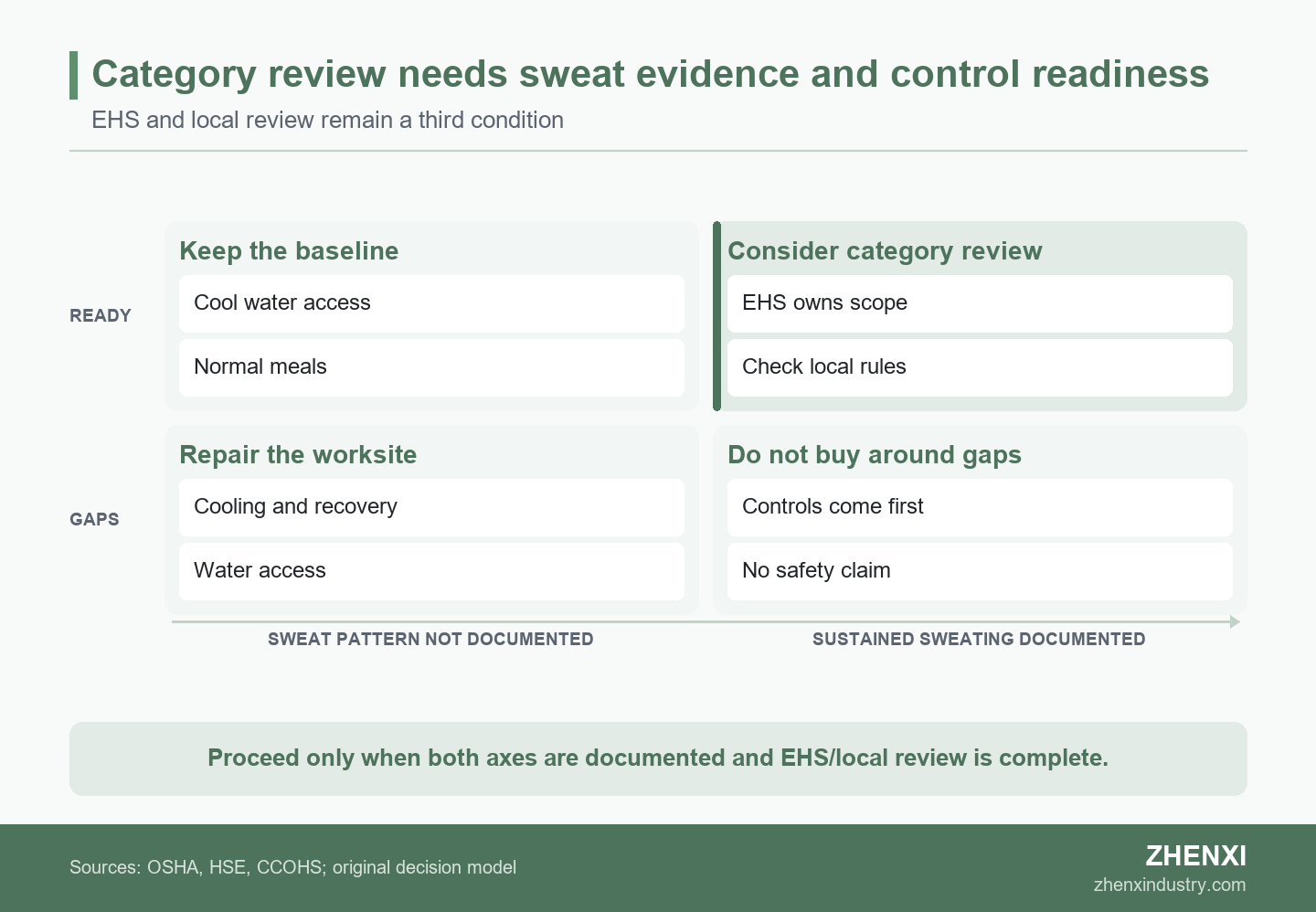
When all three conditions are documented, a procurement lead can assemble the work context, destination market, EHS-approved category boundary and packaging or label requirements, then request a target-market product-spec discussion.
The requested discussion should remain market-scoped and should not include safety, treatment or universal suitability claims.
No. Heat alone does not make an electrolyte drink necessary for every shift. Short work and a normal water-and-meals arrangement may remain the baseline, while U.S. OSHA guidance treats longer work with sweating as a different context. EHS should assess the actual task, controls, local rules and worker-response boundary instead of applying one category to every heat-exposed role.
No. A beverage category does not replace cooling, rest, shade or other worksite controls. Those measures reduce the heat burden or support recovery; a drink cannot perform either function. If the site cannot show that water access, recovery and task controls are working, the appropriate next action is to fix that gap rather than turn it into a product request.
Prepare the destination market, documented work pattern, EHS category boundary, and packaging or label requirements. Add the named internal reviewer and record that the request is not for a heat-illness prevention or treatment claim. This lets a supplier discuss a defined category and market scope without taking ownership of workplace controls or individual health decisions.


