A caffeine ingredient does not settle the risk in a hot-weather beverage concept. The risk starts when an energy phrase and a hydration phrase share package space before the formula version, serving basis, destination market and exact wording are tied to the same record. That gap can produce artwork that looks commercially coherent but cannot yet be reviewed as one defined product.
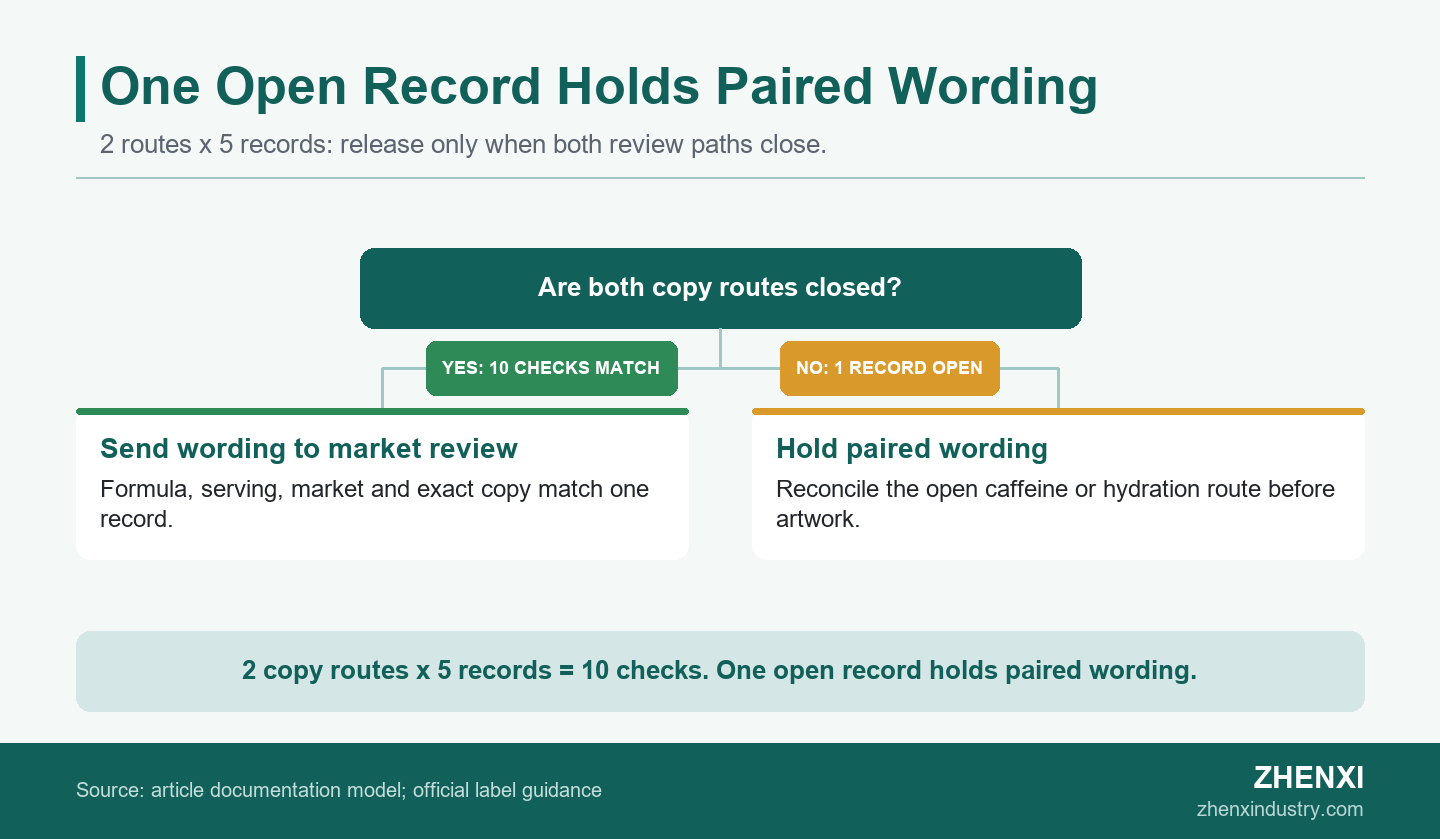
Two copy routes multiplied by five records make ten confirmation points for one paired caffeine-and-hydration wording decision. A paired line has two copy routes: separate review paths for the energy phrase and the hydration phrase. For each route, the buyer needs the same five records: the approved formula version, the total caffeine source record, the serving and package basis, the destination-market label route, and the exact words to be printed. This is an illustrative documentation model, not a legal test or a safety assessment.
| Record to match | What the buyer needs to see | What stays on hold if it is open |
|---|---|---|
| Formula version | Ingredient identity and the version under review | Any statement tied to that formula |
| Total caffeine record | Relevant caffeine sources reconciled for the product | Caffeine-related amount or warning work |
| Serving-package basis | Declared serving, container and final pack format | Per-serving or per-container copy |
| Market label route | Named destination and responsible reviewer | Warning, declaration and claim treatment |
| Exact wording | The energy and hydration phrases proposed for the panel | The paired front-panel message |
That record set creates a more useful question than “does this drink have caffeine?”: which wording depends on which incomplete record? It gives product, compliance and packaging teams a way to isolate the next decision instead of arguing from a flavour concept, a can mock-up or a single ingredient number.
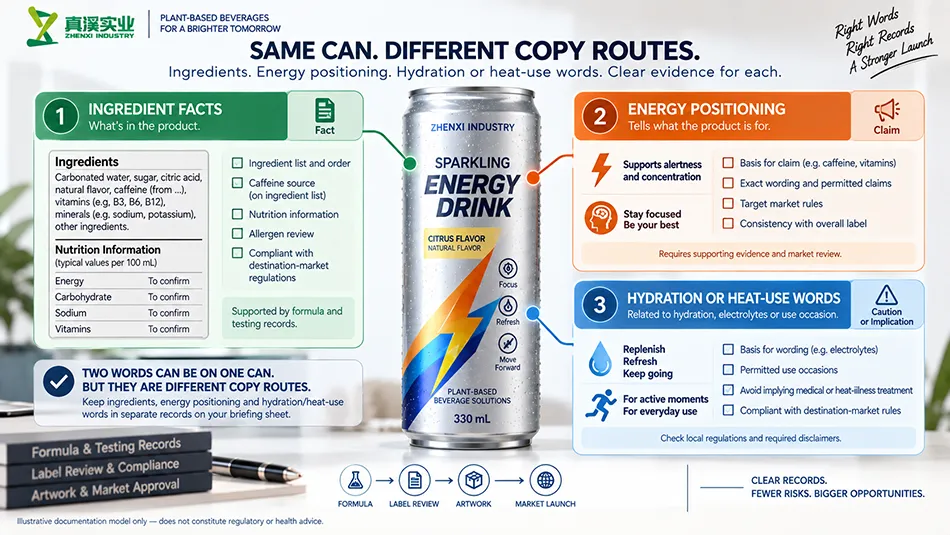
An energy phrase and a hydration phrase are different copy routes, even when they occupy the same front panel. “Energy” may point the reader toward caffeine or the wider product category; “hydration” asks a different question about the product, the use context and the permitted wording. Hot weather makes the combination tempting because the occasion feels unified. The evidence and label questions are not unified, so the language should be separated before it is polished into a slogan.
A practical briefing sheet therefore keeps three columns apart: ingredient facts, energy-positioning words, and hydration or heat-use words. The team can then ask whether a phrase is a factual listing, a caution-related statement, a nutrition or health claim, or an unsupported implication. This prevents an electrolyte reference from quietly becoming a promise about what caffeine will do in heat.
ZHENXI’s public energy-drink category can frame an OEM conversation, but it does not verify caffeine content, serving size or permitted wording for a proposed product. The public ZHENXI Energy Drink OEM context can help place an energy-drink concept within that conversation. Those details belong in the formula-and-market record, not in a category page or an early package visual.
In the United States, added stand-alone caffeine belongs in the ingredient list, while many packaged foods voluntarily disclose caffeine amounts. FDA guidance on caffeine labels is useful because it separates two facts buyers often blend together. A serving basis is the product quantity to which the declared amount applies; it must match the final container and package format. If a 330 mL concept becomes a 450 mL can, the team should not assume a per-can line, warning calculation or consumer-facing amount has survived unchanged.
Ask for the formula version, ingredient source record, total caffeine from the relevant sources, declared serving, container relationship and final artwork basis on one sheet. That is not a recommendation about a caffeine level. It is a way to prevent a correct-looking number from being attached to the wrong package or market file.
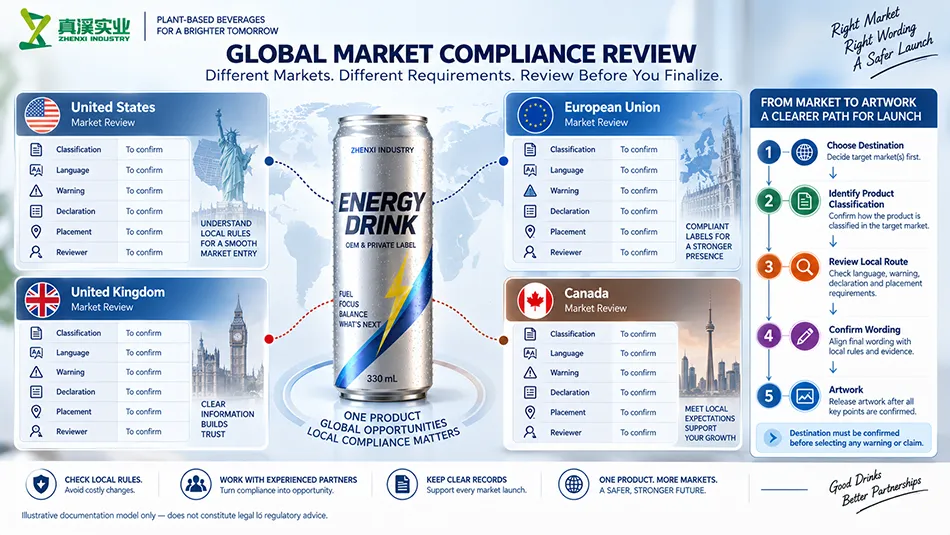
Choose the destination before finalising caffeine artwork because reviewed jurisdictions use different label routes. A market rule may depend on classification, concentration, the declared basis, language, placement, caution statements or limitations on related claims. The destination belongs near the beginning of the product brief, alongside the formula version and pack size—not as a late check after a design is approved internally.
For a buyer moving toward an OEM discussion, separate two questions: “Which country will receive this version?” and “Who owns the final label review for that country?” The public review the Beverage OEM FAQs can support the process conversation, but it should not be used as a substitute for a destination-specific legal review. The formula and artwork should be assessed against the market named in the project file.
United Kingdom guidance states that drinks over 150 mg/l must carry the specified high-caffeine statement in the same field of vision as the product name, alongside caffeine in mg per 100 ml. The lesson is not to copy the text blindly: review concentration, exception scope, declaration unit and panel placement together for the chosen market.
EU Annex III specifies a high-caffeine statement and a caffeine declaration in mg per 100 ml for specified beverages over 150 mg/l. The relevant route appears in Annex III point 4.1. The warning and numeric presentation are connected in this example. A team that receives a formula number but has not fixed the label panel, beverage category or destination has not completed the caffeine decision. Artwork should show a pending market-review field rather than treating the warning as a universal design asset.
Canadian Food Inspection Agency guidance lists a single-serving caffeine criterion, a high-caffeine statement and bilingual label information for caffeinated energy drinks, while supplemented-food guidance also addresses caution identifiers and claim restrictions. Its retailer notice gives the single-serving criterion as 180 mg or less. These are Canadian compliance examples, not a template for another destination.
FDA’s stand-alone added-caffeine ingredient-list rule is a different record path from Canada’s supplemented-food caution structure. A buyer who reuses a foreign warning because the can, flavour and caffeine source look similar can still create a documentation gap. Keep a market tab in the project packet with the product classification, applicable rule, language and label-owner name, then let that tab control the wording version sent to artwork.
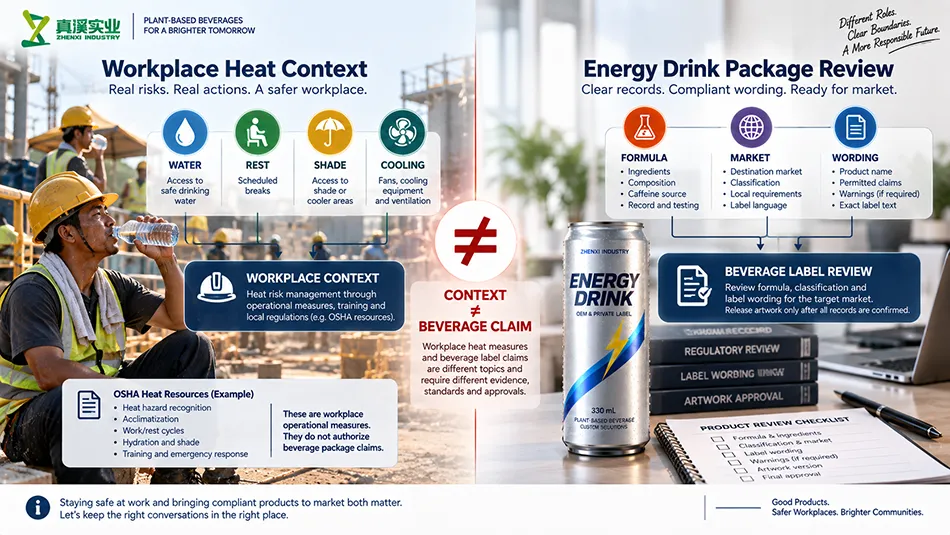
OSHA’s workplace heat resources address water, rest, shade and hydration context; they do not authorise a caffeine or hydration package claim. Its broader heat-exposure overview frames prevention around those operational controls. That context is useful for product teams, but it is not permission to convert caffeine into a safety or heat-performance promise on a package.
EFSA describes a caffeine assessment covering specified populations and combinations while excluding people affected by disease or medical conditions and medicine or drug contexts. A bounded assessment can inform a reviewer’s questions; it does not make a product’s hot-weather copy self-substantiating. Keep the occupational heat plan, product formula, label route and proposed consumer words in distinct files, then bring them together only when the responsible market reviewer is named.
For a separate supplier-context reference after those boundaries are clear, review ZHENXI Energy Drink & Fruit Tea OEM.
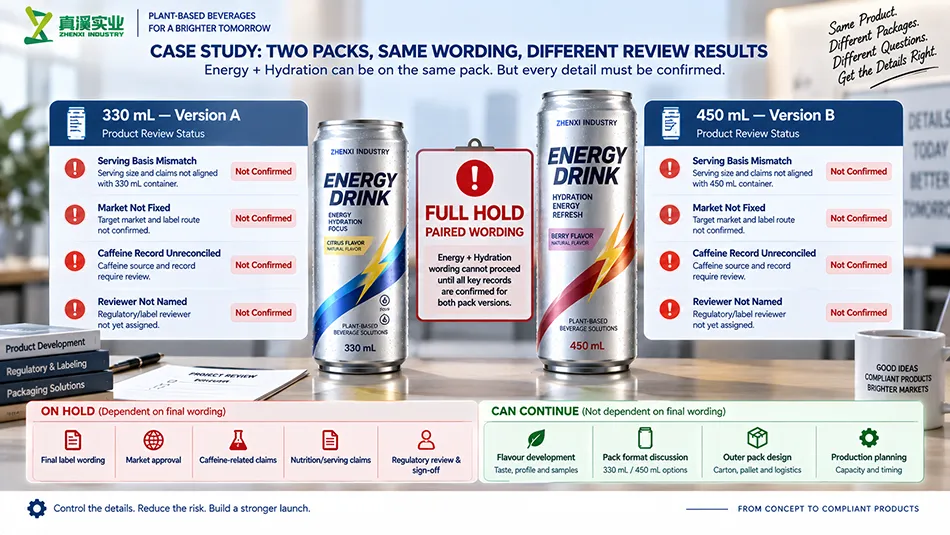
In the illustrative two-version pilot, the caffeine-and-hydration wording is held because the package basis and market route do not match one record. The hold is a copy-control decision, not a statement that the concept is unsafe, unacceptable or impossible to launch.
Reopen the words only when formula version, package basis, market route, exact copy and reviewer ownership match one record. The team should be able to point to one file and answer five questions without switching between an old formula sheet, a revised can render and an unnamed market assumption.
An importer is preparing an 18,000-can hot-weather energy-drink pilot for a retailer that has not fixed its destination market. There are 2 artwork versions: a 330 mL concept and a 450 mL concept. Added caffeine appears in the ingredient record, yet the serving declaration, warning route and proposed hydration wording have not been aligned to one final formula-market record.
The 450 mL artwork says “per can,” while the internal copy sheet still uses the 330 mL serving basis. The front panel pairs an energy phrase with hot-weather hydration language, but no destination-market reviewer is named. A third check finds that the caffeine-source total has not been reconciled with the package declaration for the version under discussion.
This is a document-product conflict: the words, package basis and market route do not describe one reviewable product. The appropriate decision is to place a full hold on the paired caffeine-and-hydration wording across both artwork versions. Neutral activities that do not depend on that wording—such as pack-format discussion or flavour development—can continue, but the held phrase cannot be treated as a nearly finished label claim.
Freeze one formula version and package basis, reconcile the caffeine record for that version, name the destination and submit the exact words with the artwork file. The verification gate closes only when the final formula, declared serving or container basis, market label route, wording and accountable reviewer all match. This is an illustrative scenario, not a ZHENXI customer case, formula recommendation or regulatory determination.
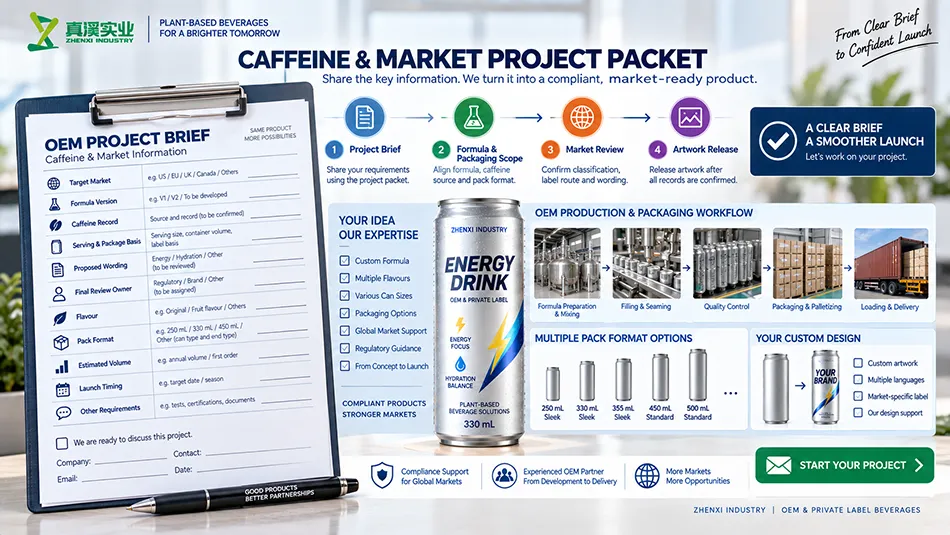
A caffeine-and-market project packet should contain the target market, formula version, caffeine record, serving-package basis, proposed wording and final review owner. Add flavour, pack format, estimated volume and launch timing when they affect scope. Keep any uncertain claim or warning field visibly open; a blank marked as pending is safer than a sentence presented as settled.
This format gives an OEM partner a usable brief. It clarifies whether the current discussion concerns formula development, package format, wording review or destination-market research, rather than rolling all of those decisions into a request for “a hydration energy drink.” An artwork release is permission to move final copy into the package file; it should follow the record match, not replace it.
Send a caffeine-and-market project brief to ZHENXI only with the information needed to scope formula and packaging discussion; final label review remains market-specific. When that record is complete, send a caffeine-and-market project brief.
Residual label questions return to the same formula, serving, market and wording record. It should not move forward as a combined claim until the formula, serving basis, target-market route and exact wording have been reviewed together. Caffeine and hydration language may sit on one panel, but they do not become one evidence question merely because the product is intended for hot weather. The reviewer should see the final panel, declared basis, product classification and local wording context, rather than an isolated slogan. Hold paired wording when either route lacks a complete record, then ask the named market reviewer to assess the final phrase in context.
No. The amount must be tied to the declared serving, container, relevant caffeine-source record and destination-market rule set. A per-can figure can change meaning when package volume, serving declaration or product classification changes. The reviewer also needs the named product category, final panel and applicable local route before deciding whether the number, declaration or related caution has been handled correctly. The useful next question is whether the formula sheet and artwork use the same basis—not whether a number has been copied onto the design.
No. Each example is a local regulatory route, not a universal warning template. The Canadian material discussed above includes retail and supplemented-food checks; the United Kingdom example links a defined threshold to warning placement and a declaration unit. A similar package format, flavour or ingredient source does not turn those examples into a reusable label asset. Before reusing either pattern, identify the actual destination, product classification, language requirements and reviewer responsible for the final label.
Send the target market, formula version, caffeine source and total, serving and package basis, proposed wording, and the person responsible for final label review. Include package format, estimated volume and launch date if they affect the project scope. If more than one can size or artwork version exists, identify the version that is actually under review. Do not substitute an intended benefit statement for those records: the decision can move faster when the supplier, packaging team and reviewer work from the same defined product.


