The August 2026 El Niño outlook is strong enough to justify tighter monitoring, but it is not specific enough to authorize a purchase, packaging change, route change, or market claim. Beverage teams should treat the global signal as an alert to gather local evidence. Action becomes defensible only when a dated official outlook, market-specific exposure, and the timing of a real commercial decision point in the same direction.
That distinction matters through early 2027 because forecast confidence and business confidence do not rise together. A team can be highly confident that a strong Pacific event is developing while remaining uncertain about rainfall, heat, transport, demand, or supply effects in a particular country. The practical task is therefore to maintain a controlled watchlist, not to convert one headline into one company-wide response.
A usable ENSO watchlist separates the global signal from the local evidence that can change a commercial decision. ENSO is the recurring tropical Pacific ocean-atmosphere pattern that includes El Niño and La Niña. Its status establishes the climate backdrop; it does not establish what will happen to a warehouse, retail channel, ingredient lane, or consumer occasion.
The watchlist should remain small enough to govern. A forwarded article without an issue date is not a controlled input, and a global probability without a geographic scope is not a local forecast. Keep background learning separate from the decision record; teams that need broader category context can browse ZHENXI beverage resources without mixing evergreen material into the live outlook row.
This structure prevents urgency from becoming authority. The climate signal can trigger questions and monitoring, while local operating evidence controls whether those questions become actions. It also makes disagreement useful: if procurement, sales, and logistics reach different conclusions, the dashboard shows whether they are using different dates, regions, assumptions, or decision horizons.
NOAA's 13 August 2026 discussion says El Niño is strengthening under an El Niño Advisory. The official ENSO Diagnostic Discussion replaces older monthly status records as the current global anchor. It should be stored with its issue date because the headline, probability, and next-review timing are a single evidence package rather than timeless facts.
The observed ocean conditions support that status. NOAA reported July sea-surface temperature departures of 1.4°C in the Niño 3.4 region, 1.7°C in Niño 3, and 2.9°C in Niño 1+2, alongside substantial subsurface warmth. Those values describe the evolving tropical Pacific system. They do not tell a beverage planner whether a specific distribution corridor will be hotter, wetter, drier, busier, or more expensive.
For a buyer, the immediate consequence is procedural. Replace any July forecast snapshot in the dashboard, preserve the August issue date, and open a new validation cycle for markets whose critical decisions fall in late 2026 or early 2027. The August update permits closer review; it does not permit an automatic volume or product decision.
Read the discussion in layers. The synopsis establishes the current status, the probability language describes the expected strength and horizon, and the impact paragraph preserves uncertainty. Copying only the most dramatic percentage removes the scope that makes the number usable. A controlled entry should therefore retain the date, wording, measurement basis, impact caveat, and next release together.
NOAA reports a greater than 90 percent chance of a very strong event during fall and winter 2026-27. RONI is a three-month index that describes relative strength against an adjusted tropical Pacific reference. The same August 2026 official outlook assigns a 69 percent chance that the October–December 2026 event will exceed the strength of previous events since 1950, using a RONI value of at least 2.5°C as the threshold.
The index is useful for comparing event strength on the official scale. It is not a 69 percent probability of disruption, demand growth, drought, flooding, or any other outcome in a destination market. The number supports a stronger watch posture, while a separate chain of local facts must support a business response.
High event-strength confidence should change the monitoring intensity. Teams with late-2026 launches, long replenishment cycles, concentrated routes, or time-sensitive artwork can shorten the interval between local reviews and move contingency questions forward. The purpose is to protect decision lead time. It is not to treat an extreme index value as a commercial forecast.
A stronger El Niño raises the chance of characteristic impacts, but it does not guarantee a particular outcome in any market. The World Meteorological Organization's June 2026 update stresses that each event is unique and that regional effects vary with the event's evolution and other climate drivers. That boundary remains necessary even after the later NOAA update raised confidence in event strength.
The information gap exists because the global event and the local outcome are different layers of evidence. Pacific conditions can alter the odds of familiar weather patterns, yet geography, season, atmospheric circulation, local infrastructure, and exposure determine what a business actually experiences. Two markets can therefore share the same global El Niño label and require different operating responses.
Monitor the event globally, validate the exposure locally, and approve the action against the decision it affects.
This rule is deliberately conservative. It lets the team prepare earlier without presenting climate uncertainty as product evidence or a demand guarantee. It also prevents a strong global forecast from overruling a current local forecast that shows limited exposure for the place and period being considered.
Market decisions require national or regional climate outlooks plus local operating evidence; a global ENSO label is not enough. WMO directs users toward national and regional climate services because a local authority can interpret the event for its own geography and season. The WMO preparedness guidance also notes that extreme weather can occur outside a declared El Niño, which is another reason not to use the ENSO status as the only trigger.
A teleconnection is a recurring statistical link between Pacific conditions and a weather pattern in a distant region. It can raise or lower the likelihood of a regional outcome, but it is not a promise that the outcome will occur in every city or week. A buyer should pair that broad relationship with the latest national outlook, a shorter-range forecast when the commitment date approaches, and company data that shows what is actually exposed.
| Evidence layer | Question it can answer | Buyer record | What it cannot authorize alone |
|---|---|---|---|
| Global ENSO outlook | Is the Pacific event present, strengthening, and likely to persist? | Agency, issue date, probability, horizon, next update | A market-specific inventory or product change |
| National or regional outlook | Which seasonal temperature or rainfall patterns have higher odds? | Geography, season, forecast map, confidence language | A facility or route response without exposure data |
| Operating indicators | Which suppliers, routes, channels, or selling periods could be affected? | Lead times, route options, stock position, service alerts, demand signals | A decision outside the indicator's scope |
| Approved decision evidence | Does the risk cross the company's action threshold? | Owner, assumption, financial or service impact, approval, expiry date | Any claim beyond the approved project scope |
Build exposure from the destination backward. Start with the country and selling window, then map the channel, route, storage point, supplier dependency, pack format, and decision date. A hot-season retail question, a port-continuity question, and a crop-input question require different evidence even when all three appear under the same climate headline.
Use a minimum local-input packet before assigning a commercial owner. It should include the place and period covered, the local authority's wording, the operating asset or channel at risk, the observation that would confirm exposure, and the last date for a low-cost response. If any of those fields is missing, the next task is information gathering rather than volume approval.
Geographic fit is only one boundary. Timing can also break the link: a seasonal pattern may not overlap the selling window, shipment, or launch gate. Operational fit matters too. A forecasted dry period may be relevant to one upstream input yet immaterial to a project with diversified supply and adequate lead time. Record the mechanism instead of assuming the category name proves exposure.
The product brief belongs at the end of that chain, not the beginning. If validated market evidence supports an Energy Drink project, buyers can review Energy Drink OEM options and then confirm formula, flavor, packaging, sampling, specifications, and commercial terms for the actual project. The climate outlook does not establish a functional benefit, a health outcome, or a universal product-market fit.
A controlled dashboard should record the source, issue date, scope, owner, next review date, decision trigger and permitted action for every signal. These fields expose stale evidence and make it clear when a regional forecast has been stretched beyond its geography, season, or purpose.
A useful row is written so that another manager can reproduce the decision. “El Niño risk high” is too vague. “NOAA global status, issued 13 August; review after the next monthly discussion; climate analyst owns the row; opens local validation only” is governable. The second version separates the evidence from the action and prevents a headline from silently acquiring commercial authority.
| Dashboard field | Minimum entry | Control question |
|---|---|---|
| Signal and source | Named agency or approved company indicator | Is this source qualified for the claim being made? |
| Issue date and horizon | Publication date plus covered season or operating period | Will the evidence still be current at the decision date? |
| Scope | Global, regional, national, route, facility, channel, or product | Has a broad signal been treated as local proof? |
| Owner and next review | Named role plus a calendar date or release event | Who refreshes the row before it expires? |
| Trigger and allowed action | Observable threshold plus observe, validate, review, or approve | What is the most consequential action this row can support? |
Keep source facts and company assumptions in separate columns. A forecast probability belongs in the source-fact column. “The route may lose two days” is a company assumption until a carrier, port, or operating record supports it. The distinction prevents a real climate source from appearing to validate an invented cost, lead-time, or demand number.
Add a short change log beneath the live rows. Each entry should show what changed, who changed it, which source or approved record prompted the change, and whether the allowed action moved up or down. This record is especially useful when teams revisit a late-2026 choice in early 2027 and need to distinguish a reasonable judgment from hindsight.
The global ENSO row should refresh after each monthly NOAA discussion, while local rows should refresh at the pace of the decision they govern. NOAA scheduled its next discussion for 10 September 2026, so the August global status should carry that next-review trigger rather than remain open-ended.
Local rows need different clocks. A seasonal outlook may be reviewed monthly, a launch plan at each approval gate, an inventory position weekly, and a route alert daily when a shipment is active. Matching cadence to consequence prevents a recently updated global forecast from making stale operational data look current.
The dashboard should show both the next scheduled review and the event that can force an earlier one. That combination preserves routine governance while allowing a carrier notice, local warning, supplier update, or material demand change to accelerate review.
Calendar reminders alone are insufficient for commitments that can lock early. Work backward from the last reversible date, allow time to collect local inputs, and place the review before the cost of change rises. This turns cadence into lead-time protection instead of a reporting ritual.
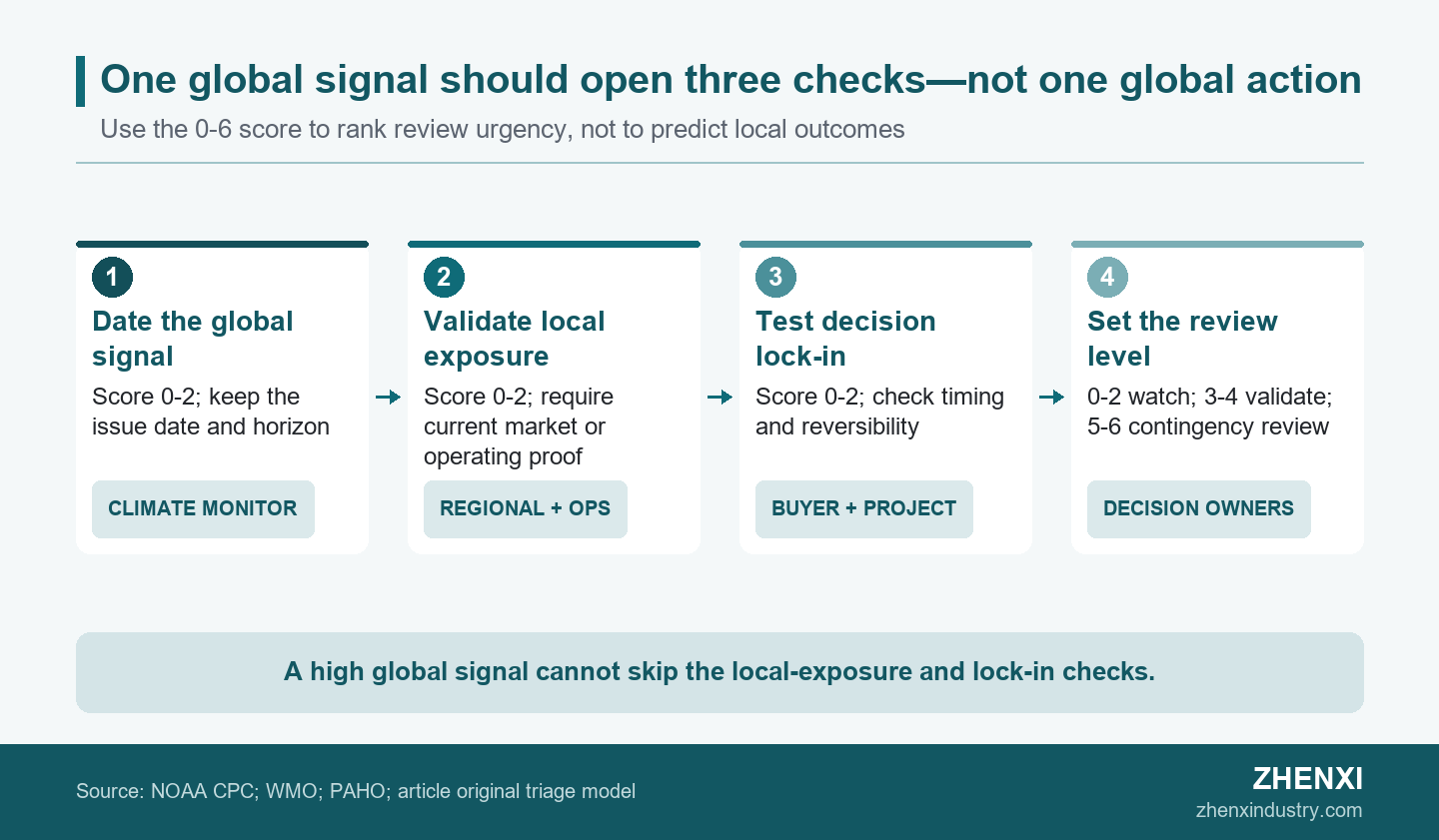
An illustrative 0-6 triage score can prioritize review effort without pretending to forecast local weather or commercial outcomes. Add three independent dimensions: official signal strength, local exposure evidence, and decision lock-in. Score each from 0 to 2, then use the total only to decide how urgently the team should review the issue.
| Dimension | 0 | 1 | 2 |
|---|---|---|---|
| Official signal | No relevant active signal | Developing or uncertain signal | Active, high-confidence signal for the decision horizon |
| Local exposure | No validated exposure found | Plausible exposure; evidence incomplete | Current local or operating evidence identifies exposure |
| Decision lock-in | Decision is distant and reversible | Lead time is narrowing | Commitment is near or costly to reverse |
Illustrative reasoning: official signal + local exposure + decision lock-in = review priority. A score of 0–2 stays on routine watch. A score of 3–4 opens market validation and assigns missing evidence. A score of 5–6 triggers contingency review by the responsible owners. The score is not a climate probability, a financial model, a safety rating, or an instruction to buy.
Consider a late-2026 packaging commitment with a strong official signal scored 2, incomplete local exposure scored 1, and a costly-to-reverse artwork date scored 2. The total is 5. That result does not prove disruption; it says the evidence gap deserves immediate review before lock-in. If local evidence later falls to 0, the total becomes 4 and the team can return to validation rather than maintain an unsupported contingency.
The score works because the dimensions fail independently. A high global signal cannot compensate for no local exposure, and a local alert cannot authorize a product change when the relevant decision remains reversible and distant. Each organization must define who can change a score, what evidence qualifies, and which approvals remain outside the model.
PAHO's 2026-2027 analysis identifies uneven potential heat, water, food, wildfire and service-continuity risks across the Americas. The regional preparedness analysis also discusses infrastructure pathways. Its geography matters: it is not a global operating forecast and not evidence for a beverage performance or health claim.
The outlook should change the questions a buyer asks before it changes inventory, packaging, routes, claims or product scope. PAHO's example shows why a broad climate event can create different local pathways. The buyer's job is to identify which pathway, if any, intersects with the planned market and then assign it to the right owner.
| Decision area | Question opened by the outlook | Evidence needed before action | Premature response to avoid |
|---|---|---|---|
| Inventory | Could an approved route, supplier, or selling-window risk reduce service reliability? | Current stock, replenishment lead time, local outlook, logistics evidence, scenario owner | Increasing volume on the El Niño headline alone |
| Packaging and artwork | Does the destination, channel, or timetable create a verified requirement or constraint? | Market brief, approved specifications, compliance review, artwork deadline | Changing claims or format without a validated market need |
| Routes and distribution | Which lane, port, warehouse, or final-mile operation is actually exposed? | Carrier notices, route alternatives, facility limits, local warnings | Assuming a regional climate pattern affects every lane |
| Product scope | Is there a buyer-approved use context and demand case for the project? | Channel, audience, use occasion, volume range, decision date, product specification | Turning climate risk into a functional or health promise |
Use reversible actions while evidence is incomplete. Increase the review frequency, request a local forecast, confirm an alternative route, or move a supplier discussion earlier. Reserve irreversible actions—volume commitments, printed claims, final artwork, material changes, and market launches—for evidence that covers the right place, period, product, and owner.
This approach also clarifies what not to combine. Public-health preparedness belongs with qualified local authorities and company safety owners. Commercial planning belongs with procurement, logistics, sales, and finance. Product specifications and claims belong with the relevant technical and compliance review. One climate document should not be allowed to approve all three.
Assign questions by function before the meeting. Logistics can test route and storage assumptions; procurement can map supplier concentration and replenishment time; sales can confirm the channel and selling window; technical and compliance owners can control specifications and claims. Finance can then compare the cost of a reversible precaution with the cost of a late change. Clear ownership prevents every function from interpreting the same climate percentage in a different way.
Close the loop after each gate. If local exposure is not confirmed, document why the issue remains on watch and when it will be checked again. If exposure is confirmed, record the smallest proportionate response, its owner, and its expiry. A contingency that has no end date can become an accidental permanent policy long after the source that prompted it has changed.
A useful supplier handoff names the market, channel, use context, local source, pack format, estimated volume and decision date. It should also identify the assumption that triggered review and the evidence still missing. That input set keeps the conversation specific without asking a supplier to interpret a global climate signal as a product requirement.
Availability, specifications, sampling, volume, timing, and commercial terms remain subject to confirmation. The brief organizes the buyer's evidence; it does not claim that an Energy Drink or any other beverage solves an El Niño-related risk. When those inputs are ready, send your ENSO market-planning brief to ZHENXI.
No. A very strong El Niño forecast describes the tropical Pacific event, not a guaranteed outcome for any country, city, warehouse, or distribution route. Use it to raise monitoring attention, then check the current national or regional outlook for the market and season involved. A local commercial action still needs operating evidence tied to the actual decision.
Refresh the official ENSO status after each monthly NOAA discussion, then review local forecasts and operating indicators at the pace of the decision they affect. Add event-driven reviews before a volume commitment, artwork approval, production release, or route booking. Every row should show an owner, a next-review date, and the condition that can force an earlier update.
Not on the ENSO headline alone. Inventory changes need current evidence that a particular market, route, supplier, or selling period is exposed, plus an approved commercial response. While evidence is incomplete, the safer actions are to refresh lead times, map alternatives, and define a trigger. That preserves preparation time without turning climate probability into a demand or disruption forecast.
Include the country, channel, use context, local forecast source, pack format, estimated volume, decision date, and the assumption that triggered review. State which inputs are confirmed and which remain open. A focused brief lets the supplier assess relevant options and project requirements while keeping specifications, sampling, availability, timing, and commercial terms subject to project confirmation.


