The costly error is not missing a seasonal climate headline. It is treating a probability for a Pacific ocean-atmosphere pattern as a local verdict before checking the forecast season, the target location, and the decision that would become difficult to reverse. A climate outlook can make a buyer more alert; it cannot, by itself, predict a city-level weather event, a route disruption, a demand shift, or a beverage outcome.
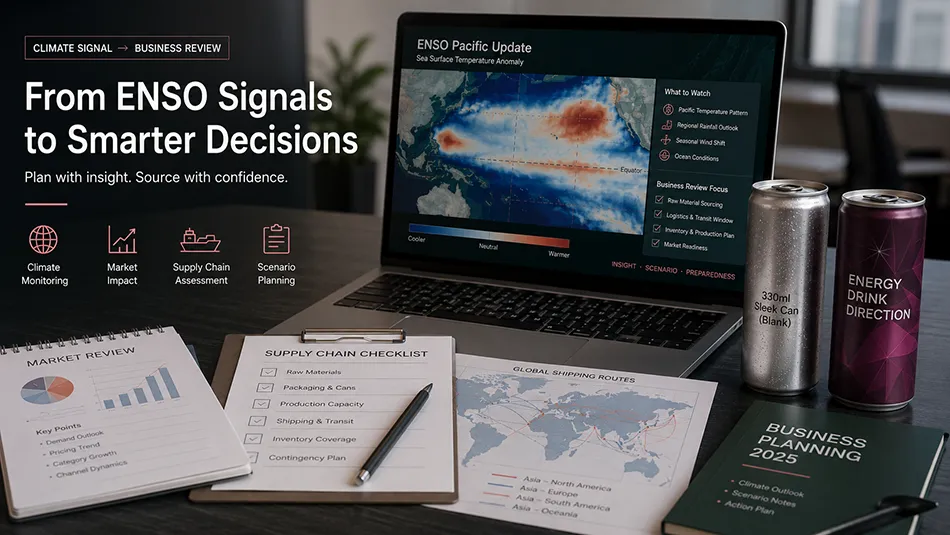
Treat an ENSO outlook as a reason to open a review, not as a local verdict. ENSO, the El Niño-Southern Oscillation, is a Pacific ocean and atmosphere pattern that includes El Niño, La Niña, and neutral phases. Its value for a buyer is to frame better questions while local evidence is still being gathered, especially when a decision may later affect an import, distribution, or product-launch plan.
A strong global signal can justify a planning meeting. It does not turn a planning assumption into a fact. That distinction is especially useful for importers, distributors, and product managers who must make decisions before every local condition and project input is known.
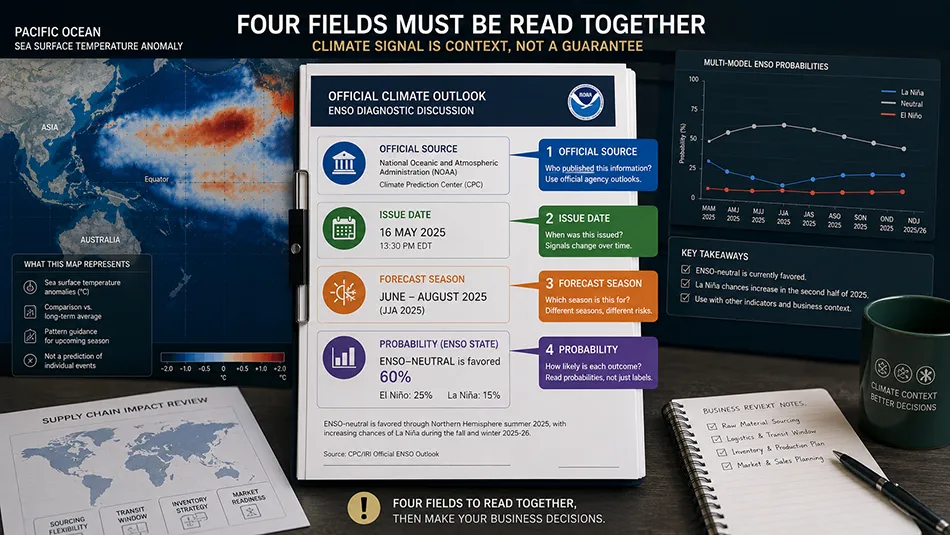
On 13 August 2026, NOAA's Climate Prediction Center said El Niño was strengthening and gave a greater than 90% chance of a very strong event during Northern Hemisphere fall and winter 2026-27. The same diagnostic says that impacts consistent with El Niño become more likely at greater magnitude, but are not guaranteed. That is the correct reading posture: retain the context that gives the number its meaning.
Keep the source, issue date, season, and probability together whenever an ENSO outlook enters a planning discussion. If a slide or email preserves only “90%” or “strong El Niño,” it has removed the information a buyer needs to judge whether the message is current, what period it covers, and what outcome it actually assesses.
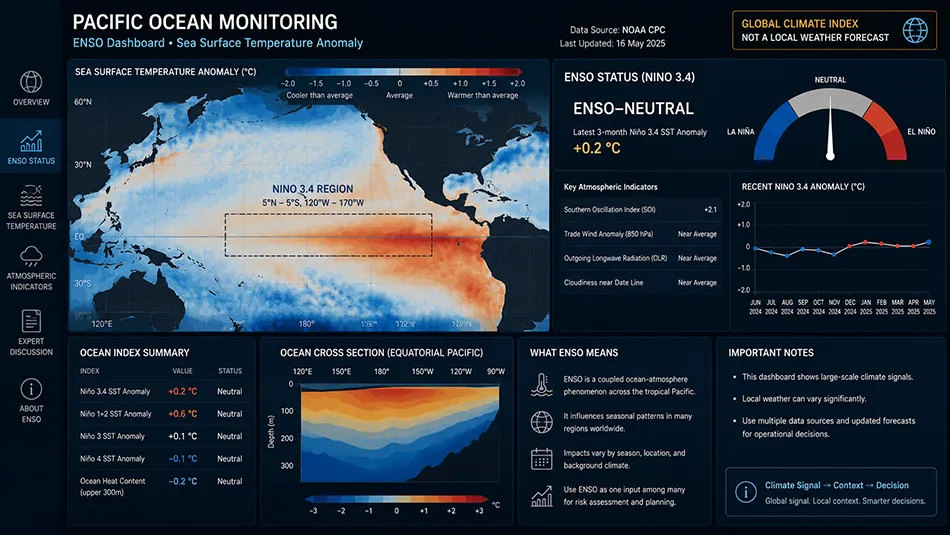
Niño 3.4 is a named ENSO monitoring index, so read it with the outlook's category, season, and probability rather than as a local impact label. In plain language, it is a Pacific monitoring index used in ENSO outlooks, not a local forecast. It tells the reader which part of the climate pattern is being monitored; it does not say that a particular city, port, customer group, or ingredient will experience a defined result.
That boundary matters because technical labels can create false precision. A buyer may see a Niño 3.4 value, an event-strength label, and a regional impact map in the same briefing. They answer different questions. The index helps describe the broader ENSO state. The impact map describes changing probabilities at a broader regional scale. Neither removes the need for a local outlook or evidence about the commercial dependency under review.
A forecast percentage answers a category-and-season question; it is not the probability of a specific local business outcome. A 90% chance attached to an ENSO category for a named season should not become “a 90% chance of disruption,” “a 90% chance of drought in our market,” or “a 90% chance that demand will change.” Those are different questions with different evidence requirements.
Use probability language to calibrate attention, not to manufacture certainty. A higher probability can justify a shorter review cycle, a request for local information, or a discussion of decision timing. It cannot establish the magnitude, direction, or commercial effect of a local condition. The more irreversible the next choice would be, the more important it is to preserve the exact scope of the forecast rather than paraphrase it into a business prediction.
WMO says ENSO impacts vary by intensity, duration, development timing, other climate patterns, and location; not all regions are affected. That is why a global outlook should never be the final evidence in a local planning conversation. It is a reason to ask better local questions, not a reason to assume a common result across markets.
A teleconnection describes how a Pacific pattern can influence conditions far away. It is useful for anticipating where a closer look may be warranted, but it does not override local variability. The next evidence layer is an NMHS, or National Meteorological and Hydrological Service: the official national service that provides weather and climate information. For a buyer, the local-validation question is practical: does the relevant local outlook change the condition of a named market, route, input, sales period, or launch date?
The next useful question is whether an official local outlook affects a named market, route, input, or launch date. A useful review record names the exposure in plain terms: “rainfall could affect a transport handoff,” “heat could change an event calendar,” or “a dry-period outlook could require a conversation with a local distributor.” It does not jump from an ENSO label to a purchase quantity, an availability claim, or a public health message.
For a beverage project, local validation should create questions for confirmation, not assumptions about formula, packaging, quantity, or destination. For a ZHENXI energy-drink project, once the buyer has named the target market and the open question, they can review Energy Drink OEM options in the correct context: as a category and project discussion, not as proof that an ENSO forecast has determined a product or supply outcome.
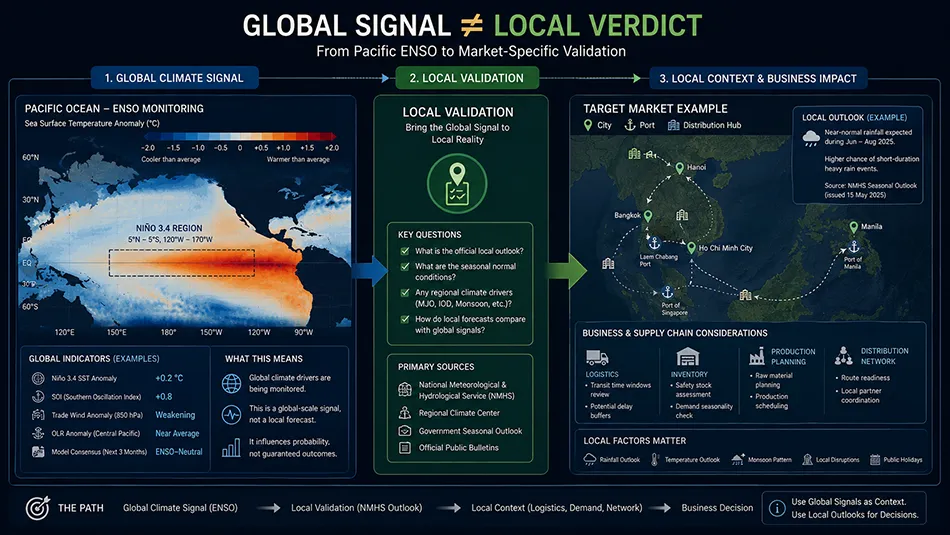
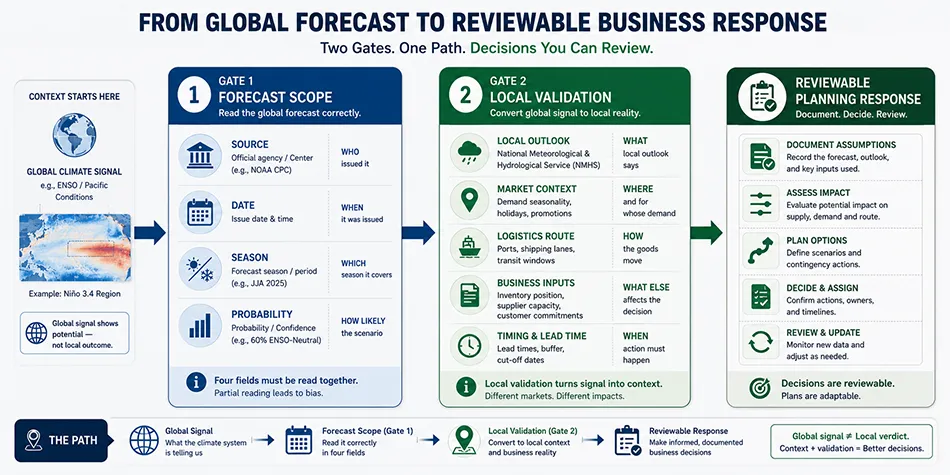
A forecast can change a planning conversation only after it clears a scope gate and a local-validation gate. The scope gate checks that the team has an official source, a current issue date, a stated season, and the actual probability wording. The local-validation gate asks whether an official local outlook and a named business dependency make the signal relevant. This two-gate rule makes uncertainty usable without pretending to turn it into certainty.
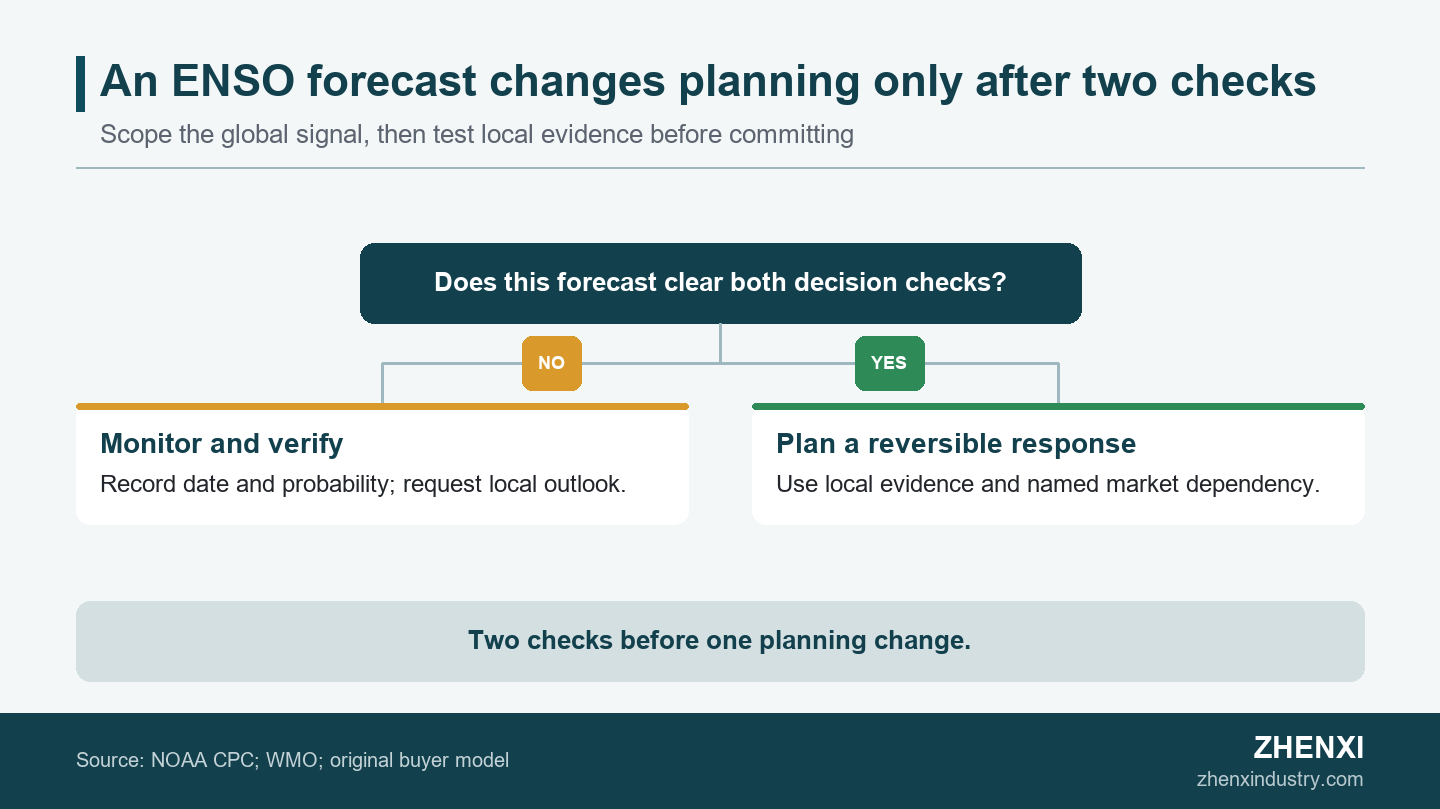
One global signal can start a review. Two completed gates make a local planning response reviewable.
| Gate | What the buyer tests | If the gate is incomplete | Appropriate response |
|---|---|---|---|
| 1. Forecast scope | Official source, issue date, ENSO category, probability, and season. | The team has a headline or isolated number, but not its source context. | Record the full statement and monitor the next official update. |
| 2. Local validation | Official local outlook plus a named market, route, input, or timing dependency. | The local service or the commercial dependency is unknown. | Request the missing local or project evidence; keep the choice reversible. |
Based on this comparison, the first missing gate decides the next action. Do not spend time debating a downstream response while the forecast has not been scoped or the local dependency has not been identified. This is a decision tree, not a risk score: it tells the team which evidence to obtain next, not what local event will occur.
WMO Members work through National Meteorological and Hydrological Services that provide meteorological, climatological, hydrological, and related services. For a global business, that directory is a useful official starting route to the national-service layer. Use it to find the appropriate local outlook; do not treat the directory itself as a forecast for your location.
Before assigning an OEM, product, or market response, write a one-line decision statement: “We are deciding whether to change this assumption by this date.” Then name the missing evidence. Buyers who need help translating that input list into a production conversation can check Beverage OEM FAQs for public process questions, while keeping the climate evidence separate from supplier confirmation.
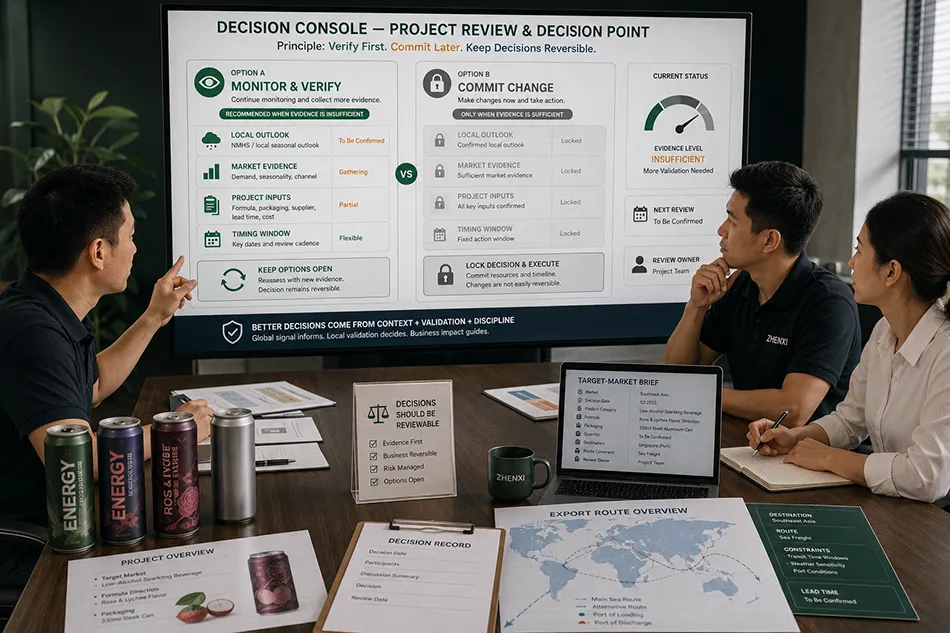
If either gate is incomplete, the responsible action is to monitor or verify while keeping the commercial choice reversible. A reversible decision is one that can still change before money, inventory, or customer-facing claims are locked in. That may mean scheduling another review, requesting a local outlook, or preparing options rather than approving a committed change.
When the scope gate is incomplete, the missing item is usually simple to name: the current update, the official source, the forecast period, or the category behind the percentage. Capture it before discussing consequences. This prevents an old chart, a shortened headline, or a strength label from quietly becoming the working assumption for a planning team.
When the local-validation gate is incomplete, name the missing connection rather than guessing at it. A buyer might need an official regional outlook, a distributor's view of a particular sales period, a logistics check for one handoff, or a clear definition of the product decision at stake. These are distinct requests. Combining them into a vague “El Niño risk” note makes it hard to assign an owner or decide when the review can close.
Use the gates in sequence. The first gate asks whether the climate signal has been read accurately. The second asks whether that accurately read signal is relevant to a particular decision. A team can prepare options after the first gate, but it should reserve commitment for the point at which local evidence and the named dependency have been checked together.
ZHENXI supports private-label energy-drink projects with formula, packaging, sampling, and export coordination, subject to project confirmation. That is the right commercial boundary for an ENSO-informed conversation: bring a defined market question and project inputs to a supplier discussion, rather than asking a supplier to convert a climate headline into a promise.
A useful target-market brief starts with the decision, not the forecast label. State whether the team is reviewing a launch date, a distribution period, a route handoff, a category plan, or a customer communication. Then attach the dated local outlook and explain why it may matter to that specific decision. The aim is not to prove that a teleconnection will cause an outcome. It is to make the uncertainty visible enough that the right owner can validate it.
Climate context should identify what must be confirmed, not substitute for product or delivery confirmation. Add the target market, decision date, product category, formula or pack question, intended quantity, destination, and any route or launch constraint. If a required item is unknown, label it as an open input rather than filling the gap with an ENSO-based assumption.
Give each open input an owner and a review date. The commercial owner can confirm which assumption is being reconsidered. The market or logistics owner can identify the local dependence. The product owner can clarify the formula or pack question. This split prevents a seasonal climate discussion from becoming an unowned request for a supplier to solve every unknown at once.
For example, a buyer could write: “We need to assess whether the local seasonal outlook changes the timing of a launch in this market. Please confirm the product and packaging options once formula, quantity, destination, and timing are defined.” This is more useful than “El Niño may affect the market,” because it names the evidence gap, the commercial decision, and the information needed to resolve it.
When the local outlook and the project scope are ready to review, collect the decision date, market, product category, and outstanding confirmation questions, then send a scoped target-market brief.
It describes the assessed chance of an ENSO category for a stated forecast period, not the chance of a specific local event. Read the percentage with its official source, issue date, and season. A percentage may help a team decide how closely to monitor a condition, but it does not quantify the chance of a particular weather, transport, sales, or supply outcome in one market.
Read Niño 3.4 as a named ENSO monitoring index and keep it attached to the report's date, season, and probability statement. It provides context about the wider Pacific pattern. It does not function as a label for the weather in your city or as a direct instruction to change a commercial plan. Local outlooks and named business dependencies supply that next layer.
Start with the relevant National Meteorological and Hydrological Service or regional climate outlook service for the target market. Use an official local outlook to test the business question that the global ENSO signal raised. If the market, route, or input is not yet defined, record that missing input first; no local forecast can resolve a dependency that the business has not named.
No, not by itself; it can justify a review, while a change still needs local evidence and confirmed project inputs. A buyer can use an ENSO outlook to set a review date, request a local outlook, or prepare reversible options. Inventory, packaging, route, launch, and customer-facing choices should wait for the relevant local and commercial facts rather than follow the global signal alone.


