There is no universal “best” can size for a hot-climate route. Choose the candidate volume that fits the planned drinking occasion, the outlet and distribution route, the label-and-serving brief, and the project evidence that can actually be confirmed. A 250ml, 330ml, 473ml or 500ml can may all be worth testing. None should be treated as a confirmed ZHENXI format or an export-ready choice until the formula, packaging, quantity and destination have been checked together.
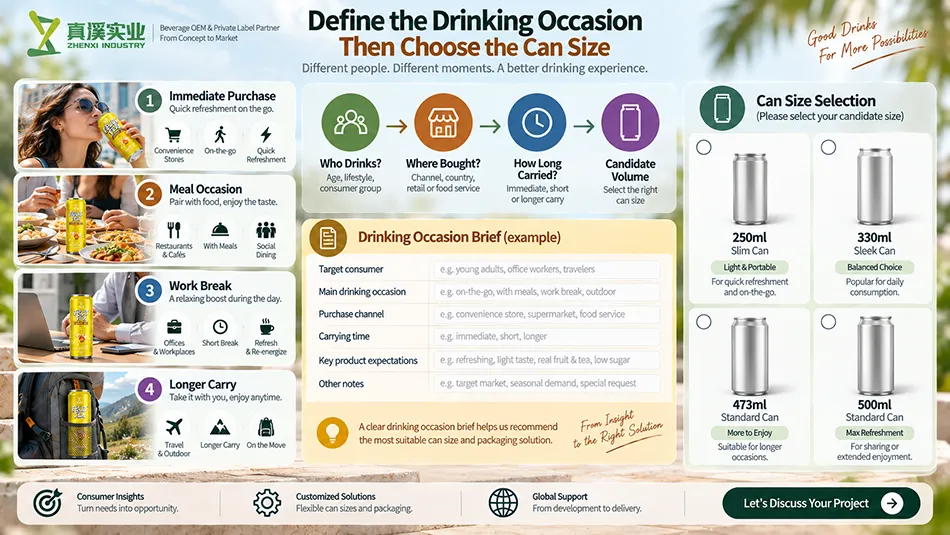
A can size becomes a meaningful candidate only after the buyer defines the drinking occasion and channel use.
“Hot climate” describes part of the route context, not a serving occasion. The useful question is what the buyer expects one package to do: a short refreshment purchase, a commute companion, a longer break, or a product carried through part of the day. A single serve is a one-package drinking occasion for the customer; it does not prove how much a person should consume. As a United States label example, FDA serving-size guidance says serving sizes reflect what people typically consume, rather than a recommended amount. That distinction is useful when a team writes a serving brief for a can candidate.
A usable occasion record names who drinks, where the can is bought, and whether it is consumed quickly or carried longer.
Put those answers into one line of the brief. “Adult convenience purchase, chilled counter, intended for a short break” is more useful than “hot market.” It gives packaging and commercial teams a shared starting point without guessing at demand, price, margin, formula or any specific can dimension. If the buyer cannot write that sentence, the volume choice is still a preference rather than a project decision.
It also helps a distributor explain the intended shelf and purchase moment before testing a volume.
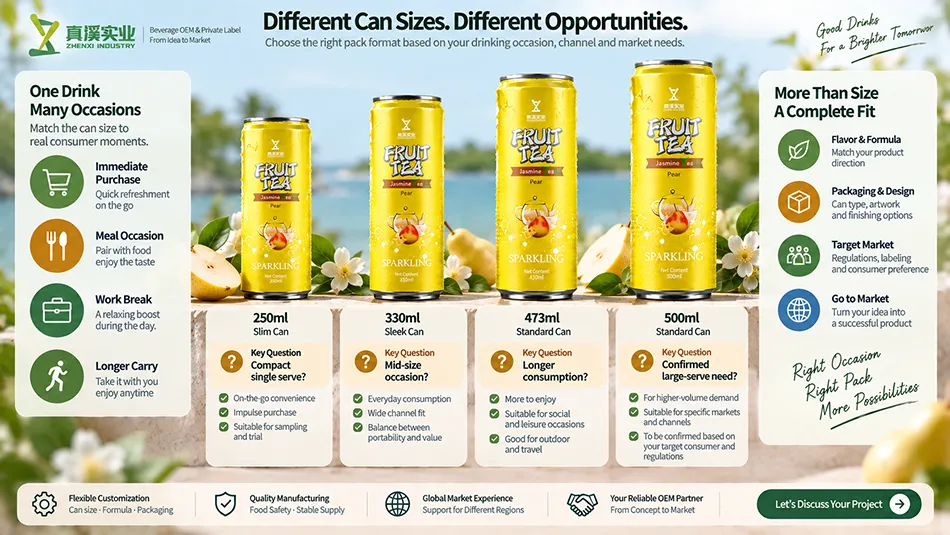
250ml, 330ml, 473ml and 500ml should be evaluated as candidate volumes with different questions, not as a ranked availability list.
The comparison is intentionally conditional. It helps a buyer prepare a shortlist, but it does not say that any listed format is currently available, suitable for a particular formula, or approved for a destination. A larger number is not automatically better value; a familiar number is not automatically easier to sell. The useful comparison is the extra question each candidate creates. The product catalogue context can orient a category discussion, but it cannot confirm a candidate format for this brief.
| Candidate volume | Useful starting question | May fit when | Keep open until confirmed |
|---|---|---|---|
| 250ml | Is a compact single serve central to the intended occasion? | The brief rewards a deliberately compact purchase and concise front-label hierarchy. | Actual package specification, serving presentation, destination and channel fit. |
| 330ml | Does a mid-size single serve match the confirmed outlet and drinking moment? | The team wants a middle candidate and can describe why the occasion supports it. | Whether “familiar” is a channel fact rather than an assumption. |
| 473ml | Is there a defined longer-consumption occasion that justifies the larger package? | The serving, artwork and route plan are documented for a larger candidate. | Label hierarchy, physical format details and destination requirements. |
| 500ml | Does the large-format idea solve a confirmed buyer need, not only a value perception? | The project can evidence a large-serve occasion and a workable package brief. | Availability, formula fit, handling, label presentation and market checks. |
A comparison table cannot verify current format availability, dimensions, fill level, cost, MOQ or destination compliance.
Those are project records, not editorial assumptions. Do not fill the gaps with a supplier-template number, a competitor image or a remembered freight quote. Treat every blank field as a request for confirmation. This keeps a commercial discussion honest and avoids turning a helpful pack-size comparison into a promise about a SKU, a factory capability or an export outcome. It also keeps the table as a planning aid rather than a substitute for a packaging specification.
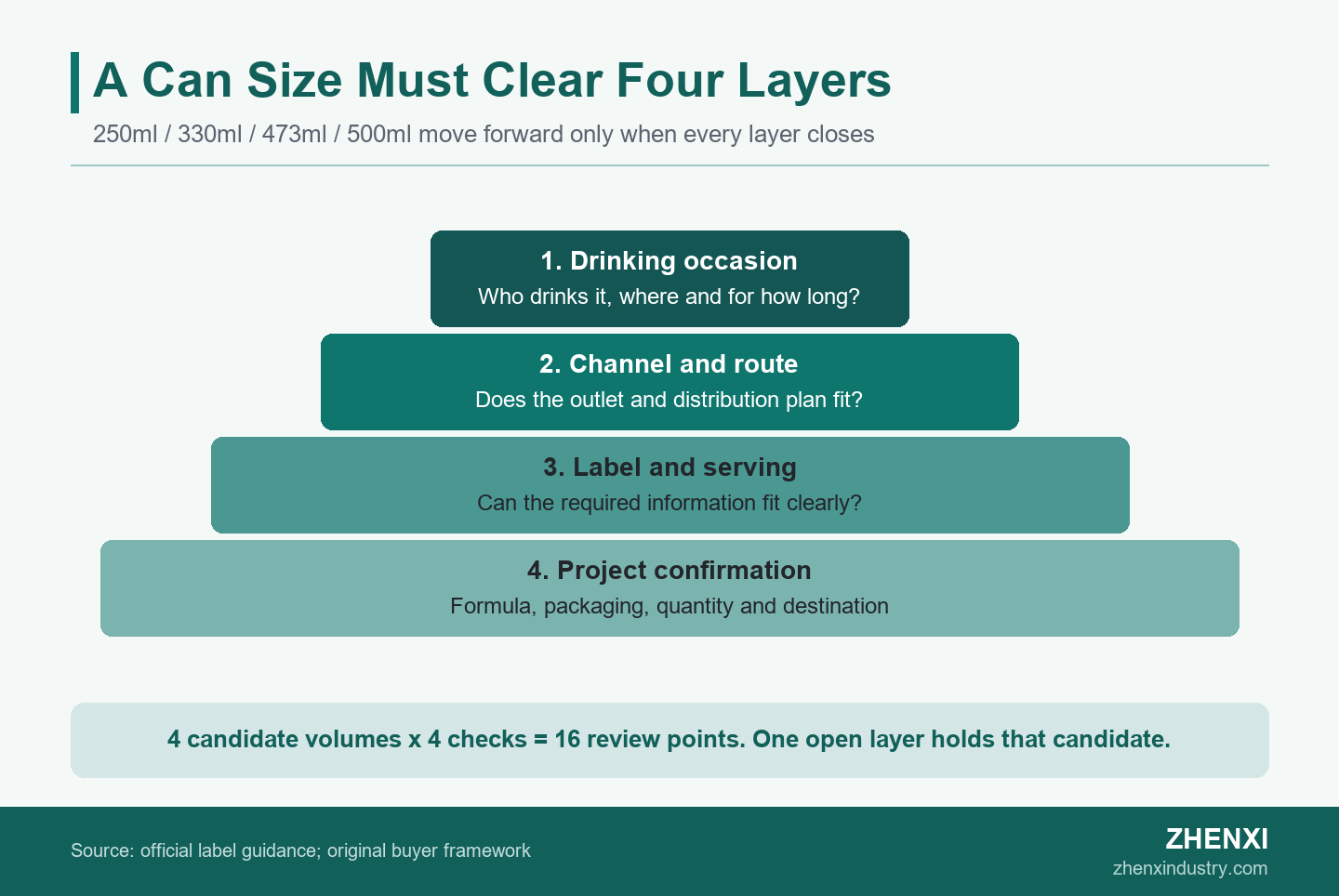
Four candidate volumes multiplied by four decision checks create 16 visible review points before a project moves to sampling.
This is an original buyer-planning model, not a regulatory scorecard. Give each candidate the same four checks, then keep its status as “open,” “needs evidence” or “ready to confirm.” The count prevents a team from choosing a favourite volume first and treating unresolved constraints as small details later.
| Check | Illustrative weight | What a buyer must be able to show | If the answer is open |
|---|---|---|---|
| Drinking occasion | 35% | Who drinks, where, and for how long. | Do not assume the package value story. |
| Channel and route | 25% | Outlet type, planned handling context and distribution route. | Do not infer suitability from climate alone. |
| Label and serving | 25% | Required information, serving presentation and artwork hierarchy. | Do not start final artwork around an untested assumption. |
| Project confirmation | 15% | Formula, packaging, quantity and destination for the actual brief. | Keep the candidate unranked and request confirmation. |
The weights are illustrative. They make the decision order visible; they are not market data or a formula for choosing 500ml over 330ml. A buyer can change the weights for a real route, but should identify the reason in the brief. The hard rule is simpler: an open mandatory field is not made safe by a high score elsewhere.
An unresolved destination, serving or label constraint should block a candidate even if it appears attractive on a softer preference.
Use a two-step read. First, decide whether a candidate clears the non-negotiables: a defined occasion, a known destination and a workable label-and-serving brief. Only then compare softer preferences such as a perceived value story or a buyer’s initial familiarity with a size. That sequence makes the matrix a decision aid rather than a way to disguise missing proof. It also gives sales, packaging and label reviewers a shared reason for keeping an appealing option on hold.
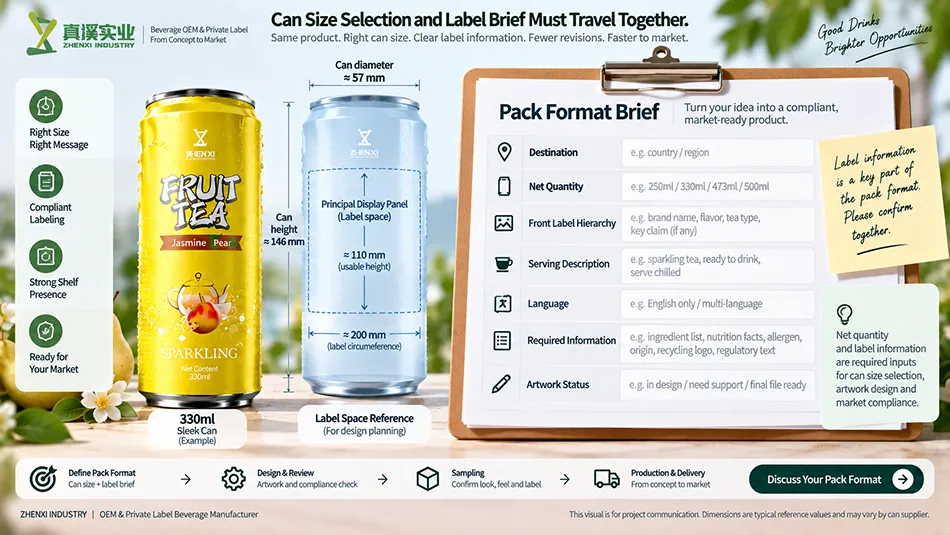
The selected pack must carry the mandatory information required in its destination, so label and net-quantity review belongs in the format brief. Net quantity is the package volume shown to the customer. Codex CXS 1-1985 treats net contents as a label particular and provides for liquid contents to be declared by volume. The European Commission's prepacked-food overview likewise lists net quantity among mandatory particulars. These sources do not choose a can size; they show why package information must travel with the volume decision.
Codex, United States, European Union and United Kingdom materials all treat net quantity and mandatory food information as defined label inputs within their own scopes. For a United States example, the FDA Food Labeling Guide discusses liquid net-quantity statements and principal-display-panel placement. A principal display panel is the main front-facing label area. In the European Union, Regulation (EU) No 1169/2011 includes net quantity among mandatory particulars and sets volume units for liquids. The UK net-quantity guidance provides another named-market example. Use these sources to ask the right label questions; do not copy one market's presentation rule into another destination.
The pack brief should carry the destination, net-quantity presentation, required information and artwork assumptions alongside the candidate volume.
That one-page record should state the selected market, front-label information hierarchy, intended serving description, language needs, and any marks or warnings the team already knows it must review. It should also show which fields are not yet known. Separating confirmed information from working assumptions is more useful than asking artwork to solve an incomplete commercial brief. The record should travel with every revised candidate so the same assumptions are not rebuilt in separate emails.
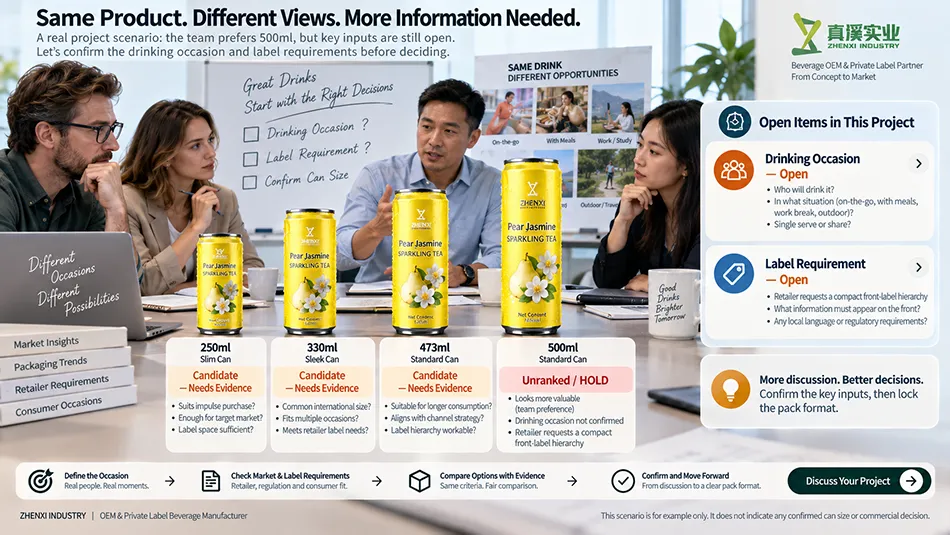
When a buyer prefers a larger can but the occasion and artwork inputs are open, the responsible outcome is an unranked hold rather than an assumed selection.
Consider an illustrative importer preparing a hot-climate route brief. The team starts with four candidate volumes, but one person prefers 500ml because it appears to offer more value. The intended purchase occasion is still vague, and the retailer has asked for a compact front-label hierarchy. Those are not minor drafting details: they are two open cells in the shortlist.
The corrective action is to complete the occasion, label and destination record, then review the candidate against the confirmed project inputs.
An importer is preparing a first hot-climate route brief for a single-serve canned beverage. The team is comparing 4 candidate volumes before a project quotation or packaging confirmation. The destination market is named, but formula and artwork fields are still incomplete.
The buyer initially prefers 500ml because it looks like more value. The retail channel requires a compact front-label hierarchy and the intended drinking occasion is not yet agreed.
The large-format preference cannot close the occasion, label-and-serving and project-proof cells. Across the shortlist, the 4 volumes create 16 decision cells, and several remain open. 330ml and 473ml remain candidates only until the team documents the occasion and front-label requirements. Hold the 500ml preference as an unranked candidate and test the alternatives only after the brief closes the missing checks.
Record the intended drinking occasion, outlet type, label information needs and selected destination before asking for a pack-format confirmation. The next review confirms the actual formula, packaging specification, quantity and destination against the selected candidate. This is an illustrative planning scenario, not a ZHENXI order, demand study, cost model or confirmation of any can format.
Format availability and specifications are confirmed by formula, packaging, quantity and destination, so site signals cannot release a can size for a buyer's project.
That boundary matters because public product pages may show a broad category or a format signal without carrying the exact evidence needed for your route. Once a buyer has defined the brief, the ZHENXI energy-drink OEM project context can be a useful category starting point. Neither public page nor category context is proof that a specific candidate volume, formula, delivery condition or label treatment is available for your project.
For a truthful first review, mark what you know and what you need confirmed. That approach lets ZHENXI discuss beverage OEM or private-label packaging questions without turning an early size preference into a promise about a finished product.
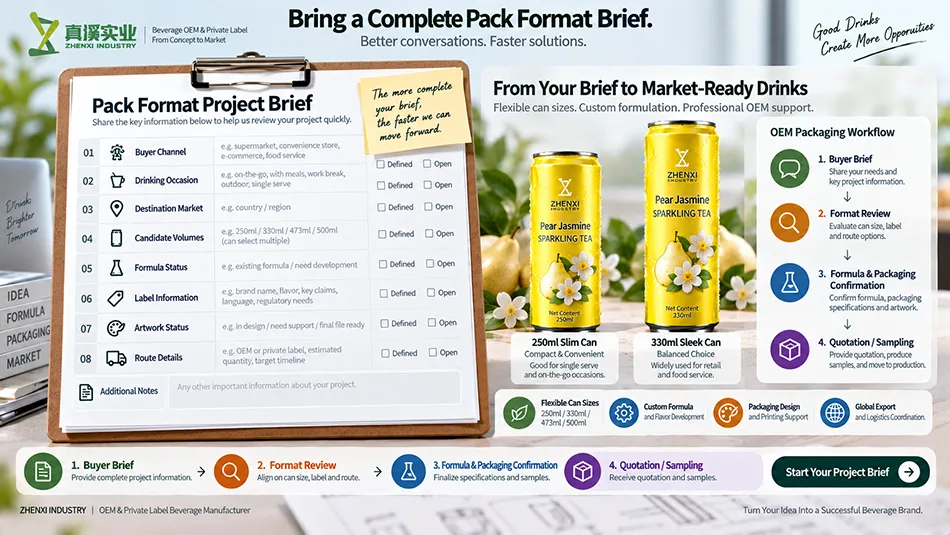
A reviewable first brief names the channel, drinking occasion, destination and one or two candidate volumes, with unresolved formula or artwork fields marked openly.
Keep the first handoff short enough to act on. Name the buyer channel, expected drinking moment, destination market and the two formats you want to compare. Then attach formula status, required label information, artwork status and any route detail that is already confirmed. If a field is unknown, say so. An open field is more useful than a confident-looking guess.
If you already have those four inputs, contact ZHENXI with your pack brief.
No. A 330ml candidate is only useful when its serving occasion, channel, label presentation and project proof fit the same brief. It can be a sensible middle option, but “common” or “familiar” is not evidence that it fits a particular retailer, route or package-information plan. Compare it against the same four checks used for every other candidate, then request confirmation for the actual project.
No. They may occupy similar large-format conversations, but each option still needs its own serving, artwork, handling and confirmation review. A small numerical difference does not eliminate questions about the drinking occasion, label hierarchy or route. Keep both candidates separate until the product and destination brief shows why one is more appropriate.
The destination affects the label information and presentation that must fit the selected pack, so it should be named before artwork is finalised. The UK food-labelling overview and the European Commission presentation guidance are named-market examples, not a universal legal checklist. Naming the destination early keeps the label brief, candidate volume and local review path together.
Send the intended channel, drinking occasion, destination market and one or two candidate volumes, then mark any formula or artwork assumptions as unresolved. Add the reason each candidate is on the shortlist and any known label or route constraint. This starts a scoped conversation without presenting an unfinished product brief as a fixed specification.


