East Africa heavy-rain risk should not be converted into a hydration-product opportunity. When flooding may affect safe drinking-water or public-health services, the first responsibility belongs to local authorities, water systems and clinical pathways—not to a commercial beverage brief. A regional distributor can still prepare responsibly, but only by treating a weather signal as a prompt to verify country context, public guidance and communication limits before discussing any non-medical product.
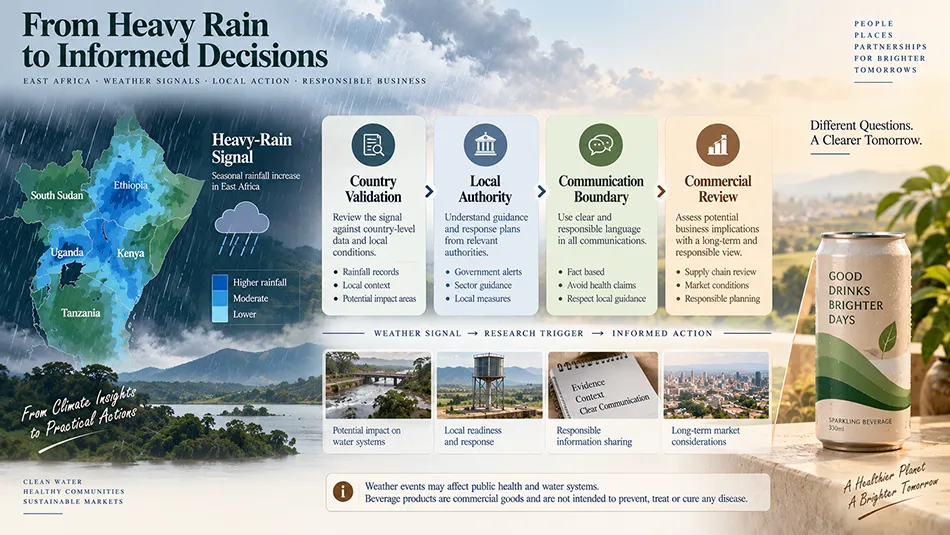
A heavy-rain signal requires a public-interest boundary before any beverage discussion. Here, a public-health boundary means the line that keeps public safety and clinical responsibilities separate from commercial product communication. It stops a distributor from using water-safety risk, an outbreak concern or a relief narrative as evidence that a beverage should be bought, promoted or described as necessary.
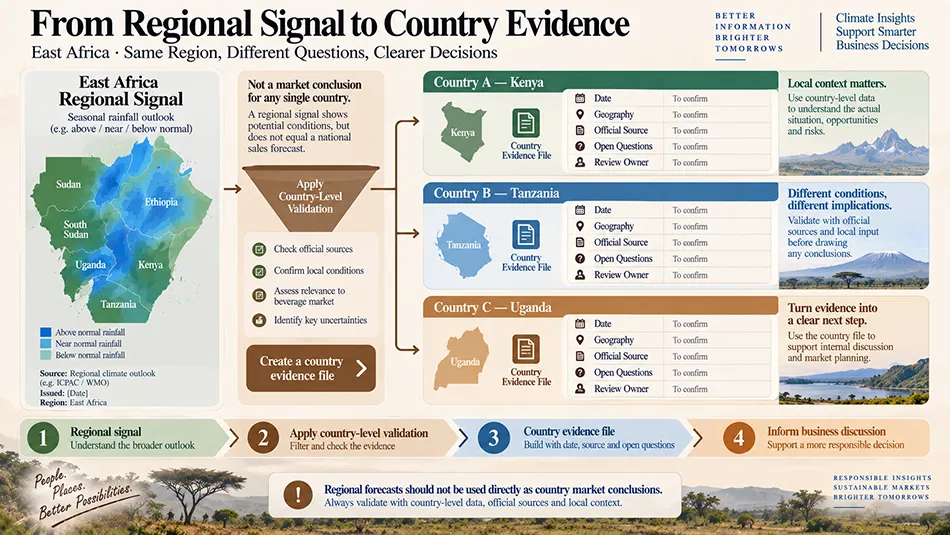
WMO says no two El Niño events are exactly alike and impacts can vary from region to region. That is the operational starting point. “East Africa” may be a useful regional frame, but it is not a single weather outcome, public-health condition, regulatory environment or beverage market. A buyer should therefore replace a regional sales deck with one country evidence file that has a date, geography, source owner and unanswered questions.
The file should preserve the outlook’s stated season and location rather than borrowing a memorable regional headline. It should also distinguish a forecast probability from a confirmed local event. Those distinctions are not administrative detail. They are what keep a distributor from making availability, demand or safety claims that the climate source never made.
WMO reports an increased likelihood of wetter-than-normal conditions in the Greater Horn of Africa during the final quarter of 2026 and notes that national services will issue detailed country-specific forecasts and advisories. That statement is useful because it is both current and bounded. It points a distributor toward local verification; it does not support a conclusion about one country's store demand, transport access, product fit or public-health needs.
Keep the source date, rainfall period and named areas in the country file. If the file later contains a local advisory, record what changed rather than silently replacing the earlier outlook. A proper decision trail should show whether the commercial team is reacting to a current national update, a local service notice, an assumed scenario or an old regional document. Only the first two can inform current local context, and neither authorizes a medical or water-safety claim.
ICPAC says seasonal forecasts should be used with weekly and monthly forecasts and climate-monitoring products issued by ICPAC and National Meteorological and Hydrological Services. An NMHS is a national meteorological and hydrological service that issues country weather information. Its role matters because a seasonal document is not a standing instruction for a local route, a retail channel or a public-facing message.
For each prospective country, name the latest official source, its publication date and the person responsible for checking the next update. Then add the relevant public-health or water authority source separately. Climate, water and health information may converge in one decision file, but they should not be collapsed into one unsupported conclusion. If the local authority record is absent, the correct commercial status is research hold—not “likely market opportunity.”
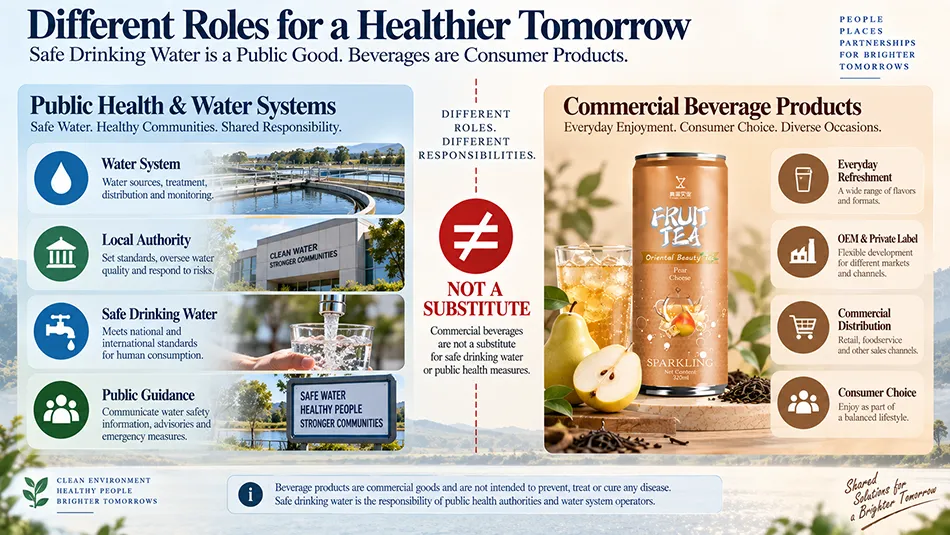
WHO says uninterrupted provision of safe drinking water is the most important preventive measure after flooding to reduce the risk of water-borne disease outbreaks. This is the central boundary for any hydration-product discussion. Safe drinking-water comes from public systems and their controls. An ordinary beverage is not a substitute for water-source protection, water-service continuity or the instructions issued for an affected location.
WHO's current drinking-water guidance also places water safety with water and health regulators that manage hazards and develop national standards. That governance role is the reason a product brief cannot claim to deliver safe water, restore water safety or solve a flood-related water problem. The practical implication is simple: remove such language from packaging concepts, distributor presentations, retail activation and inbound sales replies.
This does not mean a distributor should ignore water context. It means the distributor should record it correctly. The country file can name the official authority, the date of the information and the communication rule: do not use public hardship, water contamination or restricted access as a product benefit. That rule protects readers from a false choice between “doing nothing” and promoting a beverage. The responsible action is to refer to current local public guidance while keeping commercial research separate.
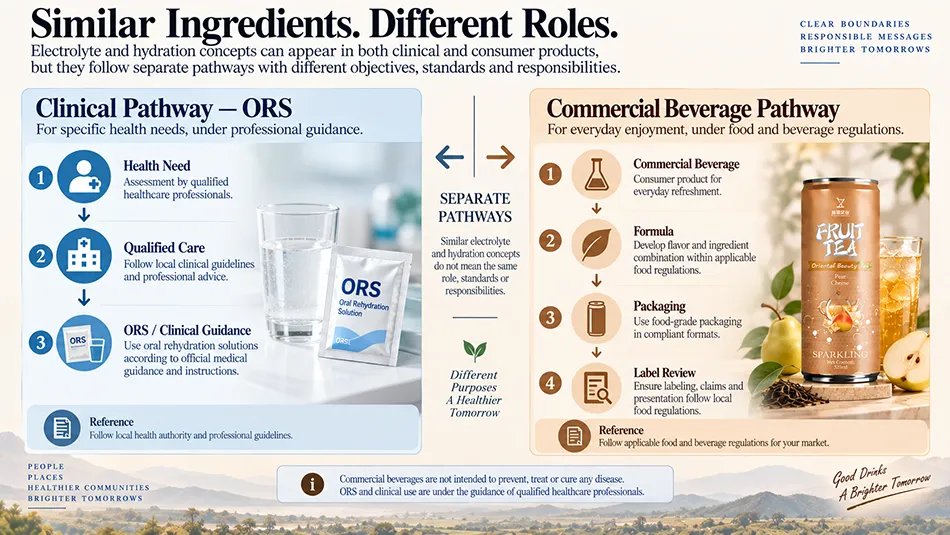
WHO identifies oral rehydration salts solution as a treatment measure for diarrhoea and describes it as a glucose-electrolyte solution in a clinical guidance context. Oral rehydration salts, or ORS, are therefore a defined clinical product category, not a marketing comparison point for an ordinary beverage. Its presence in a public-health discussion is a reason to clarify scope, not to borrow treatment-like wording.
WHO's ORS publication describes an adequate glucose-electrolyte solution for dehydration from diarrhoea and discusses pharmaceutical-quality manufacture for national authorities. That clinical identity cannot be transferred to a commercial drink through similar ingredients, flavour cues, packaging or a crisis-themed campaign. The article does not offer diagnostic, treatment or product-selection advice. Where a health need is being considered, local health guidance and qualified care pathways take priority.
The communication test is stricter than a label check. Avoid terms that suggest treating dehydration, preventing illness, responding to an outbreak, replacing ORS or compensating for unsafe water. Also avoid visual or verbal cues that cause a reader to infer those roles. A non-medical beverage project can be scoped only after its formula, label wording and destination rules are reviewed for the selected market. Until then, the correct description is simply a conditional commercial project—not a response measure.
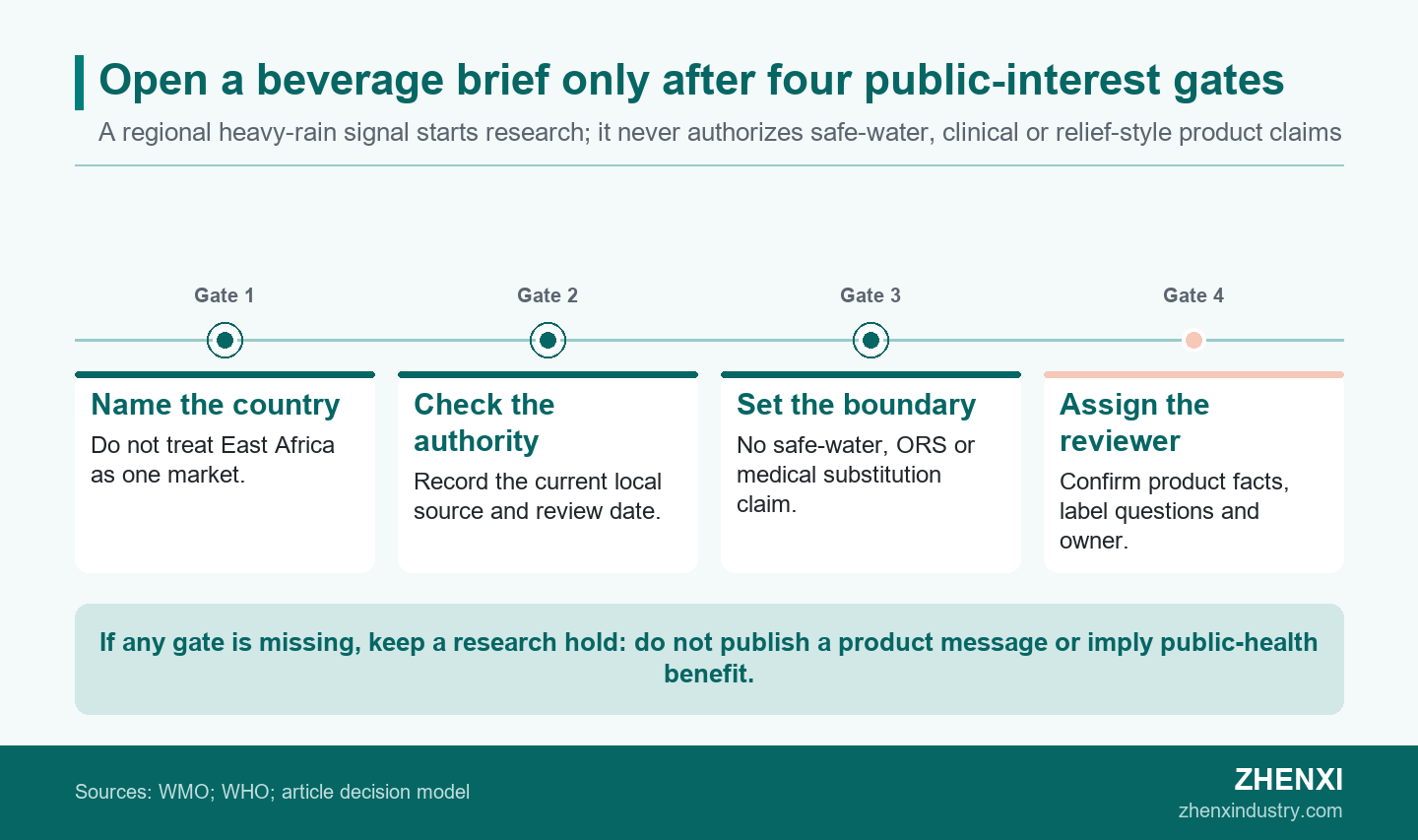
A product conversation opens only when a named country, current local authority guidance, a documented no-substitution communication boundary and a named commercial reviewer are all present. This is an editorial decision rule, not a legal, medical or market-approval test. Its value is that each gate belongs to a different owner: country selection prevents regional overreach; authority guidance protects public-interest context; the communication boundary blocks unsafe claims; and the reviewer keeps product facts and label questions visible.
Four gates do not prove that a project should launch. They prove that it is responsible to discuss a narrow, non-medical project scope.
The four-gate rule is deliberately conservative. A climate signal without an authority source fails Gate 2. A current notice without a written no-substitution rule fails Gate 3. A well-intended category discussion without an accountable product or compliance reviewer fails Gate 4. Each failure sends the work back to research. It does not create permission to “test the market” with relief-style language, donation claims or implied health outcomes.
For ZHENXI, the relevant commercial question begins only after those limits are documented: can a buyer review non-medical energy drink OEM options for a specified country, category and packaging brief? The answer remains conditional. Availability and specifications must be confirmed by formula, packaging, quantity and destination, and any health or nutrition wording remains subject to composition data and target-market regulations.
Repeated gaps should stop a product message before it reaches the market. One unresolved item may be a normal research task; a sequence of unresolved public-interest and communication items shows that the file needs accountable escalation instead of a faster sales response.
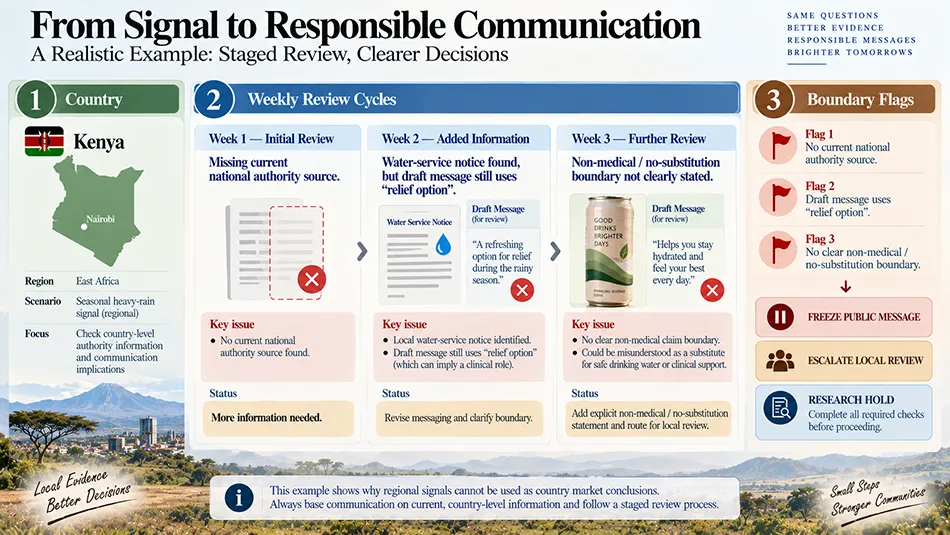
When three boundary flags remain in one country evidence file, freeze public-facing product language and escalate the file to accountable local review. In this illustrative example, a distributor reviews 1 prospective country across 2 weekly review cycles after a regional heavy-rain signal. No order, campaign or country-market conclusion is approved. The file has a regional outlook, but it lacks a named current national update, a confirmed local communication boundary and a completed product-label review.
In the first cycle, the team can cite a regional outlook but cannot identify the country authority document that should govern current local context. In the second cycle, a water-service notice is added to the file, while a draft message still calls the product a relief option. The compliance reviewer then finds a third problem: the notes do not state that the proposed beverage is non-medical or that it cannot replace safe water or ORS.
Those 3 boundary flags in 1 country evidence file change the decision. They do not justify a more urgent campaign. The gaps show that public information is reaching the commercial file faster than accountable review. The team freezes the message, retains only a research task and assigns a local public-guidance owner plus a product and compliance reviewer. This is a staged escalation, not a claim that an event will occur or that the country is commercially unsuitable.
The corrective action is to replace one regional sales slide with a dated country record. It separates the forecast source, local authority guidance, safe-water boundary, intended non-medical category, product facts, label questions and remaining assumptions. Conditional scoping can reopen only after all four gates have owners and dates. This illustrative scenario is not a client case, medical protocol, emergency-response plan, market forecast or approval to sell a beverage in any country.
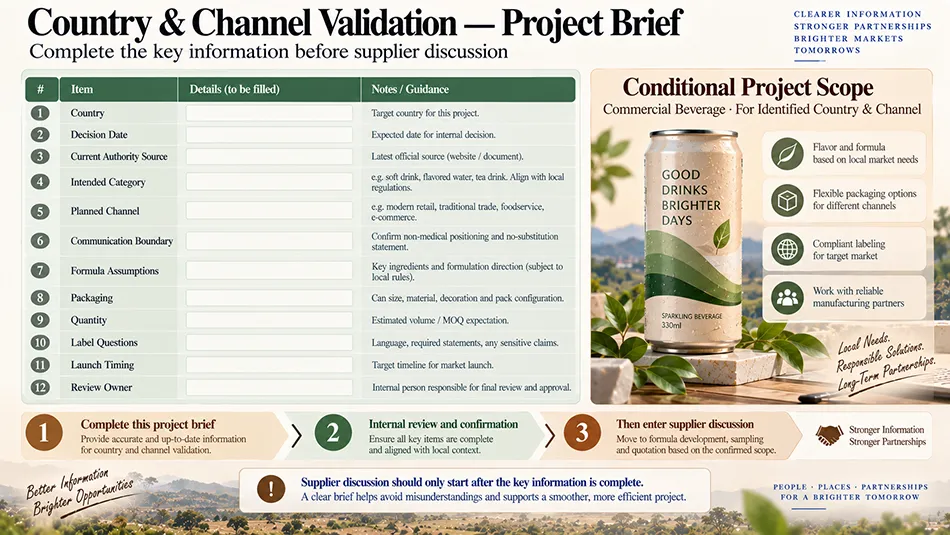
A country-and-channel validation brief can support conditional product scoping without promising public benefit, country availability, compliance or clinical suitability. Begin by writing the country name, intended non-medical category and a current local authority source. Add the date checked, the planned channel, the communication boundary and the owner who will revisit each assumption. Only then is it useful to compare the public beverage product range as a category reference.
This brief is useful because it reveals the difference between an information request and a product decision. A climate team may need a newer outlook. A public-health contact may need to clarify an official message. A product team may need to confirm whether a proposed formula and label concept can be assessed for a particular destination. None of those tasks can be solved by a general claim about hydration, and none should be hidden behind a regional demand assumption.
It also gives the buyer a clear supplier handoff. ZHENXI can review a conditional private-label beverage scope when the brief names the country, category, formula and packaging assumptions, intended channel, quantity estimate, label questions and launch timing. That review does not validate public-health language, safe-water claims or clinical suitability. If the file cannot yet make that distinction, it remains research work rather than a project request.
Once those inputs and limits are documented, a distributor can submit a country-specific beverage brief for scope review.
No, a regional outlook can justify local preparedness research, but it does not establish country demand, channel conditions, legal status or public-health suitability. Use it to open a dated country evidence file and identify the current national and local sources that matter. Keep the file on hold when the location, authority source or communication boundary is missing. A distributor should not use regional rainfall language as evidence that buyers need a particular beverage.
No, a commercial beverage should not be described as a safe-water response, because drinking-water safety is governed through public-health and water-supply controls. The responsible message is narrower: refer affected people to current local authority guidance and keep product communication non-medical. A beverage project may still be researched in a specified country, but its brief must not imply that the product makes water safe, replaces water-service measures or responds to a public-health need.
ORS is a defined clinical rehydration product used within health guidance, so it cannot be replaced, imitated or implied by an ordinary beverage project brief. Similar-sounding ingredients or a hydration theme do not make a commercial drink equivalent to a clinical product. Do not use treatment, dehydration-management or disease-response language for a beverage. When health needs are involved, follow current local health guidance and qualified care pathways rather than a commercial product decision.
Verify the country, current local authority guidance, safe-water boundary, intended channel, label questions, product facts and a named reviewer before discussing scope. The practical rule is four gates: country, authority source, no-substitution communication rule and commercial reviewer. If any gate is absent, keep the work as research. When all are documented, a supplier conversation can stay focused on conditional product scope, packaging and destination-specific requirements rather than public-health claims.


