Are you still worried about your round belly? Are you still trying to improve your bloated figure by dieting and lifting weights? Do you dare to believe that a cup of fragrant tea in your spare time can not only relax your mood, but also help you lose weight?
Don't disbelieve it! Studies have confirmed that plant molecules such as polyphenols, polysaccharides, amino acids and alkaloids in tea can effectively prevent and treat a variety of metabolic disorders including metabolic syndrome, type 2 diabetes and obesity. A meta-analysis showed that the intake of catechins in green tea can reduce the total fat area, visceral fat area and subcutaneous fat area, which helps to improve abdominal obesity and metabolic disorders.
Since drinking tea has such a magical effect on weight loss, what is the mechanism behind it? Two studies recently published may give us some answers.
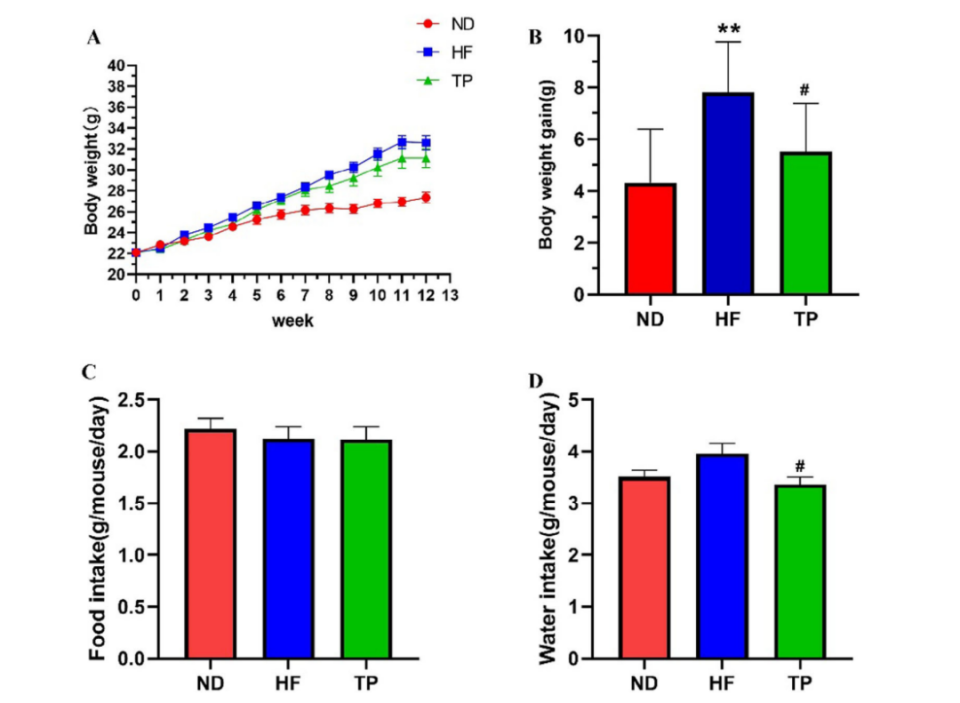
In this study, mice were divided into three groups: a normal diet control group (ND), a high-fat diet control group (HF), and a high-fat diet plus tea polyphenols group (TP). The effects of tea polyphenols on the body weight, food and water intake, liver fatty degeneration, serum lipid content, adipose factors, liver lipid metabolism indicators and inflammatory factors of mice induced by a high-fat diet were observed. In addition, the mice were subjected to fecal microbiome sequencing analysis, short-chain fatty acids (SCFA) determination, and the intestinal barrier status of the mice was evaluated by transmission electron microscopy.
The results showed that compared with the HF group, the weight gain of mice in the TP group was significantly inhibited (p<0.05) (Figure 2), and the epididymal fat weight, fat index and liver weight were significantly reduced (p<0.05), indicating that tea polyphenols can reduce the weight gain of mice fed a high-fat diet. In order to explore the mystery, the researchers conducted a series of explorations and found that the weight-reducing effect of tea polyphenols may be achieved through mechanisms such as regulating intestinal flora, improving lipid metabolism, maintaining intestinal barrier and inhibiting inflammation.
Relieve inflammatory response: Compared with the HF group, lipid droplet hyperplasia and inflammatory cell infiltration in the liver of mice in the TP group were significantly reduced. After analysis, the pro-inflammatory cytokines (such as TNF-α, IL-1β and IL-6) in the serum of mice in the HF group were significantly increased compared with those in the ND group (p<0.01), and tea polyphenols significantly reduced the levels of these inflammatory factors and inhibited the activity of NF-κB p65 and TLR4 genes (p<0.01). Inflammatory pathways such as TLR4 are closely related to obesity-related pathways such as insulin resistance and lipid metabolism disorders.
Optimizing lipid metabolism and promoting SCFAs production: Compared with the HF group, the free fatty acids, total cholesterol, low-density lipoprotein cholesterol and triglycerides in the TP group decreased significantly (p<0.01), while high-density lipoprotein cholesterol increased significantly (p<0.01), serum adiponectin increased (p<0.01), and leptin decreased (p<0.01). This shows that tea polyphenols not only improved the lipid metabolism of mice, but also effectively alleviated the leptin resistance and adiponectin secretion problems caused by a high-fat diet.
Further studies found that tea polyphenols effectively reduced the expression levels of genes related to lipid accumulation (including ACC, PPARγ, SREBP-1c and FAS) (p<0.01), and greatly increased the expression levels of AMPKα1, CPT-1α, PGC-1α and PPARα genes (p<0.01).
More importantly, tea polyphenols can correct the decrease in total acetate, butyrate and SCFAs caused by a high-fat diet (p<0.05), and improve the mRNA levels of SCFA receptors free fatty acid receptor 2 (FFAR2) and free fatty acid receptor 3 (FFAR3). Previous studies have found that SCFAs can reduce obesity by maintaining intestinal mucosal structure, promoting metabolism-related signal transduction, regulating intestinal immunity and other effects.
Regulating the balance of intestinal microbiota: Tea polyphenols increased the content of beneficial intestinal microorganisms (such as Blautia, Parasutterella and Faecalibaculum), while reducing the content of intestinal bacteria associated with obesity (including unclassified Lachnospiraceae and Colidextribacter). This shows that taking tea polyphenols can effectively change the dysbiosis caused by the intake of a high-fat diet, thereby reshaping the structure of the intestinal microbiota.
Enhancing intestinal barrier function: Tea polyphenols treatment significantly increased the mRNA levels of tight junction proteins such as ZO-1, claudin and occludin (p<0.01). The researchers also observed that compared with the HF group, the TP group had regenerated colonic mucosal microvilli, tighter epithelial cell bonding, and a stronger mechanical barrier of the intestinal mucosa.
|
Weight loss needs |
Scientific causes |
Tea intervention mechanism |
|
Decline in basal metabolic rate |
Decline in mitochondrial function |
EGCG activates AMPK pathway, increasing heat production by 15% |
|
Excessive sugar and lipid absorption efficiency |
Excessive activity of digestive enzymes |
Tea polyphenols inhibit α-amylase and block sugar conversion |
|
Stress-induced overeating |
Increased cortisol stimulates appetite |
Theanine regulates GABA receptors and reduces anxiety-induced eating |
|
Stubborn accumulation of visceral fat |
Insulin resistance in fat cells |
Catechins enhance adiponectin and promote fat decomposition |
|
Common misunderstandings |
Scientific truths |
Authoritative basis |
|
"The more tea you drink, the faster you lose weight" |
Excessive caffeine causes increased cortisol, which in turn promotes abdominal fat accumulation |
PharmaDoctor warns: >1g of caffeine per day is counterproductive |
|
"Drinking tea on an empty stomach is more effective" |
Excessive secretion of gastric acid damages the mucosa and reduces metabolic capacity |
Health Guide: When gastric juice pH <3, the inactivation rate of EGCG reaches 60% |
|
"Adding honey to enhance the effect" |
Fructose directly offsets the fat burning effect and causes fat deposition in the liver |
Experiments show that sugary tea reduces weight loss efficiency by 81% |
|
Physique type |
Best tea drink |
Synergistic formula |
Drinking strategy |
|
Metabolic slow type |
Green tea + ginger |
3g green tea + 2g ginger, brew at 85℃ |
Drink 200ml on an empty stomach in the morning (after meals for those with weak stomachs) |
|
Sugar addiction type |
Oolong tea + cinnamon |
Tieguanyin 5g + cinnamon powder 0.5g |
Drink 300ml immediately after a meal |
|
Pressure obesity type |
Pu'er + tangerine peel |
5g cooked Pu'er + 1 old tangerine peel, stew in boiling water |
Drink 500ml slowly from 15:00 to 17:00 in the afternoon |
|
Edematous and puffy type |
Lotus leaf + cassia seed |
3g lotus leaf + fried cassia seed 5g |
Replace drinking water throughout the day, 1.5L per day |
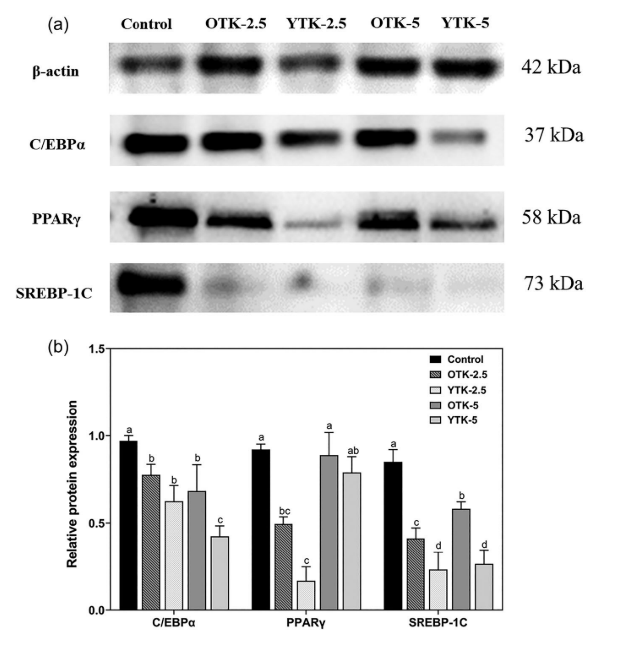
The researchers used mouse OP9 cells to evaluate the inhibitory effect of kombucha on adipocyte differentiation. The results of the cell counting experiment (CCK) and cell observation showed that high concentrations of OTK and YTK would affect the survival rate of OP9 cells.
OTK and YTK were diluted to 2.5 times and 5 times respectively, and OP9 cells were treated. It can be observed that the number of lipid droplets in the cells decreased, and the high concentration group had a stronger anti-adipogenic effect, and its dose-dependency showed the potential for preventing obesity.
From the above two studies, it is not difficult to find that drinking tea can help fight obesity in many magical ways! For example, regulating lipid metabolism, balancing intestinal flora, reducing inflammatory response and intestinal barrier damage, inhibiting digestive enzyme activity and adipocyte differentiation, and even regulating genes related to lipid metabolism. It seems that tea is not just our daily drink, it has great potential in health management! In the future, we may be able to explore in depth how to incorporate tea drinking into daily health guidance and play a greater role in long-term weight management.
Tea, fragrant leaves, young buds. The yellow pistil color is fried in a pot, and the bowl turns the koji dust flower. Drinking a cup of clear tea, you can not only gain comfort, but also embrace health, why not?


