A private label non alcoholic beer project can move slowly for reasons that have little to do with flavor. The sample may be acceptable, the aluminum can direction may look clear, and the importer may already have a launch window. Then the project stops because brand files, label details, authorization papers, or shipment documents were not prepared early enough.
For non alcoholic beer OEM work, documents are not just administrative attachments. They connect brand ownership, can printing, product specification, export review, and local import checks. This article explains which beverage export documents buyers should prepare, when to prepare them, and how to work with a private label beer supplier before production pressure begins.
Before the first production discussion becomes serious, buyers should separate brand documents from product documents. Brand documents support printing and ownership checks. Product documents support formula, specification, shipment, and market review. Mixing the two often creates a delay.
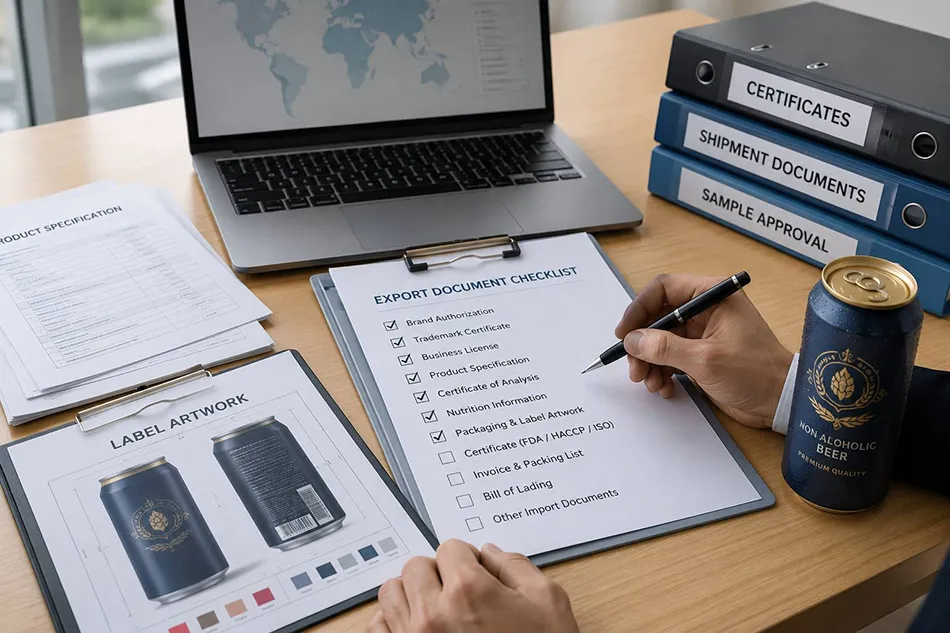
Brand authorization is one of the first files a buyer should prepare for private label non alcoholic beer. If the aluminum can design carries a trademark, logo, or brand-owned visual element, the supplier needs proof that the buyer has the right to use it. This is especially important when the importer is not the trademark owner, or when a distributor is producing for a retail customer. A signed authorization can reduce back-and-forth before prepress work, color separation, and proofing. It also helps the supplier avoid printing a brand that later faces ownership questions. Buyers should prepare this file before printing the confirmation.
A trademark registration certificate and a company business license can make the private label process more stable. They help confirm who owns the brand, who places the order, and who takes responsibility for commercial use of the design. These files do not replace local legal review. If a buyer uses different entities for brand ownership, payment, and import, this should be explained early. Otherwise, the supplier may need to pause the project. For a non alcoholic beer OEM order, such details are easier to solve before artwork and production scheduling begin.
After the brand side is clear, buyers should think about export and import review. Different markets may request different documents, so buyers should not assume one file package works everywhere. The safer approach is to confirm the exact SKU, destination country, label wording, and buyer-side import requirements.
Buyers often ask for certificates at the quotation stage, but they should also ask which certificates apply to the exact product and shipment. Certifications such as FDA, FSSC, GMP, HACCP, HALAL, and ISO may support supplier evaluation, but the importer should still check what the destination market requires for alcohol free beer export. A certificate list is not the same as local market approval. The buyer may also need product specifications, ingredient information, nutrition details, shelf life statement, carton information, and invoice documents. When working with ZhenXi, we discuss documents by product route and market instead of treating every country as the same export case.
Shelf life, volume, packaging, and MOQ should be confirmed for the exact product. A 250ml fruit-led product and a 500ml beer-style product may not share the same role, carton plan, or label layout. Buyers reviewing the non-alcoholic beer range can compare serving size, flavor route, and packaging before asking for final documents. Common planning references may include 250ml / 8.4 oz, 500ml / 16.9 oz, 20–25 days after order confirmation, 1 container for first commercial discussion, and 12 months above or 365 days by SKU. These are useful planning points, not universal promises.
A simple timing table can prevent document work from piling up at the end. The right file should be ready before each project gate.
|
Project Stage |
Document or Data |
Planning Reference |
|
Before artwork review |
brand authorization, trademark file, business license |
3 core identity files |
|
Before sample confirmation |
flavor route, alcohol wording, target can size |
250ml or 500ml reference |
|
Before printing proof |
AI artwork, fonts, color sample, risk disclaimer |
before proofing |
|
Before mass production |
approved sample, carton plan, order details |
1 container reference |
|
Before shipment |
product specs, certificates, carton data |
export review package |
|
Launch planning |
delivery schedule |
20–25 days reference |
These items are planning references. Final document names and formats should be checked by the buyer, supplier, and freight forwarder.
The table is useful because it connects document timing with real production timing. If the buyer has no brand authorization, the design may not move into proofing. If the artwork file is missing fonts, color separation may be delayed. If the destination market requires a specific alcohol statement, the label should not be finalized before that wording is checked. If carton data is needed for retail listing, it should not wait until shipment. For alcohol free beer export, the expensive delay is often not one missing file. One missing file can hold artwork, printing, production, shipment booking, and retail listing together.
The buyer controls the market plan, while the supplier controls production execution. A good workflow respects both sides. The buyer should provide brand and market information early, while the supplier should respond with practical production questions and timing risks.
Brand files include authorization, trademark information, business license, artwork source files, fonts, color references, and risk disclaimer. Product files include formula direction, alcohol statement, specification, shelf life, packaging data, carton information, certificate requests, and shipment documents. Keeping these groups separate helps teams avoid confusion across marketing, purchasing, quality, and import work. This separation also makes discussion with a private label beer supplier easier. If every file is mixed together, the supplier may spend extra time sorting the purpose of each document.
A supplier can usually support product specifications, production planning, carton data, certificates, and export document discussion based on the confirmed SKU. The buyer should ask early which items are standard and which need extra time. For broader workflow reference, buyers can review the OEM and ODM beverage service before preparing their own checklist. The supplier should also explain what needs buyer-side market input. Local label language, nutrition panel format, claim wording, deposit rules, and alcohol category definition may depend on the destination market. A clear boundary prevents both sides from assuming that the other side has already verified the same issue.
Export delays are often preventable. They come from late brand papers, unclear label wording, incomplete artwork, or copied market assumptions. A document checklist should reduce these risks before the order reaches the production line.
Words such as non alcoholic, alcohol free, 0.0%, and below 0.5% may be treated differently by market, product type, and sales channel. Buyers should confirm local rules before final artwork approval. If the label says one thing and the product specification or import category says another, the shipment may face questions later. A buyer can first decide whether the SKU is a fruit-led alcohol-free drink, a beer-style alternative, or a wider non-alcohol range. Then the product name, claim, and alcohol statement should be checked as one group. For background on product route and flavor structure, buyers can read How is Non Alcoholic Beer Made and Why Does Craft Non Alcoholic Beer Taste So Good before final sample review.
Artwork delay is one of the most common reasons private label projects lose time. Buyers should avoid sending low-resolution images, missing fonts, unfinished label claims, or color ideas without source files. If custom aluminum can printing is needed, the supplier must check design format, color count, separation, proofing route, and final sign-off. Late artwork can also affect beverage export documents because product name, flavor name, alcohol wording, nutrition details, and carton marks should match across files. A good rule is simple: do not treat packaging as decoration after the product is approved. In private label non alcoholic beer, packaging is part of export readiness.
Private label non alcoholic beer projects run better when documents are prepared before pressure builds. Buyers should prepare brand authorization, trademark files, business license, artwork source files, risk disclaimer, product specifications, certificate requests, carton data, and shipment information in the right order. A document checklist does not make the project slower. It helps the buyer and supplier move faster with fewer last-minute changes.
For your next non alcoholic beer OEM project, send your export document checklist with target market, product route, can size, artwork status, brand files, certificate needs, and first order plan.
Q: What documents are needed for private label non alcoholic beer?
A: Buyers may need brand authorization, trademark registration certificate, business license, risk disclaimer, artwork source files, product specifications, shelf life data, certificate copies, carton data, and shipment documents.
Q: Can one set of beverage export documents fit every market?
A: Not always. Alcohol wording, label format, nutrition information, certificate requests, and import category can vary by market. Buyers should confirm local requirements before final artwork and shipment.
Q: When should buyers prepare brand authorization and artwork files?
A: Brand authorization and artwork source files should be prepared before printing proof, or final design approval. Late files can delay proofing, production scheduling, and export document matching.


